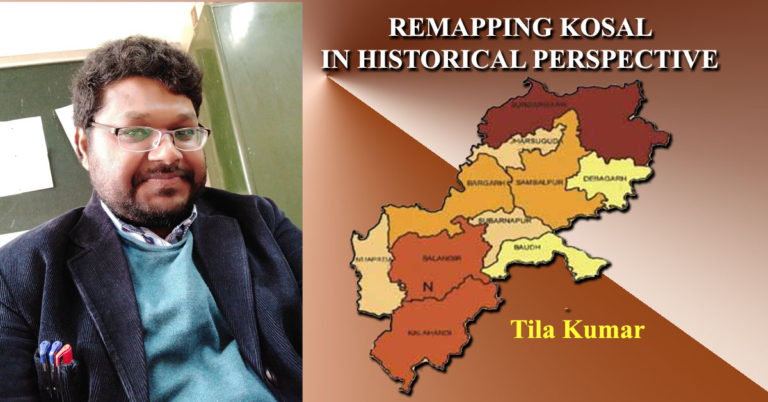
The main objective of the present paper is to situate our area of study in an historical perspective. The Kosal movement which is calling for a separate state of its own is being mobilized by the people located in the western part of Odisha. ‘Western Odisha’, in common parlance, refers to the four undivided districts of Kalahandi, Bolangir, Sambalpur and Sundargarh. Recognizing their common culture and common fate of being poor, backward and underdeveloped, the Government of Orissa constituted a special agency for their “accelerated development and advancement” which is known as ‘Western Odisha Development Council’ (WODC).[1] The main objectives and functions of the Council from its very inception have been to prepare appropriate long term and shot term plans and programmes for the removal of developmental imbalances between different districts within the Council area, keeping in view the overall levels of development of the State.[2] It also suggests long term measures for removal of imbalances as aforesaid and ensures optimal utilization of available resources for removal of such imbalances, keeping in view the potentialities of different districts within the Council area and the ways and means position. Further, it formulates plans and programmes for equitable arrangements in providing adequate facilities for technical, educational and vocational training for the purpose of creating sufficient opportunity for employment in services under the control of the government within the Council area. The four (4) Districts comprising the area of the Council, as a consequence of reorganization of Districts in Orissa in 1993 now consist of Kalahandi, Nuapada, Bolangir, Subarnapur, Sambalpur, Bargarh, Deogarh, Jharsuguda and Sundargarh districts.[3] However, after people from Boudh and Athamallik Sub-Division of Angul District appealed and demanded for their inclusion in the special programme, the jurisdiction of “Western Odisha” has been extended to eleven (11) areas/zones[4].
Nevertheless, the whole of this Western Odisha region is found to subscribe to a common socio-cultural milieu. “Culture” seen as a broad term comprises of tradition, rituals, festivals, language, life-style, food pattern etc. Or more suitably to bring in the classic definition of E. B Tylor, the celebrated cultural anthropologist, “culture… is that complex whole which includes knowledge, beliefs, arts, morals, law, customs, and any other capabilities and habits acquired by a human as a member of society”.[5] It is, therefore, that an understanding and appreciation of the culture of a particular region warrants a proper analysis of its historical geography and the changes that take place across time and over space. Needless to mention here that as regards Odisha or for that matter Western Odisha, we have not come across any detailed study of the ‘culture-complex’[6] i.e., a group of cultural traits all interrelated to each other which constitutes a representative culture of a particular people, community, nation and region, particularly with regard to its historical geography. It is only to some extent that the work of J. K. Sahu[7] signals the way various regions nay kingdoms of Odisha such as Kalinga, Utkala, Odra, Toshala, and South Kosala emerged, flourished and disintegrated at different times due to their specific physical, geographical and cultural features. As he succinctly explains, in the Preface to his book, a study of the geography of a country is essential for a critical evaluation and appreciation of its history. Further, he underlines the importance of ‘Historical Geography’ and suggests that Geography and Chronology are two eyes of all history, whereby we study the history of changing territorial boundaries and administrative divisions on account of frequent political changes.
However, as a researcher or as a concerned individual trying to understand the history of the region or more so the socio-cultural life of people of this region comes across such a situation, which until recently, has been unexplored and unexplained. Although ‘regional histories’ are said to have emerged in the early part of the twentieth century for instance, in Bengal, Maharashtra and Tamil Nadu, as a part of the nationalist response to the process of colonial ‘centralized archivization’ and production and circulation of knowledge, as Sahu points out, and “there has been a shift from regional histories to the histories of the regions…efforts to understand regions on their own terms”[8], we hardly see any significant historical analyses on the western Orissa as a region to refer to and fall back upon. Despite there being volumes of historical writings on Orissan society and culture, what we come across while mapping State Libraries, State Archives or State Museums is nothing but a limited, partial and predominantly coastal Odisha perspective on the same despite the fact that during the creation of the modern state of Orissa province, the nationalist leaders were so enthusiastic about inclusion and merger of the western region of the state for a “United Greater Orissa”.[9] Western Odisha, as a region, has hardly attracted the attention of scholars as an independent object or subject of study and hardly finds any mention while dealing with Orissan history culture, economy, identity or polity.[10] In fact, Fanindam Deo[11] succinctly brings out the problematics of Orissan history in general and history of Kosal region in particular. He points out that: 1) Prior to 1976, historians, writing on the history of Orissa concentrated mainly on the study of administrative and political history. These historians did not pay serious attention to the ‘social history’ of the people. 2) During the last few decades, scholars have produced a number of studies on the socio-cultural history of Orissa[12] . However, except a few, these studies concentrated on coastal Orissa alone, and there is a tendency to generalize the history of Orissa from the perspective of coastal Orissa. 3) That the separate studies on Kosal region were scarce and the material available for elaborate study was scanty. 4) The archaeological remains of the area are still unexplored. 5) Attentions to use oral tradition of pre-literate societies who were predominant in Kosal or Paschim Orissa have not been made seriously.
Such a sorry state of affair, however, needs to be reckoned with the fact that there are only a few historians of Odisha whose contributions in this regard, are noteworthy, such as B. C. Mazumdar,[13] who dealt with all the ancient dynasties of Orissa of which any record exists and has come to the conclusion that “Orissa took its present shape during the rule of the Kosala Guptas who sprang from the family whose rule over Dakshina Kosala came to an end in the latter part of the 9th century AD”[14] R. D. Banerji, whose works in the sphere of epigraphy and numismatics produced some of the most valuable materials for the reconstruction of the history of ancient Orissa/India not only recognized the Kosala and Mahakosala tract of Orissa but also discussed in great details, the Charters, Plates and various archaeological inscriptions of various Kosala Kings such as that of the Somavamsis, (who initially ruled in Western Odisha and due to the expansionist attacks of the Kalachuris from the western side, moved over to the East and by mid-10th century AD, occupied the coastal belt and ruled over a kingdom corresponding to the present day Odisha comprising of the whole of undivided Sambalpur, Bolangir, Balasore, Cuttack and Puri districts and parts of Ganjam, Kalahandi, Mayurbhanj and Midnapore districts),devoting a full chapter-XIV in his magnum opus.[15]Purna Chandra Rath (1909-1952)[16], a crusader and avid historian, archaeologist of the region has not only been instrumental in recording and documenting the chequered moments of the region but he initiated himself to a thorough understanding of the land and the people and delved deep into their heritage and problems. His voluminous works are wide-ranging in nature — beginning with outlining the very geographical boundary of the region to the unique gift presented by the region to Indian culture and civilization. He analyzes the classic kavya of Gangadhar Mishra’s Kosalananda Kavya and presents a graphic description of the region. Offering an analogy of the Patna Empire with that of an elephant having five limbs such as the head, heart, belly, legs and the back, he suggests that “the river Hasti and the side of this river where there is a fort is like the very head of this kingdom, Chandrapur, which has been described as the heart of the kingdom, looks very beautiful adorned with bright chains of gold and gems, the city Sambalpur is the belly of this kingdom, where Samaleswari, the manifestation of the Supreme Spirit, wards away all fears and anxieties and is the granter of boons like ‘Kamadhenu’, then the two fore legs of the kingdom is the city of Sonpur, which fulfills the desires of those who resort to it and is famous for the numerous shrines dedicated to Siva and Parvati and is certainly like another Baranasi, the two hind legs of the Empire are the rivers Byaghri forming the southern border of Kosala and river Haridra to the north of it and finally, Patna is the back of this kingdom and also its capital, which is the strong place of veteran warriors skilled in warfare, adorns all the people of this kingdom and at the time of war, removes the fear of enemies even if they confederate and present formidable array”.[17] As regards the distinctive culture of Kosala, he says that “(T)he mighty flow of Indian culture is fed by countless number of streams and the contribution of Kosala to that mighty stream by no means is mean and negligible”.[18] Beginning with the Cheta dynasty, who ruled the Kosala tract from the time of Mahabharata, Rath illustrates that they had played a very conspicuous part in the cultural evolution of not only Kosala but also of eastern India as a whole. For instance, Ketubhadra, a famous king of this line is said to have sent out colonists to the Indian Archipelago and is mainly said to have been responsible for the spread of Indian culture in these islands. Referring to the ruins of forts, temples, embankments, wells etc., it is suggested that various rules of the region, over the period, evolved and patronized a distinct “Kosala school of architecture”[19] He notes further that from the accounts of Hiuen Tsang, the Chinese pilgrim, it is known that Nagarjuna, the great expounder of Mahayana Buddhism, had made Kosala his field of work.[20] The Tantric religion thus introduced took a new form due to the teachings of this great Master and along with the spread of Mahayana Buddhism, did spread with tremendous rapidity not only throughout India but also in tracts like Tibet and Nepal. And needless to mention how the catholicity for religious views of the region, which is illustrated by the tolerance shown to all religions and especially to followers of ‘Alekh’ or ‘Mahima Dharma’, who are practically atheists.[21]
Another celebrated historian of Odisha N. K. Sahu[22] who is known for having given a new direction to the history of Orissa emphatically asserts that “Our study of the history of Orissa will remain incomplete without a survey of the history of South Kosala as this territory comprised a considerable portion of Western Orissa and as the political movements in one greatly influenced those in other during the period”.[23] While demarcating the territorial boundary, Sahu goes on to say that “(R)oughly speaking, the country of Daksina Kosala consisted of the present Raipur and Bilaspur districts of C.P (read as Central Province) and Sambalpur, Patna and Kalahandi districts of Orissa.”[24] Regarding the origin of South Kosala, he suggests that it may be traced in the Puranic and epic literature. Sahu narrates thus: “According to Puranic accounts Sudyumna, one of the ten sons of Vaivaswata Manu, had three sons named Utkala, Vinitasva and Gaya. When Manu divided his extensive kingdom among his sons, Sudyumna received a portion out of which Utkala got the territory that was named after him, Vinitasva received the region to the west of Utkala, and Gaya got gayapuri with some eastern region. Vinitapura, the celebrated capital of South Kosala, was very likely named after Vinitasva and as such, the western territory received by him was no other than South Kosala”.[25]Sahu discusses in details, various dynasties that ruled over the country of South Kosal in different periods[26] such as the Sarabhapuriyas, the Nalas, the Panduvamsis, the Somavamsis, the Kalachuris and the Gangas but also laments about the striking absence of any reliable evidences which makes us unable to reconstruct the history of South Kosala before the 4th c. A.D, although Gunji rock inscriptions from Barpali near Sakti in Chhattisgarh has supposedly been dated to be of 1st or 2nd c. A. D. Sahu, rather refers to the Allahabad inscription of Samudra Gupta, and suggests that a King named Mahendra was ruling over South Kosala about the middle of the 4th century A.D who recognized the overlordship of the Gupta Emperor during his Deccan campaigns. Further, he ascertains that “South Kosala was probably not annexed to the Gupta Empire, but that it was within the sphere of Gupta influence, which is proved by the use of Gupta coin types.”[27]
In a privately circulated pamphlet called “Whither Kosal?”[28] by an unknown author, which is dated to be written around 1946, one gets to know of a comprehensive history of the region and the distinctiveness of the region or ‘regional particularism’ as has been characterized in the pamphlet, on the basis of language, culture, economic condition and political and administrative organization vis-à-vis rest of the Orissan State. The pamphlet which has clearly set its objectives for its circulation so as to examine the possibilities of reunion of Kosalin the context of constitutional settlement of India and revision of boundaries of different regions of the country, is more concerned with the injustice and cruelty of keeping culturally homogeneous groups and sub-groups divided and the disadvantages of such artificial separation. With a forceful cautionary note, the author suggests that “the formation of new units would have to take account of past tendencies as well as present trends”[29] and that the removal of anomalies would not be an easy task. The pamphlet was mainly aimed at the people of the Sambalpur tract, which according to the author, was the “heart of Kosal”[30]. Needless to mention that the author of the pamphlet had a very clear and definitive idea about the territory of Kosal, its boundaries, its demography and more so its cultural homogeneity. To quote: “DakshinaKosal, better known in ancient, medieval and modern history as Kosal, is the tract of land situated in the upper and central valleys of the Mahanadi and its tributaries the Tel, Jonk, Aung, Iband Brahmanirivers. The area of this tract is over 40,000 square miles and present population of about 5,000,000 people. The States of Bastar, Kalahandi, Patna, Raigarh, Sakti, Sarangarh, Athmallik, Baudh, Bamra, Rairakhol, Sonepur, Bonaiand Gangpur which are over 31,000 square miles having a population of over 3,500,000, at present in the Eastern States Agency,[31] together with Sambalpur including Bora sambar and Khariarand the Khondmals, at present in Orissa, and Phuljhar, Deoriand BindraNawagarh, which are, at present, in the Central Provinces, make up the Kosal country”.[32]
Hermann Kulke, a well-known German historian and Indologist, was one of the founding members of the Orissa Research Project (ORP) of the South Asia Institute (SAI), Heidelberg during 1970-75 and was instrumental in spearheading various studies on Orissan history, culture, religion, identity and polity. As an individual researcher as well as a leader of a collective dedicated to Orissan studies, Kulke has volumes of writings to his credit[33]. However, mention may be made of two other notable works of him – a) his detailed analysis of different structural models of state formation in early medieval and pre-modern India including that of Orissa[34] and b) an edited volume with Georg Berkemer,[35]which are quite useful for our own research and throws some definitive historical light on Kosala/Daksina Kosala, the region of our study. Thus, whereas in the later edited volume, which came out as a result of the second Orissa Research Project (ORP) of Heidelberg on “Various Identities: Socio-Cultural Profiles of Orissa in Historical and Regional Perspectives” (1999-2005) with a major shift from the dominant discourses of coastal Orissa and extending its areas of study to the hinterland and giving a stronger emphasis on peripheral and subaltern folk and tribal people including that of western Orissa, for example, the illustrious contribution of Bhairabi Prasad Sahu on ‘Profiling Daksina Kosala’, and Shishir Kumar Panda’s chapter on ‘KosalanandaKavyamand the Chauhans of Western Orissa.’In the former article, Kulke shows how “Orissa provides an excellent example of a continuous and stepwise territorial integration”[36]. Kulke further suggests that “the basis of principalities and small kingdoms of Orissa of the early centuries were ‘nuclear areas’[37]. Based upon the Allahabad inscriptions of Samudragupta (4th c. A. D)which details numerous small principalities which he had passed through and with the help of indigenous epigraphical sources, Kulke suggests of four nuclear areas on the Orissan coast—three in the valleys and one on the upper plains of the highlands of Orissa. The four nuclear areas on the coast, according to Kulke[38] are: 1) Kalinga, centred in the delta area of the Nagavali and Vamshadhara rivers in the Srikakulam district of northern Andhra Pradesh. Though outside Orissa proper, Kalinga was of great importance for further development of Orissa after it had become the nuclear area of the Eastern Gangas at the end of the 5th c. A.D. Their capital Kalinganagara was situated on the bank of the river with the significant name “bearer of the dynasty” (Vamsha-dhara). 2) Kongoda Mandala, situated on the western coast of the Chilka lake and in the lower valley of the Rishikulya river is identical with present day Ganjam district. It was the homeland of the Sailodbhava dynasty since the late 5th or early 6th c. A.D and was elaborately described by the Chinese pilgrim Hsuan Tsang in the early 7th century. 3) (South) Tosala in the southern Mahanadi delta had been the centre of the Mauryan province of Kalinga with its capital at Tosali (= Dhauli?) near Bhubaneswar and also of Kharavela’s empire with its capital at Kalinganagara- near Bhubaneswar. 4) Uttara (North)Tosala, situated in the northern delta area of the Mahanadi and in the Brahmani delta, is identical with the modern Cuttack and Balasore districts. Its chronological and territorial demarcations against Odra and Utkala which later came to be known in this area are still disputed. After short-lived dynasties in the late 6th and early 7th centuries, the most important dynasty which came up in this region was that of BhaumaKaras since the late 7th century. Like-wise, Kulke[39] demarcates further the three important nuclear areas in the valley including that of Daksina Kosala. According to Kulke, these nuclear areas were: i)Daksina Kosala which comprised in its Orissan part, mainly the fertile plain of the Mahanadi valley the region between the present Hirakud reservoir and Sonpur and included the Tel valley south of Sonpur. Since the early 6th century, parts of Daksina Kosala, together with some of its neighbouring tracts, were ruled in succession by the Sarabhapuriyas, Panduvamsis, and the Somavamsis. The latter became most important for the whole of Orissa when they conquered coastal Orissa. The two other nuclear areas were ii) Khinjali-Mandala lying between Daksina-Kosala and coastal Tosala in the less prosperous Baudh valley region of the Mahanadi, which was ruled by Bhanja dynasty in the 8th and 9th centuries. iii) Kodalaka Mandala in the lower Brahmani valley in the present Dhenkanal district which formed the home of Sulki dynasty during 8th and 9th centuries. Kulke also mentions of several smaller nuclear areas of early principalities, most important among them being Khijjingakottain the present day Mayurbhanj district of northern Orissa whuch had Khiching as its capital, famous for its temples, which was ruled by another Bhanja dynasty since the 8th century and also Keonjhar which was under the control of some other unknown Bhanja kings as early as the 4-6th centuries A.D.
Of contemporary historians, Bhairabi Prasad Sahu is perhaps one among whose works in the context of regional history as well as history of the region under our study is noteworthy.[40] In his attempt to analyze the evolution of ‘Dakshina Kosala’ and its consequent trajectory during the early historical and early medieval times, he examines how the socially unified space came to acquire discernible qualities which more or less defined it as a historico-cultural unit. According to Sahu, “Daksina Kosala is a part of the Central India Intermediate Zone, which separates the northern plains from Peninsular India”.[41]Taking cue from Cunningham, Sahu points out further that “Daksina Kosala broadly comprised the space between Amarkantak in the north to Kanker in the south, and from Wen-Ganga Valley in the west to the middle valley of the Mahanadi (extending up to Sonpur) in the east. It was bounded by Mekala in the north, Vidarbha in the west, Bastar in the south and Kalinga in the south-east. More specifically, the cultural unit is spread over the modern districts of Bilaspur, Raipur, Durg and Raigarh in Chhattisgarh and the undivided districts of Sambalpur, Bolangir and Kalahandi in Orissa”.[42] To begin with, Sahu reiterates, “western Orissa or Chhattisgarh do not constitute a historical region on its own. They are rather the products of administrative decision and represent political units. Taken together, however, they manifest commonly shared traits, derived through a long process of historical evolution, and constitute an ‘organic socio-cultural entity’”.[43] Regarding the earliest reference to the territory as ‘Kosala’, Sahu refers to the Allahabad inscriptions of Samudragupta (335 – 380 c. AD) who was the fourth ruler of the Gupta Empire and the son and successor of Chandragupta- I, wherein it is listed among a dozen Atavikarajyas, which suggests that it was a post-tribal chiefdom or an early state. Even the rock edicts and pillar inscriptions of the third Mauryan King Asoka (304 B.C-232 B.C) mention the Atavipeople to refer to the unconquered forest people of central India. And to add to the list Sahu mentions the Vakataka inscriptions of the 5th c. A.D and theAihle inscription of Pulakesin-II which record successively the conquest of Kosala along with contiguous territories such as Mekala, Kalinga and Andhra. Also reference to the region is mentioned in the travel records of the Chinese pilgrim Hiuen Tsang (602- 664 c. A.D) and the epigraphical records of Panduvamsi King Tivaradeva who is said to be the Lord of the whole of Kosala and in the land-grant charters of the Somavamsis in which the donated area is usually mentioned as a part of some administrative unit in Kosala desa and the reference quite discernible going up to even in a 17thcentury Sanskrit text KosalanandaKavyam. Also, it is brought to our attention the existence of a seal from Malhar, Chhattisgarh, dated to the 2nd c. A.D which bears the legend of GamasaKosaliya, which, according to Sahu, may possibly suggest its post-Mauryan origins.[44]
Moreover, as people from this very region became more and more conscious of their plight, they have started unearthing their own history, culture and identity and putting their head and heart to write more and more about their land and themselves.
An avid historian and archaeologist, Raja Jitamitra Prasad Singh Deo, himself coming from the ancestry of earlier princely rulers of Khariar zamindari under Patna State has extensively worked on the early history of the region[45] and shows vividly through various literary sources and archaeological evidences that this Western Odisha region, in its historical past, formed a significant part of the Kosala/Dakshin(South) Kosala/Maha-Kosala kingdom which also included some parts of the current state of Chhattisgarh where ruled such dynasties as the Sarabhapurias, Panduvamsis, Somavamshis, Kalachuris and Nagavamshis during 6th-12th centuries. Singh Deo, while trying to show how western Odisha nay South Kosala has been depicted in the ancient literature and also in archaeology suggests that“the first sovereign King of the state, situated to the west of Utkala, on the Vindhya precipices, was Vinitasva,[46] which has been deciphered by another historian N. K. Sahu[47], as being Vinitapur, the celebrated capital of South Kosala. Moreover,in one of his earliest works on history of the region Singh Deo[48]explains that “once a mighty King named Kosala ruled over the country around Nagapatan and after him the kingdom came to be known as “Kosala”. After a few generations, the kingdom passed on to Bhanumant, whose daughter Kausalya was married to Dasaratha, King of Ayodhya. As Bhanumant had no male issue, Dasaratha inherited the kingdom of his father-in-law on the latter’s death…Since then Kosala came to be known as Daksina Kosala and Ayodhya as Uttara Kosala”.[49] Thus, Kosala has been an ancient land whose existence from time immemorial is known from ancient Indian epics like Ramayana and various Puranas such as Brahma Purana VII, Matsya Purana XI and Vayu Purana XXCV and Upanishad such as KaushitakiUpanishad[50].
Despite that the precise territorial extent of Kosal is not revealed properly till about 4th century A. D, the political history of the region[51]suggests that it was contiguous to ‘MahaKantara’, which is identified with Bastar-Koraput-Kalahandi tract. It is also supposed to be the ‘Atavi’ or ‘Atavika’, the land of ‘unconquered frontages’ mentioned in the Ashokan inscription of 3rd century B. C. Mishra further notes that although there is no mention of the name of Kosala in the inscriptions of 5th-7th century A.D, when Nalas and Sarabhapurias ruled, Kosala has been clearly referred to in the inscriptions of the Panduvanshis of Sripura in 8th century AD and the Somavanshis during 9th-11th century.[52] One of the earliest available writings on the Western Odisha tract is KosalanandaKavyam[53], which was written during 1663-64 by one Gangadhar Mishra, a court poet in the court of Raja Baliar Singh of the Chouhan dynasty of Sambalpur. It was written on palm leaf in Sanskrit depicting the history of Chouhan rule in Western Odisha or Kosal region such as Patna-Bolangir and Sambalpur tract, beginning with the foundation of the Chouhan dynasty with Ramai Deo (1360–1385), whose branches ruled over major parts of Western Odisha such as Patnagarh, Subarnapur, Khariar and Sambalpur till 1947, when India became a Sovereign Republic and subsequently abolished monarchy. Another historical kavya called Jaya Chandrika[54]was composed in Lariya by Prahallad Dubey, the court poet of Sarangarh, written in the 17th century (between 1781-1792) also narrates the story about the foundation of Chouhan dynasty in the western tract of Odisha and their spread after the death of Prithvi Raj Chauhan.[55] In both of these historical kavyas, it may be appropriately noted, that the geographical, political and socio-historical references have been made interchangeably to the empire of ‘Kosal’ and ‘South Kosal’. And the rest of the history of the region, as it comes out, passed into the oblivion for a long time thereafter.
Moreover, as R. K Sharma, an avid historian of the region, emphatically announced in his key note speech during a national seminar on “History and Culture of South Kosala” organized by the Department of History, Sambalpur University during 3rd and 4th November, 2003, “the broad and variegated canvas of the ancient history of South Kosala is very tempting. The area comprising modern Chhattisgarh and Western Orissa has hoary antiquity…where highly interesting experiments in art and culture have taken place” (2010: xvii). Further, he adds that “during recent past, archaeological excavations were conducted at various sites in Chhattisgarh and Western Orissa. Explorations carried at hundreds of sites in the Mahanadi and its tributaries alongwith rock-paintings have thrown welcome light on the pre- and proto-history of South Kosala.Chance discoveries of inscriptions, coins, seals, sealings and manuscripts have helped in reconstruction of the political and cultural history of the region” (ibid: xvii).
While mapping the historical landmarks, archaeological antiquities and sacred sites in the region, we come across a rich stock of various strands, some even dating back to pre-historic times in traces, ruins and extant in different stages of preservation. Mention may be made of Paleolithic rock art of Gudahandi cave and Neolithic ones of Yogimath and Dumerbahal in Kalahandi and Nuapada districts and Vikramkhol rock paintings in Jharsuguda,[56] no proper study has yet been done to decipher them and they are gradually getting destroyed due to natural calamities as well as man-made disasters. There is a vast corpus of materials including inscriptions on stones and copper plates, coins etc. of different ruling dynasties,[57] and their proper studies may throw new light on the detailed history of the region.
Here, one may also refer to the two monumental volumes on Sculptural Art of Upper Mahanadi Valley (2012) by Sasanka Sekhar Panda, whose contributions to uncover the history and culture of the region is unparalleled. In addition to dozens of articles on the archaeological explorations and excavations in western Orissa and various historic findings on Sakti cult, Bhairava worship, Naga dynasty and rock-cut carvings in western Orissa and temple art of Orissa as a whole,[58] these two volumes numbering more than five hundred pages and with about a thousand of illustrations, bring into limelight more than 50 hitherto unknown temple sites of the period from the 6th c. AD to the 14th c. AD, which added new chapters in the history and culture of the region. These two volumes which are an outcome of the extensive explorations undertaken by Panda during the period 1984 to 2000 throws new dimensions to the art history of the region with its pure and original Kosli architectural designs.
While doing my field work especially in Kansil,[59]Ranipur-Jharial[60], and Kosaleswar temple Baidyanath,[61] what we came across is a serious neglect of various historical heritage of the region such that either the State Archaeological Department is not recognizing their historical value or even if it has taken over them, they are not taking proper preservation and security of these monuments. In fact, there have been appeals by people at large and history lovers in particular, to apprise of the sorry state of affairs in this regard to respectable authorities. And manyvoice in unison that this is nothing but due to ‘step-motherly attitude’[62] on the part of the concerned government authorities, who generally come from coastal Odisha. History of Kosala region is seen to have been wrapped in obscurity. And it is to such a rich cultural past that the proponents of the Kosal Movement, asking for a separate state of their own, are anchoring to and striving to preserve, protect and promote their golden past. It is, rather becoming very obvious to see the people of this region increasingly forging their “nationality” and imagining themselves as a “political community”.[63] As Anderson suggests, “regardless of the actual inequality and exploitation that may prevail in each, the nation is always conceived as a deep, horizontal comradeship” (Ibid.: 7). Further, a nation is thought of being imagined such that even if the members will never know most of their fellow-members, meet them or even hear of them, in the minds of each lives the image of their communion. Or for that matter, a nation exists when a significant number of people in a community consider themselves to form a ‘nation’ or behave as if they have already formed a ‘new nation’. Moreover, reference may be made to some of the earliest engagements on ‘nation’, ‘nationality’ and ‘nationalism’ such as by John Stuart Mill (2010: 3), who suggests that “a portion of mankind may be said to constitute a “nationality” if they are united among themselves by common sympathies which do not exist between them and any others- which make them co-operate with each other more willingly than with other people, desire to be under the same government, and desire that it should be government by themselves or a portion of themselves exclusively.” Likewise, Ernst Renan, whose 1882 lecture on “What is a Nation? has been considered as one of the classic introductions to the contentitious issues of nation and nationality talks about nation as a soul, a spiritual principle and defines nation as “a large-scale solidarity, constituted by the feeling of the sacrifices that one has made in the past and those that one is prepared to make in the future” ((2010: 52). Further, it presupposes a past and summarized in the present by a tangible fact, namely, consent, the clearly expressed desire to continue a common life. And it is, therefore, that Renan goes on explaining how of all cults, that of the ancestors is the most legitimate, for the ancestors have made us what we are. Going a step further, he says that a heroic past, great men and glory is the social capital upon which one bases a “national” idea. To have common glories in the past and to have a common will in the present, to have performed great deeds together and to wish to perform still more are the essential conditions for being a people and a “nation”, and that is what the people of Kosal region have been striving for and hope that it is only a matter of time which will set the motion in all their side.
NOTES AND REFERENCES
[1] See ORISSA ACT – 10 OF 2000 “THE WESTERN ORISSA DEVELOPMENT COUNCIL” ACT, 2000, as notified by the Law Department, Government of Orissa, dated 5th December 2000 having been assented to by the Governor of the state on the 27th November 2000. Also see, “WODC at a Glance” vide http://www.wodcodisha.nic.in/frmglance.aspx.
[2] See “Functions” as enshrined in the Details of Western Odisha Development Council (WODC) for publication under Section – 4 of Right to Information (RTI) Act, 2005, which is available online. Also see, http://www.wodcodisha.nic.in/frmobjective.aspx for comprehensive list of “Objectives” of the Council.
[3] The original 13 districts of Orissa at the time of States reorganization and the merger of the princely states have been reorganized further due to increased developmental work and to make the administrative machinery more effective and also due to persistent demand by the people in three successive phases. The first phase which was implemented with effect from October 1992 on Gandhi Jayanti Day as per the election manifesto of the then ruling Janata Dal which effected Koraput and Ganjam districts. Koraput was divided into four new districts i.e., Koraput, Rayagada, Malkangiri and Nabarangpur while Ganjam was divided into Ganjam and Gajapati districts. The second and third phases of reorganization which became effective from April 1993 and January 1994 respectively, affected eight districts (without any change, till date, in three districts such as Sundargarh, Keonjhar and Mayurbhanj), thus giving birth finally to as many as 30 new districts in Orissa. Kalahandi district was subdivided with Nuapada as a new district, Balangir gave birth to Subarnapur/Sonepur district, Sambalpur was divided further into Sambalpur, Bargarh, Deogarh, and Jharsuguda, Baleshwar was divided into Baleshwar and Bhadrak districts, Cuttack was divided into Cuttack, Jajpur, Kendrapada and Jagatsinghpur, Puri was divided into Puri, Khurda and Nayagarh districts, Dhenkanal gave birth to Dhenkanal and Angul, and Phulbani was divided into Boudh and Kandhamal as new districts. For details, see Sinha, B.N., Geography of Orissa, National Book Trust, New Delhi, third revised edition, 1999: 5-10. Also see Kumar, Hemanshu and Rohini Somanathan, State and District Boundary Changes in India: 1961-2001, Working Paper No. 248, Centre for Development Economics, Delhi School of Economics, November 2015.
[4]Referred official website of Western Odisha Development Council (WODC) http://www.wodcodisha.nic.in/frmglance.aspx and also their Annual Activity Reports of various years such as 2012-13 and 2013-14.
[5] See Tylor, E. B., Primitive Culture, John Murray, London, vol. I, 1871, p. 1.
[6] The concept of the ‘cultural complex’ is grounded in the theory of analytical psychology, which originates with Carl G. Jung’s early work on complex theory, as in The Theory of Psycho-Analysis, 1913/1967. Such an idea emerges as a way of understanding the collective psyche, as it expresses itself in group behaviour and individual psychological experience. Common characteristics of ‘cultural complexes include their unconscious, their resistance to consciousness, their autonomous functioning, their repetitive occurrence in a group ‘s experience from generation to generation, and their tendency to accumulate historical experiences and memory that validate their point of view. For detail elaboration, reference may be made to Singer, Thomas and Samuel Kimbles (eds), The cultural complex: Contemporary Jungian perspectives on Psyche and Society, Brunner-Routledge, London, 2004.
[7] See Sahu, J. K., Historical Geography of Orissa, Decent Books & D. K. Print World Ltd., New Delhi, 1997.
[8] See Sahu, Bhairabi Prasad, The Changing Gaze: Regions and the Constructions of Early India, Oxford University Press, New Delhi, 2013, p. xi.
[9]There is a definitive story about the idea of a ‘United Greater Orissa’. The first spell of consciousness among the Oriya intelligentsia to bring together all the Oriya speaking tract under one platform came against the backdrop of the very infamous famine of 1866-67 called Na’ankaDurbhikhya. Due to the total failure of administration, indifference attitude of British authorities, unwillingness to explore alternative sources of food supply, economic policy of laissez-faire and wrong conclusions regarding the nature of the calamity took away more than a million lives. Nearly one in every three Oriyas died in the famine. Such a man-made disaster, however, awakened the consciousness among the Oriya intelligentsia to talk about the plight of the Oriya people and thus, bring the entire Oriya speaking tract together under one roof. This consequently gave birth to ‘Oriya Nationalism’ and ultimately, a ‘United Province of Orissa’ on 1st April 1936. The second spell of imagining a ‘United Greater Orissa’, however, is said to have come about during the integration of Indian states with the Union of India in the 1950s. Especially in the case of Orissa, there were 26 princely states and the pivotal role played by the then Premier of Orissa, Hare Krushna Mahatab to convince, pursue and finally to merge them despite their resistance and reluctance, into the modern state of Orissa, is what is said to have been the final act of accomplishing a ‘United Greater Orssa’. The process of merger and integration of some of these princely states such as that of Kalahandi, Sambalpur, Patna and Mayurbhanj was never peaceful and smooth but full of protests and resistance. For details, see Chand, Soma, “HarekrushnaMahtab: Creation of Greater Orissa”, in Orissa State Archives, Towards Merger: Integration of the Princely States of Orissa, Orissa State Archives, Bhubaneswar, 1998, ch: 14, pp. 273-283. Also see Barik, Pabitra Mohan, “Role of H. K. Mahatab in the Integration of Princely States”, Orissa Review, Information and Public Relations Department, Government of Orissa, January 2007, pp. 30-32 and Panda, Saroj Kumar, “Merger of Princely States in Orissa”, Orissa Review, Information and Public Relations Department, Government of Orissa, April 2007, pp. 47-50.
[10] While scanning through volumes on history of Orissa, culture of Orissa, Oriya literature, or for that matter, Oriya identity, Oriya Nationalism, Orissan Economy and Polity etc., one is perplexed by an unusually limited and partial perspective centering around the dominant coastal part of Orissa only, without any recognition to any other part(s) of the state. Many volumes and text books on the history of the state, for instance, begins with the Kalinga war (261 BC) as the entry point, whereas the history of western Odisha or the ancient Kosal (South) has been very different from that of Kalinga, Odra or Utkala, which constitutes the coastal part of Odisha and precedes much further and that it is on record by Emperor Asoka himself that although he fought with Odisha and defeated Odisha, during the historic Kalinga war, he could not conquer the Atavika and Mahakantara, the erstwhile names for part of western and Southern Odisha. When it is concerned about the history and development of Odia literature, it begins with Sarala Dasa, a 15th century poet, known for his works on Mahabharata, Vilanka Ramayana and Chandi Purana, who is considered as the originator of Odia literature and discuss various stages of Odia literature in terms of contributions from various writers and poets from coastal Odisha, hardly recognizes any contribution by writers and poets from western part of Odisha. Add to it, whenever there is any discussion on ‘Odia culture’ and ‘Odia identity’ it primarily refers to the discourse revolving around Jagannath cult, which is basically the presiding deity of coastal part of Odisha and Odissi dance, which is said to be essentializing the ‘Odia culture’. Or whenever the idea of ‘modern odisha’ is talked about or written about, it is said to have begun in the aftermath of the ill-fated 1865 famine called Na’ankaDurvikshya irrespective of the fact that archaeological excavations in many historic sites such as Maraguda valley and Asurgarh fort in western Odisha have proven that the civilization in the region was very modern and well-developed in terms of its town planning, irrigation and sewage system and in the spheres of trade and commerce, scientific metallurgy and engineering technologies etc. Not only this, but one of the major grievances people in the western Odisha pointed out is that despite that the region has rich cultural heritage and historic monuments, neither the state government has been sincerely thinking about protection of these monuments nor do they find any mention by the Orissa Tourism Development Corporation (OTDC).
[11]See Deo, Fanindam, “Kosala: The Setting and Historical Experience”, in Udgata, Srinivas et.al (eds), Cultural Legacy of Western Odisha: A Commemorative Volume in Honour of Late P.C Rath (1909-1952), P.C Rath Memorial Trust, Koshal Nagar, Bolangir, 2010, p. 124.
[12] Notable among them, for example, is Eschman, A. et.al (eds) The Cult of Jagannath and Regional Tradition of Orissa, Manohar Publishers and Distributors, Delhi, 1978.
[13] See Mazumdar, B.C., Orissa in the Making: With a Foreword by Sir Edward A. Gait, Lieutenant Governor of Bihar and Orissa,Messrs. U. Ray & Sons’ Press and University of Calcutta, Calcutta, 1925.
[14]Ibid: 10-11.
[15] See Banerji, R. D. (1929), History of Orissa: From the Earliest Times to the British Period, New Age Publications, Chandinichouk, Cuttack, New Print, 2006, ch: XIV titled “The Somavamsi Kings of Kosala”, pp. 182-202.
[16]Purna Chandra Rath was a genius who was born and brought up in a remote area like Balangir-Patna and popularized history and culture of a vast tract of territory known as Dakshina Kosala in ancient past. Many seminal and significant contributions of Rath to the Orissan history in general and history of Kosal region/western Odisha, in particular, are being recognized only very recently. His writings—both published and unpublished—are now being published and popularized by a Memorial Trust in his name, which has been established in Kosal Nagar, Bolangir, since 2009. See Rath, Purna Chandra, Foot Prints of the Forgotten Genius: A Memoir and a Compilation of the Writings of Late Purna Chandra Rath, published by Dr. GopaBandhu Rath, Koshal Nagar, College Chowk, Bolangir, 2008, especially ch: 12: “King of Kosala at the time of Hiuen Tsang’s Visit”, pp. 94-109, ch: 13: “King of Kosala at the time of Hiuen Tsang’s Visit (Summary), pp. 110-111, ch; 19: “The Geography of Patna as found in Kosalananda kavya of Gangadhar Mishra”, pp. 154-173, ch: 26: “A Treatise on Kosala and Tosala”, ch: 32: “Gift of Kosala to Indian Culture”, pp. 326-329, Udgata, Srinivas et.al (eds), Cultural Legacy of Western Odisha: A Commemorative Volume in Honour of Late P.C Rath (1909-1952), P.C Rath Memorial Trust, Koshal Nagar, Bolangir, 2010, Udgata, Srinivas et.al (eds), Glimpses of West Odishan History and Culture: A Commemorative Volume in Honour of Late P.C Rath (1909-1952), P.C Rath Memorial Trust, Koshal Nagar, Bolangir, 2013 and AlibhaPadachinha: Biographical and other Writings of Historian Purna Chandra Rath, published by Gopabandhu Rath, Koshal Nagar, Balangir, 2014.
.
[17] For details, see Rath, Purna Chandra, “The Geography of Patna as found in Kosalananda Kavya of Gangadhar Mishra” in his Footprints of the Forgotten Genius, 2008,op. cit.: 157-159.
[18] See Rath Purna Chandra, “Gift of Kosala to Indian Culture”, in his Footprints of the Forgotten Genius, 2008,op. cit.: 326.
[19] See ibid: 329.
[20]Ibid: 327.
[21] For an elaboration of Mahima Dharma, refer Nepak, Bhagirathi, Bhima Bhoi: The Adivasi Poet Philosopher, Bhagirath Prakashana, Nayapalli, Bhubaneswar, 1997, Nepak, Bhagirathi, “Mahima Dharma, Bhima Bhoi and Biswanath Baba”, Orissa Review, Information and Public Relations Department, Government of Orissa, May 2005: 25-30, Deo, Fanindam, “Socio-Political Change in Nineteenth century Orissa and the Rise of Mahima Dharma”, Studies in Humanities and Social Sciences, Indian Institute of Advanced Study, Shimla, vol. VI, No. 1, Summer 1999: 19-31, Banerjee-Dube, Ishita, “Issues of Faith, Enactment of Contest: The Founding of Mahima Dharma in Nineteenth-Century Orissa” in Kulke, Hermann and B. Schnepel (eds.), Jagannath Revisited, Manohar Publishers and Distributors, Delhi, 2001: 149–177, Eschmann, A., “Mahima Dharma: An Autochthonous Hindu Reform Movement,” in Eschmann A. et. al. (eds). The Cult of Jagannath and the Regional Tradition of Orissa, Manohar Publishers and Distributors, Delhi, 1978: 375– 410.
[22]See Sahu, N.K. (ed). (orig. 1956), A History of Orissa: By W.W Hunter, Andrew Stirling, John Beames and N. K. Sahu, New Age Publications, Chandini Chowk, Cuttack, Reprint 2005 and Sahu, N.K., “A survey of the History of South Kosala”, New Aspects of History of Orissa (NAHO), Sambalpur University, Sambalpur, 1971.
[23] See Sahu, 1956, op. cit.: 394.
[24] Ibid: 394
[25] See Sahu, N.K., “A Survey of the History of South Kosala” in P. K. Nayak (ed). New Aspects of History and Culture of South Kosala, Aryan Books International, NewDelhi, 2010, ch: 1, p. 1.
[26] See Sahu, N. K., “Orissa from the Earliest Times to the Present Day” in N. K Sahu (ed). 1956, op. cit. especially pp. 395-417.
[27] Ibid: 394-395.
[28] This pamphlet is supposedly obtained from Dilip Kumar Padhi, Hotel Sujata, Sambalpur, Odisha, which is now available online with the blog Kosal Discussion and Development Forum (KDDF).
[29] See Whither Kosal?: 3.
[30] Ibid:3
[31] The Eastern States Agency (ESA) was a grouping of princely states in eastern India during the latter years of Britain’s Indian Empire. It was created on 1st April 1933, by the unification of the former Chhattisgarh States Agency and the Orissa States Agency to which the Bengal States Agency was added in 1936. Before the creation of the ESA, 23 native states of the former Orissa Tributary States and Chhota Nagpur States were under the suzerainty of the British provinces of Bihar and Orissa and 16 were under that of the Central Provinces. As a result of the formation of ESA, this Agency dealt with 42 princely states in total from eastern India, located in the present-day states of Chhattisgarh, Jharkhand, Odisha, West Bengal and Tripura. On 1st December 1944, the status of this Agency was raised to that of a First Class Residency under the Resident of Calcutta. These states were grouped into three Political Agencies. The Head Quarters of the Orissa States Agency was at Sambalpur, the Head Quarters of the Chhattisgarh States Agency was at Raipur and the Head Quarters of the Bengal States Agency was at Calcutta. After the withdrawal of the British from India in 1947, the states acceded to the new Union of India. For details, see https://en.wikipedia.org/w/index.php?title=Eastern_States_Agency. Also refer, Devi, Bandita, Some Aspects of British Administration in Orissa (1912-1936), Academic Foundation, Delhi, 1992.
[32] Ibid: 1.
[33] See for examples, The Cult of Jagannath and the Regional Tradition of Orissa (1978), Jagannath Cult and Gajapati Kingship (1979), Kings and Cults – State Formation and Legitimation in India and Southeast Asia (1993), The State in India 1000-1700 (1993), Imaging Odisha in 2 volumes, (2013).
[34]See Kulke, Hermann, “Fragmentation and Segmentation versus Integration? Reflections on the Concepts of Indian Feudalism and the Segmentary State in Indian History”, Studies in History, vol. IV, No. 2, 1982, pp. 237-263.
[35] See Kulke, Hermann and Georg Berkemer (eds), Centres Out There? Facets of Subregional Identities in Orissa, Manohar Publishers and Distributors, New Delhi, 2011.
[36] See Kulke, 1982, op. cit.: 255.
[37] Ibid: 255.
[38] Ibid: 256-257.
[39]Ibid: 257-258.
[40]Reference may be made to his pioneering works such as Sahu, Bhairabi Prasad, “Profiling Daksina Kosala: An Early Historical Subregion”, in Hermann Kulke and Georg Berkemer (eds), Centres Out There? Facets of Subregional Identities in Orissa, Manohar Publishers and Distributors, Delhi, 2011, pp. 39-59, Sahu, Bhairabi Prasad, The Changing Gaze: Regions and the Constructions of Early India, Oxford University Press, New Delhi, 2013, Sahu, Bhairabi Prasad, “The Making of an Early Historical Subregion?” in his The Changing Gaze: Regions and the Constructions of Early India, Oxford University Press, New Delhi, 2013, ch: 4, pp. 80-105 and Sahu, Bhairabi Prasad, “Characterizing Early Medieval Indian Polity: The case of Daksina Kosala and Beyond” in his The Changing Gaze: Regions and the Constructions of Early India, Oxford University Press, New Delhi, 2013, ch: 7, pp. 152- 178.
[41]See Sahu, Bhairabi Prasad, 2013, op. cit.: 81.
[42] Ibid: 81.
[43]Ibid: 80.
[44] Ibid: 82.
[45] Of his notable works, mention may be made of his discoveries and analyses specific to the Kosal region such as “The traditional account of the origin of Daksina Kosala”, Journal of Ancient Indian History, vol. XI, 1979, “Amgura plates of Jayaraja of Sarabhapura: Regnal year 3, Indian Museum Bulletin, vol. XI, No. 1, January 1976, “Archaeological Remains of Sunabeda Plateau, The Orissa Historical Research Journal, vol. XVI, No 4 to vol. XXII, No. 1, “Pre-Historic Cave Paintings of Yogimath Danger, The Orissa Historical Research Journal, vol. XXII, No. 2, “Kosali Style of Temple Architecture”, The Orissa Historical Research Journal, vol. XXIV, XXV and XXVI, “Socio-Culture History of Orissa: A Case Study of Khariar Estate, PunthiPustak, 1986, Cultural Profile of South Kosala, Gyan Publishing House, Delhi, 1987.
[46]See Singh Deo, J.P, Cultural Profile of South Kosala, Gian Publishing House, Delhi, 1987: 61.
[47]Cited in Singh Deo, ibid: 61. Also, refer to Sahu, N. K. “A survey of the History of South Kosala”, New Aspects of History of Orissa (NAHO), Sambalpur University, 1971: 9.
[48]Singh Deo, J. P., “The Traditional Account of the Origin of Dakshina Kosala”, Journal of Ancient Indian History, vol. XI, 1977-1978, edited by Sisir Kumar Mitra, University of Calcutta, 1979.
[49]See Singh Deo, 1987, op. cit.: 61.
[50] Ibid: 89.
[51] See Mishra, DadhiBaman, “Historical Landmarks” in Guru, Giridhari Prasad (ed), West Orissa: Past and Present, Western Odisha Development Council, Bhubaneswar, 2009: 3.
[52] Ibid.: 3.
[53] See Mishra, Brundaban, “The Mirror Reflection of Sambalpur State Through the Courtly Chronicle called KosalanandaKavyam,” The Journal of Orissan History, vol. XXII, 2009, Panda, Shishir Kumar, “KosalanandaKavyam and Making of a Rajput Dynasty: A Study of the Chauhans of Western Orissa” in Kulke, Hermann and Georg Berkemer (eds), Centres Out There? Facets of Subregional Identities in Orissa, Manohar Publishers and Distributors, New Delhi, 2011, pp. 133-148, Chopdar, Debananda, “Sidelights on Kosalananda Kavya”, in Udgata, Srinivas et.al (eds), Cultural Legacy of Western Odisha: A Commemorative Volume in Honour of Late P.C Rath (1909-1952), P.C Rath Memorial Trust, Koshal Nagar, Bolangir, 2010, pp. 150-153, and Deo, Fanindam, “The Historical Background of Kosalanandam”, in Smaranika, 17th Bolangir Lok Utsav, 2016-17, pp. 5-13.
[54]The story narrated in Jaya Chandrika, is, in fact, so central to the foundation of the political history of the region. While it offers us the genealogy of the Chauhan dynasty, which ruled over the tract for a substantial part of its history, more interestingly, it opens up the way the first ruler Ramai Deo was born and brought up in a very turbulent socio-political climate. It brings out the story of a lady of a General in the Court of Prithviraj Chauhan, who after the death of her husband and the King, took asylum in the house of one Chakradhar Panigrahi, who was one of the eight Mallicks who ruled Patnagarh. The lady gave birth to a child Rama Deva and brought up him with care. When he came up age, he killed seven of the Mallicks except Chakradhar Panigrahi and founded Chauhan rule over Patnagarh in 1360 A.D. It is this Rama Deva, who came to be known as Ramai Deo later on. For details, see Mishra, DadhiBaman, “Historical Landmarks”, in Guru, Giridhari Prasad (ed), West Orissa: Past and Present, Western Orissa Development Council, Bhubaneswar, 2009: 5.
[55] Prithvi Raj Chauhan (1166-1192 A.D) was a King from the ChahamanasofShakambhari , colloquially known as the ChauhansofSambhar dynasty, which ruled parts of the present-day Rajasthan and its neighbouring areas between 7th to 12th centuries. Prithvi Raj ruled and controlled much of the present-day Rajasthan, Haryana, and Delhi, and some parts of Madhya Pradesh and Uttar Pradesh. His capital was located at Ajayameru, the present day Ajmer. He is often recognized as a patriotic Hindu warrior, who fought the Muslim invaders including Mohammad Ghor and his defeat in the second battle of Tarain in 1192 is marked as a landmark event with regard to Muslim conquest of India.
[56] See Mishra, DadhiBaman, “Archaeological Heritage of West Orissa”, in Guru, Giridhari Prasad (ed), West Orissa: Past and Present, Western Orissa Development Council, Bhubaneswar, 2009: 26.
[57] Ibid: 27
[58] Reference may be made, for e.g., Panda, Sasanka Sekhar, “Sakti Cult in the Upper Mahanadi Valley”, Orissa Review, September 2004, pp. 61-69, “Bahirava Worship in Upper Mahanadi Valley”, Orissa Review, January, 2004, pp. 37-51, “Nagas in the Sculptural Decorations of Early West Orissan Temples”, Orissa Historical Research Journal, vol. XLVII, No. 1, pp. 16-37, “Rock cut Carvings of the Upper Mahanadi Valley”, Orissa Review, August 2005, pp. 61-67 and “Architectural Explorations and Excavations in Western Orissa”, Orissa Review, December 2005, pp. 71-80.
[59]Kansil is a small village of about 1500 population living in 325 houses (according to 2011 census) in Bangomunda Block of Balangir District. This village has been supposedly once the capital city of Kosal King Kusha named ‘Kushasthali’ or ‘Kushawati’. I came across the name of the village in some vernacular writings and also writings by some noted historians such as Ramachandra Mallick (1867-1936), perhaps the earliest historian of the region with his SankhiptaKoshal-PatanaItihas (1931: 46-48, 62), wherein he emphatically proves that this village along with its neighbouring villages such as Ranipur, Jharial, Bahabal and Balkhamar constituted five units of the ancient KoshalNagar with specialized tasks such as Queen’s Palace, Bathing Ghats, Reserved Force and Storage of wealth and property respectively. Purna Chandra Rath (1909-1952), is another noted historian from the region, who devoted one full chapter on the village called “Kansil’ (2014: 108-111) with details of historical and archaeological sites in and around the village and ascertains without any doubt, how this village, once upon a time, was a well-developed town / nagari, and that the present-day name of the village Kansil is nothing but a corrupted version of the ancient Kosal Nagar or Kushasthali. Dr. Sadananda Agrawal (1952-2017), whose contributions in analyzing, interpreting and popularizing Koshal history is quite noteworthy and especially his KoshalaItihas (2013: 21) establishes with archaeological evidences that the village and the entire region especially the historic Ranipur-Jharial temples represents a very unique architectural style which is possible only in the case of a highly developed kingdom and civilization. Also, while talking to some prominent leaders of the Koshal movement such as Nataraj Mahapatra, Khariar during my field work, I could realize the significance of the village for uncovering the history of the entire Koshal region and therefore, went to the village in March 2017 and saw by myself some ruined structures at several places in and around the village, which are yet to be studied properly. However, while talking to people in the village we saw a common voice by almost all the villagers-old or young, educated or uneducated, men or women—that they are, indeed, so proud of their history as they belong to ‘Kosal Nagar’ or ‘Kausalya Nagar’, once the capital city of Kosala kingdom. They were also very enthusiastic about the prospect of the ‘Koshal Movement’, which they said, will bring back their glorious past. However, they also put forth before me the neglect on the part of the government as regards these historical monuments and requested me if I can do anything in this regard.
[60]Ranipur and Jharial are twin villages under Titilagarh Sub-Division in Balangir District and bear strong traces of their ancient heritage. The archaeological sites in and around these two villages is known as “Soma Tirtha” in various scriptures pertaining to the reign of Somavamsi kings dating back to 8th-9th century. There are more than hundred small, medium and large temple structures in different stages of decay and preservation. The unique Hypethral temple of 64 Yoginis is one of the four remaining such shrines such as Hirapur near Bhubaneswar, Khajuraho and Bhedaghat near Jabalpur. It also shows a confluence of Saivism, Vaisnavism, Buddhism and Tantrism. Although this place has already been taken over by the State Archaeology Department and also has been declared as “Monuments of National Importance”, the state of the affair as regards its protection and preservation is far from satisfactory. There is no security guard as such and as a result, many of the structures from the 64 Yogini shrine are already lost. I could even see by myself, some historical rock structures far from the site, probably being taken by someone gradually. The villagers as well as lovers of history of the region lament that had it been situated in the coastal part of Orissa such as Puri or Bhubaneswar, the situation could have been very different and the place could have been developed properly and not as it is today.
[61] The Kosaleswar temple at Baidyanath is on the bank of river Tel, situated about 15 Kilo Meters to the South-East of Sonpur in Subarnapur District. Historian N. K. Sahu has been of the opinion that the temple was constructed during the reign of Telugu-Chodas in the last part of 11th or 12th century A.D. There is also a reference in one copper plate record that BaidyanathurfKosaleswar was the tutelary deity of the Telugu-Choda ruling family. There are some who on the basis of the architecture, sculptures and especially the specimens of plastic art, date it back to 7th century AD or even earlier. Charles Fabri (1899-1968), the English curator and Buddhist doctor opines that it was originally a Buddhist structure which has been refurnished later on by the Hindus as per their need. Dr. Sadananda Agrawal (1952-2017), a crusader of Koshala history suggests it to be of around 9th century A.D and has also appealed several times to the concerned archaeological Department of the state for its protection and preservation. When I visited the temple in March 2017, I was aghast to see the sorry state of affair of such a historical monument of the region. The main temple was supposedly under repairing and all the statues of varying gods and goddesses were left unattended lying outside the temple in a far corner. While talking to the villagers, came to know that originally, there were three temples in the precincts but today there exist only two temples because one temple, the Mahakaleswara Siva temple, which was there on the bank of the river was taken away by the flood water in 1967, and only a few stones stand there today and the villagers have now got nothing but only a photo image of the temple to show to the world how elegant the Pancharatha spire of such a unique temple existed once upon a time in their village.
[62] Such a phrase or idiom is popularly used throughout India and also outside so as to refer to neglect, disregard or inattention. It also underlines the ill treatment meted out by one’s literal relatives—the step/foster father or mother, who are not real biological parents and are stereotyped of being bad vile father or mother and do not take care of their foster children at par with their own children.
[63] For the discourse on “nation” as an “imagined political community”, see Anderson, Benedict (1983), Imagined Communities: Reflections on the Origin and Spread of Nationalism, Verso, London, revised edition, 2006: 5-7.
(This article by Prof. Tila Kumar, Department of Sociology, Delhi School of Economics, University of Delhi has been published in the International Journal of Research and Analytical Reviews, December 2020, Vol. 7, Issue No. 4, pp. 465-477).