Sunday, April 26, 2026
Home Blog Page 7

Rebuttal to Dr Debiprasanna’s Outburst against Koshali

When I learnt that Odia got classical status, I was glad. Within two weeks of this announcement learnt that Koshali has been recommended by Odisha government to be included in the eigth schedule, I was elated. Koshalis have been asking for their language to be recognised for very practical purposes for a long time. I remember my early childhood days when for umpteenth number of times I had to stand on my stool because I spoke Koshali in my class. Koshali students always were disadvantaged compared to kids from coastal area in both written and verbal expression of school subjects even though their knowledge of matter was not any worse. I know of many of my classmates failing again and again in Odia though their marks in other subjects was okay, and became dropouts.

Non-recognition of Koshali has other important consequences. Interestingly, it has influenced the migratory pattern within Odisha. You will find numerous migrants from coastal Odisha in teaching, clerical and other lower level civil service in all parts of Koshal but you won’t find migration in the same scale from Koshal to coastal Odisha. Kosholis are moving west to Chhattisgagh and Madhya Pradesh.Non-recognition of Koshali has made Koshalis feel alien in their own land. Therefore I am so happy that this major irritant is about to be removed. In my humble opinion,the social impact of recognition of Koshali is far more profound than recognition of Odia as a classical language.

The other benefits will also accrue. Koshali is as rich and sweet as Awadhi, which is the language of Tulsidas Ramayana. Koshal’s poetic genius, such as GangadharMeher and Bhimabhoi have embellished Odia literature over the last century.Now I see the renaissance which has started in enrichment of Koshali literature with little or no government support for the last fifty year or so will get be further encouragement. A new generation of Koshali poets, playwrights, storytellers, film-makers, artists and creative folks are pouring in their creations. It is as if the dammed up creativity has been unleashed. This will lead to de facto recognition of Odisha as a state with two major languages in addition to many smaller tribal languages. One of my students, Dr.AjitMohanty recently wrote that experiments in teaching some tribal kids in their own language have been found very successful in Odisha. This confirms my conviction that mother tongue is the most efficient mode for teaching young kids. Therefore Odisha government must be congratulated for this step which should have been taken long time ago. This is why I was shocked to see the comments of Dr. DebiP Patnaik in The Telegraph, where he says,

“On February 20, I was delighted to learn that the Union Cabinet had given its nod to grant classical tag to Odia.Nine days later I was suffered immense pain when I came to know that our chief minister Naveen Patnaik had written a letter to the Centre for including languages such as Sambalpuri/ Koshali and Ho in the Eighth Schedule of the Indian Constitution.”

Though I have great respect for Dr.Patnaik as one academic to another and for the way he stick- handled the acceptance of Odia as a classical language, I find such outburst as irresponsible, unwise and incendiary. It is reminiscent of “Odiaswatantrabhashanoi” slogan of Kantilal Bhattacharya in 1870 when Odia speakers were trying to proclaim Odia as a separate language in its own right, not an apabhransha of Bengali.I do not understand what makes him so hostile towards Koshalis ? What harm have we caused to him or Odisha ? Why does he want to perpetuate an unvarnished colonial attitude towards Koshal ? What could have been a win win situation, he made it into lose-lose situation because he just ignited the perennial conflict between Koshalis and coastal Odishans. Does he want to recreate a pan-Odia empire (it was called Kalingan empire in his submission for classical status of Odia)from Ganga to Godavari erasing all the cultural and linguistic heritages of all people within his field of dream ?. Really !! Dr.Patnaik has become an nineteenth century pan-Bengalinationalist(such as Dr. Rajendralal Mitra and Kantilal Bhattacharya) this time in Odia garb.

It seems Dr. Patnaik does not like the idea of recognising any language in the eighth schedule,. If so he should take his fight with the central government which has got this frame work, not Odisha government, which is following the guide line in place.

More recently four more languages have been included in the 8th schedule. Ironically, according to one of his recent essays, he was an advisor to the Bodo group whose language was recognised under 8th schedule as to script they should use.For his effort, he got his Padmashree. What is so special about Bodo,Santhali,Maithili andDongri; what they have which Koshali does not ? Why is it alright to enjoy a warm feeling of worth because Odia got classical status and is so painful to bear the thought that Koshali might be included in the eighth schedule? If Dr.Patnaik thinks that by raising objection to Odisha government’s endorsement to Koshali,he can somehow derail the process of inclusion in the 8th schedule, he better think of the consequence. Recently our survey indicates that all leaders irrespective of all political affiliations are completely committed to the cause of Koshali language just asstrongly the general population is. This is not a negotiable subject matter anymore. Any tempering with the process will result in consequences which will have profound effect on the very integrity of the state.

There is genuine fear among the coastal intelligentsia that recognition of Koshali will eventually lead to separation. For fear of separation, coastal intelligentsia objected when, Sambalpur and Berhampur universities were created, when Burla Engineering college was established in Burla and when Regional Engineering college was established in Rourkela. History proves this thesis to be wrong; if anything these attempts softened the demand for separation. Debi Babu’s solution is to strengthen Odia language and that will prevent any sentiment of separation. He has been demanding five hundred crores from the government to create an Odia university, where ALL subjects would be taught in Odia right upto post-graduate level. In addition seven or so other Indian languages would be taught.

If anybody has bothered to look at the condition of state universities in Odisha, he will find that more than half of the academic positions are vacant because state government cannot afford to pay the salary of these profs. Some of the hardest hit are Odia departments because graduates cannot find any employment after graduation. In the mean time state government is announcing creation of more universities and medical colleges. So acceding to Debi Babu’s proposal, which is a colourful dream of a linguist, may end up being very costly without much of tangible benefits! But the idea that language alone will hold a state together is passé. It did not prevent formation of Telengana. It did not prevent formation of Chhattisgarh or Uttarakhand either. If Mayavati will have her way, U.P. would be split into four provinces! What binds the population together are good governance, a sense in the population that that the state government provides equal access to all the resources of the state irrespective of location or cultural/linguistic or religious affiliation, a sense of fair play when it comes dealing with grivances and an ambiance of good relationship between government and governed, among others.

Ever since the inception of the state, intelligentsia and bureaucrats from coastal Odisha have been suppressing the development of Koshal area sometimes bluntly and often surreptitiously with excuses that such development will stimulate separatist feelings. Objections, similar to the one Debi Babu just raised, had been raised, when Sambalpur university was established, when BurlaEngineering college was established in Burla, when Regional Engineering college was established in Rourkela, and when a Diploma course in Koshali was instituted in Sambalpur University.

During the five years or so, Odishans from all quarters of the state campaigned for central educational institutions at the tertiary levels showing that Odisha has been neglected. Central government agreed and tried to correct the situation and granted IIT, NISER, AIIMS, Central Univerity of Law, Post Graduate University of Public Health, EISC medical college and a central University. Not a single one of these institutions were established in Koshal area. Koshal has become the heartland of industrialisation, but there has not been matching growth in human resource development. All these institutions, except the central university went to the sixty mile zone coastal area.

Recently, entire Koshal area agitated in unison to have a branch of High Court so that Koshalis can a little better access to jurisprudence. What seems to be good for the province was actively opposed by the lawyers of High Court in Cuttack, by having a strike !How dare the Koshalis even think that they would have access to legal remedy in a High Court without going through Cuttack, they argued. All such manuevres are perpetrated against Koshalis because apparently if Koshalis become better educated and have easier access to services, they may want a separate state. So I am not surprised by Debi Babu’s outburst against Koshalis. This is one of many indignities we have learnt to endure, but remarks contained in his comments are below the belt, and crosses the line. Such overt attack is not banter due to sibling rivalry but sounds like fratricidal battle cry. Debi Babu wants Koshalis to remain as second class citizen forever. So ever wonder, why Koshalis want a separate state?

Dr Arjun Purohit

(Canada)

What Women Want ?

0

Dr Saheb Sahu

Once in the mythical city of Bagdad, a thief was brought in front of the caliph to be judged. The usual punishment was  to have his hands cut off, but that day the caliph was in a good mood and he offered the bandit a way out. “Tell me what women want and you will be free,” he said. The man thought for a while, and after invoking Allah and His Prophet, he gave the caliph an astute answer. “Oh, sublime caliph, women want to be heard. Ask them what they want and they will tell you.”

 This is what women want: to be educated, to have their own resources, to be safe, to have control over their bodies and lives, and above all, to be treated as equal. (Allende)

I will confine my discussion to women in India.

A – To Be Educated

Though it is sharply increasing, the female literacy rate in India is less than the male literacy rate. Far fewer girls than boys are enrolled in school, and many girls drop out. In urban India, girls are nearly on a par with boys in terms of education. However, in rural India, girls continue to be less educated than boys.

According to National Family Health Survey (NFHS) 2019-21, the average literacy rate in India was 77.7%, 84.7% for male and 70.3% for female. The highest literacy rate was in Kerala. The average was 96.2%, and for male 97.4% and for female 95.2% .In Odisha the average was 77.3%, and for male 84.0% and for female 70.3%.

 According to experts no country has attained developed status without educating most of its population. Quality public education is core strategy in fighting poverty everywhere. Not only education is important in fighting poverty, it is also key to wealth creation. Without creating wealth poverty cannot be eradicated.

 All developmental experts agree that the potential benefits of girls’ education are even greater than that of boys’ education. The benefits of educating girls are many: decrease pregnancy rate, reduction of under- 5 mortality rates, increase productivity and income, gender equality in family decision making and many more. Women who are educated are more likely to work outside the home. Women who have independent income have higher social standing and more likely to run for political office.

B – To Have Resources of Their Own

How does one get resources of one’s own? One gets an education and gets a job or inherits some wealth. If you do not have a decent education, your chance of getting a job in India is very slim. Without an education a woman will be a laborer or domestic servant. In India women have equal rights under law to own property and receive equal share of their inheritance like their brothers, but in practice, it is not happening.

Women constitute almost half of Indian population (48%), but their participation in the work force amounts only to one-fourth of the total working people. The gender pay gap in India is estimated to be around 20 % (2019), e.g. women make 80 cents while make a rupee for similar work.

 Women perform around 10 times more unpaid works (house hold work, caring for children and parents) than men do. Sixty percent of working women in India work in agriculture sectors, where the pay is low. Research suggests that when countries are able to raise the female labor participation rate, this stands to benefit the entire economy.

 Only about four percent CEOs of Indian major companies are women. In Indian Lok Sabha out of 543 members only 78 are women (14%).

C- To Be Safe

 Violence against women has been common in most societies for millennia. It is worse in India. A young woman thinks twice before doing something as routine as walking past a group of men. Safety of women in India is threatened by various acts like- feticide (aborting female fetuses), child marriage, domestic violence, rape, forced prostitution, honor killing, bride burning for dowry, sexual harassment at work place and many more. About third of Indian women have suffered from domestic violence.

 Nearly a decade since the gang rape and murder of a student on a bus in Delhi that shocked the country, state and central spending to combat violence against women is “grossly inadequate”, according to Oxfam India.

 How to solve this unacceptable situation? All the state governments should vigorously enforce the existing laws against all forms of violence against girls and women. Child labor should be completely banned. All girls until the age of 16 should attend schools. Some of the reasons for drooping out of schools are under-age marriage, pregnancy and child labor. Sanitary pads, birth control pills, morning after pills, immunizations,  iron and vitamin tablets should be available to all high-school and college- going  girls at low cost  or be free.

Families, educational institutions, and societies should teach boys and men to respect women. Only strict laws on the books will not solve the problem of women safety in India. Implementation of existing laws in a time bound manner will help. However, unless men change their mindset towards women, laws alone will not solve the problem. Unfortunately politicians are satisfied with passing the laws but are not serious enough to implement them in a timely manner.

D- To Be Treated As Equal

Although the constitution of India grants men and women equal rights, gender disparities remain in all aspects of Indian lives.  While Indian laws on domestic violence, rape, and dowry related killing, and adultery have women’s safety at heart, these unacceptable crimes are still rampant in India.

 Women have equal inheritance rights under the law, but in real practice, they are not inheriting equal shares of their parental properties as their brothers. Less than 25% of women own any agricultural land in their names.

 India is one of the largest and fastest growing economies in the world. Yet, when it comes to gender equality, India ranks poorly on global indicators (UNICEF). Across India gender inequality results in unequal opportunities for girls and women, almost in all spheres of their lives.

 The root cause of gender inequality in Indian society lies in its patriarchy system going back to thousands of years. Patriarchy is defined as a system of social structure and practices, in which men dominate, oppress and exploit women. Exploitation of women is a cultural phenomenon of Indian society. The system of patriarchy finds its validity and sanctions in India’s religious beliefs, whether it is Hindu, Muslim or any other religion.

 For instance, as per Ancient Hindu law giver Manu,” Women are supposed to be in the custody of their fathers when they are children, must be under the custody of their husbands when married and under the custody of their son in old age or as widows.”

 Most girls and women in India do not fully enjoy many of their rights due to deeply entrenched patriarchal views, norms, traditions and social structure.  The patriarchal system is changing but not fast enough. India will not be a developed country unless both girls and boys are equally supported to reach their full potential.

Conclusion

The UN Commission on the Status of Women adopted agreed conclusions on “Women’s full and effective participation and decision-making in public life, as well as the elimination of violence, for achieving gender equality and the empowerment of all women and girls” on 26 March 2021.

Women all over the world want to be educated, have their own resources, to be safe and like to be treated equal to men. Unfortunately, in most countries these aspirations are not being met. India is no exception. According to UNICEF, when it comes to gender equality, India ranks poorly on various indicators. India’s constitution guarantees equal rights to women with men but in real life, every day, in every part of India; women are treated as second class citizens. Things are changing but in a snail pace. The age-old patriarchy system persists. Unless women get an education, are employed in large number outside their homes, have their own money and resources, and get political power, things are not going to change that much. In 2014, 11.42% members of Lok Sabha were women. It increased to 14.36% in 2019. What a slow progress! Unless Indian women are elected to all political offices (from panchayat to parliament) in much larger percentage than at present, things will not change fast.

Sources

1- Isabella Allende. The Soul of A Woman. Ballantine Books: New York, 2020

2-UN Women.org

Culture, Religion and Science: Dr Saheb Sahu

0

Culture

Definition of Culture

Culture is an umbrella term which encompasses the social behavior and norms found in human societies, as well the knowledge, beliefs, arts, laws, customs, capabilities, and habits of the individuals in these groups. Humans acquire culture through learning process of enculturation (the process by which an individual learns the traditional content of a culture and assimilates its practices and values.) and socialization, which is shown by the diversity of culture across societies. These include expressive forms like art, music, dance, ritual, religion, and technologies like tool usage, cooking, shelter, and clothing.

 Most people tend to believe that they are the center of the world, and their culture is the anchor of the human history. Chinese nationalists believe that history really began with the Yellow Emperor and Xia and Shang dynasties, and that whatever Westerners, Muslims, or Indians achieved is but a pale copy of original Chinese ideas and inventions.

 Indian nativists dismiss these Chinese boasts and argued that even airplanes and nuclear bombs were invented by ancient Indian sages. They believe that Maharishi Bhardwaj invented rockets and airplanes, Viswamitra not only invented but also used missiles and Acharya Kanad was the father of atomic theory.

 Many Greeks believe that history began with Homer, Sophocles, and Plato and that all important ideas and inventions were born in Athens, Sparta, Alexandria, or Constantinople.

 Pious Muslims regard all history prior to Prophet Muhammad as largely irrelevant, and they consider all history after the revelation of Quran to revolve around the Muslim umma. The main exceptions are the Turkish, Iranian, and Egyptian nationalists, who argue that even prior to Muhammad their particular nation was the fountainhead of all that was good about humanity.

 Needless to say, the British, French, Germans, Italians, Russians, Japanese, Americans, and countless other groups are similarly convinced that their cultures, their political systems and religious practices were essential to the very laws of physics.

All these claims are false. They combine a wishful ignorance of history with more than a hint of racism. None of the nations or religions of today existed when humans colonized the world, domesticated plants and animals, built the first cities, or invented writing and money. Morality, art, spirituality and creativity are universal human abilities embedded in our DNA. Their beginning (based on our present knowledge) was in Stone Age Africa. It is therefore crass egotism to ascribe to them a more recent place and time, be it China, India, Greece or Arabia in the age of Muhammad. (Harari)

Religion

Definition of Religion

The definition of religion is a controversial and complicated subject in religious studies, with scholars failing to agree on any one definition. Oxford Dictionaries defines religion as the belief in and/or worship of a superhuman controlling power, especially a personal God or gods.

 According to many scholars religion is a modern Western concept. Parallel concepts are not found in many current and past cultures. There is no equivalent term for religion in many languages. An increasing number of scholars have expressed reservation about ever defining the essence of religion. (Wikipedia)

There are over 4,000 religions in the world, but three –quarters of the world’s population practice one of the five major religions: Christianity, Islam, Hinduism, Buddhism and Shinto.

Westerners often use the term “the three great religions”: Christianity (2.3billion adherents), Islam (1.9 billion), and Judaism (15 million). Hinduism, with its 1.2 billion believers, and Buddhism, with its 500 million followers- not to mention the Shinto religion (87 million) and the Sikh (26 million) do not make the cut. Followers of the ‘three great religions” believe that all major religious traditions emerged out of the womb of Judaism, which was the first religion to preach universal ethical rules like the Ten Commandments. But this is a baseless and insolvent idea, which ignores the world’s most important ethical traditions.

 Stone Age hunter-gather tribes had moral codes tens of thousands years before Judaism. When the first European settlers reached Australia in the late eighteenth century, they encountered Aboriginal tribes that had a well-developed ethical worldview despite being totally ignorant of Moses, Jesus, and Muhammad.

 Scientists nowadays point out that morality in fact has deep evolutionary roots. All social mammals, such as wolves, dolphins and monkeys, have ethical codes, adapted by evolution to promote group cooperation. For example, when wolf pups play with one another, they have “fair game” rules. If a pup bites too hard or continues to bite an opponent, the other pup will stop playing with him.  In chimpanzee bands dominant members are expected to respect the property rights of weaker members. If a junior female chimpanzee finds a banana, even the alpha male will usually avoid stealing it for himself.

 The so called biblical prophecies of “Thou shalt not kill” and “Thou shalt not steal” were well known in the legal and ethical codes of Sumerian city-states, pharaonic Egypt and the Babylonian Empire.

 The Bible is far from being the exclusive source of human morality. Confucius, Laozi, Buddha, and Mahavira established universal ethical codes long before Jesus. And at a time when Judaism still mandated the sacrifice of animals, Mahavira and Buddha were already instructing their followers to avoid harming not only all human beings but any living being whatsoever, even including insects. It therefore makes no sense to credit Judaism, Christianity and Islam for creation of human morality.

The Birth of Bigotry

Bigotry is defined as obstinate or intolerant devotion to one’s own opinions and prejudices. Followers of monotheistic religions (Judaism, Christianity and Islam) believe in a single God. The first concept of a single God goes back to Pharaoh Akhenaten of Egypt, around 1350 BCE, long before the God of the Old Testament, Yahweh. Followers of monotheistic religions believe that there are no other Gods except their own, called Yahweh, Jesus or Allah. Polytheists like the Hindus find it perfectly acceptable that different people worship different gods. They rarely if ever fought, persecuted, or killed people just because of their religious beliefs. The big exception was the 1947 partition of India and Pakistan. Monotheists, in contrast, believed that their God was the only god, and that he demanded universal obedience. Consequently, as Christianity and Islam spread around the world, so did the incidence of crusades, jihads, inquisitions, and religious discrimination. Even the Jews, the fellow monotheists were not spared. The Jews have been persecuted by the Christians from the 4th century onward culminating in the death of round 6 million Jews by Nazi Germany during the Holocaust (1941-1945).

By insisting that “there is no god but our God,” monotheistic idea tends to encourage bigotry according to Yuval Harari, lecturer at Hebrew University of Jerusalem. He says, “Do you really think Muslims or Christians or Jews are more ethical than Hindus just because they believe in many gods?”

Science

Science is the pursuit and application of knowledge and understanding of the natural and social world following a systematic methodology based on evidence.

Scientific methodology includes the following:

  • Objective observation: Measurement and data (possibly although not necessarily using mathematics as a tool)
  • Evidence
  • Experiment and/or observation as benchmarks for testing hypotheses
  • Induction: reasoning to establish general rules or conclusions drawn from facts or examples
  • Repetition
  • Critical analysis
  • Verification and testing: critical exposure to scrutiny, peer review and assessment

Modern science is typically divided into three major branches[ that consist of the natural sciences (e.g., biologychemistry, and physics), which study nature in the broadest sense; the social sciences (e.g., economicspsychology, and sociology), which study individuals and societies. Disciplines that use existing scientific knowledge for practical purposes, such as engineering and medicine, are described as applied sciences.

What is the difference between science and religion?

  • Science tends to concern itself with the natural or physical world – that which can be observed and measured. If it cannot be observed or measured empirically, then it is not scientific.
  • Scientific knowledge is gained primarily through the experimental method: a hypothesis is formulated and then experiments designed to test the hypothesis. Experiments use standardized procedures of data collection, so that other scientists can repeat the exact same experiment in the same way and verify the data and test the findings for them.
  • In contrast religion tends to concern itself with the spiritual world, many aspects of which cannot necessarily be observed and measured in a scientific extent. For example, knowledge in many religions comes ultimately from God, and belief in the existence of God cannot be verified empirically. Belief in God is a matter of faith.
  • Any knowledge claims made by religions which are not verifiable by empirical observations cannot be regarded as ‘scientific’.

Conclusion

Culture is much   older than religion and religion is older than science. Humans acquire culture through learning process of enculturation and socialization, which is shown by the diversity of culture across societies. These include art, music, dance, food, shelter and clothing. Each society has its own culture which it has acquired over long time. The idea that Western culture is better than other culture is product of ignorance and racial bias by the Westerners.

 It is certainly true that belief in god was vital to various social orders, and that it sometimes had positive consequences. Indeed, the very same religions that inspire hate and bigotry in some followers inspire love and compassion in others. Yet even though belief in gods can inspire us to act compassionately, religious faith is not necessary condition for moral behavior. Morality of some kind is natural. All social animals from chimpanzees to rats have ethical codes that limit behavior like theft and murder. Among humans, morality is present in all societies, even though not all of them believe in the same god, or in any god. We don’t need to invoke God’s name in order to live a moral life. Secularism can provide us with all the values we need.

What then is the secular idea? The most important secular commitment is to the truth, which is based on observation and evidence rather than on mere faith. Secularists strive not to confuse truth with belief. In addition, secularists do not sanctify any group, person, or book as if it and it alone has sole custody of the truth. This commitment to the truth underlies modern science, which has enabled humankind to crack the atom, track the evolution of life from one cell organism to a highly evolved human being, cured many diseases and sent men to the moon.

I will conclude this essay with a quote from late Stephen Hawking, Professor of Physics and Cosmology at Cambridge University.

“There is a fundamental difference between religion, which is based on authority, and science which is based on observation and reason. Science will win because it works”.

Sources

  1. Yuval Noah Harari, 21 Lessons for the 21st Century. New York: Spiegel& Grau, 2018
  2.  Wikipedia.org, Feb, 15, 22.

CLEAR urges governments to follow policies of mother tongue based education and language equality to make India a powerful knowledge economy

0


Campaign for Language Equality and Rights (CLEAR) greets all citizens of India on this great  International Mother Language Day, celebrated across the world.
On this day, we would like to urgent both the Union and State governments in India to uphold the flags of our mother languages and guarantee the language rights to all of us without any discrimination whatsoever.
In every state in India, in the name of education, the mother language medium education is attacked by market forces and clueless governments. Millions of students, particularly in rural India, won’t be educated in English alone. Though we don’t reduce the importance of English or any other language considered useful, it is very clear that mother tongue-based education is the foundation to set the stage of our children for further learning of any language or subjects. 
Every country that achieved great advancements in becoming a knowledge economy, did so with the help of widespread and modern education to the people in their languages. By making languages as the carriers of knowledge, societies achieve a strong foundation in creating millions of youths as knowledge workers.  Having a few elite schools here and there, forcing English, or renouncing mother tongues won’t help. 
On the Union government level, the discrimination of languages prevail despite the strong protests across India by various language people. For example, every union government program’s name is either in Sanskrit or Hindi. The names aren’t got translated for different states. Many union ministers still send their letters to the non-Hindi states in Hindi alone, despite the protests by the members of parliament and ruling by courts. The official language rules have clearly told us that non-Hindi states to be communicated not in Hindi. 
In every state, the discriminatory language politics of India has played havoc with the lives of the native people.  
This year, in Kerala, the language rights activists fought for proper implementation of Malayalam education in CBSE schools and engineering colleges In West Bengal, language activists went to the court to direct banks to support Bengali in the banks in Bangladesh. In Tamil Nadu, and even ask the state government to protect the world famous Bengali film industry. In Tamil Nadu, the finance minister Mr Palanivel Thiyagarajan asked the banks to implement native language support in all of its public services. In Karnataka, Maharashtra, Punjab, Odisha and many other states, language activists continue to protest for language rights.and mother tongue education.
CLEAR urges both the union and state governments to upload the rights of all languages in India and understand no imperial language policy would help the country to become a knowledge economy. The only route to become a global knowledge powerhouse goes through the mother tongue education and the only way to guarantee the unity and integrity of the great country is through treating all languages equal. 

Thanks and regards

Dr Joga Singh Virk, President
Mr Aazhi Senthilnathan, Federal Secretary

Ten Precepts for Everyday Life

0

 Dr Saheb Sahu

1- The Golden Rule

The Golden Rule is the principle of treating others as one wants to be treated. It is a maxim that is found in most religions and cultures. . It can be considered an ethic of reciprocity in some religions, although different religions treat it differently.

The maxim may appear as a positive or negative injunction governing conduct:

  • Treat others as you would like others to treat you (positive or directive form)
  • Do not treat others in ways that you would not like to be treated (negative or prohibitive form)
  • What you wish upon others, you wish upon yourself (empathetic or responsive form)

The idea dates at least to the early Confucian times (551–479 BCE). The concept appears prominently in Buddhism, Hinduism, Judaism, Christianity and Islam.

2- In-group/Out-group (Us vs them)

An in-group is a group of people who identify with each other based on a variety of factors including gender, race, religion, or geography. Our tendency to distinguish between in-group and out-group members has moral implications.

People may harm those whom they perceive to be in an out-group in ways that they would not harm in-group members. For example, one study showed that when soccer fans viewed fans of their own team being harmed, they felt empathy. But when they viewed fans of a rival team being similarly harmed, they felt pleasure.

Likewise, people tend to make different moral judgments based on in-group and out-group distinctions. When someone in our in-group misbehaves, the natural reaction is often to dismiss the behavior as no big deal. But when someone in our out-group does the same thing, we will tend to judge the behavior much more harshly.

Indeed, when automatic in-group and out-group distinctions replace conscious and thoughtful reflection, we are more likely to harm one another and behave unethically.

3-Cognitive Biases

A cognitive bias is a systematic pattern of deviation from norm or rationality in judgment. A continually evolving list of cognitive biases has been identified over the last six decades of research on human judgment and decision-making in cognitive science, social psychology, and behavioral economics. Daniel Kahneman and Tversky (1996) argue that cognitive biases have efficient practical implications for areas including clinical judgment, entrepreneurship, finance, and management.

Here is a list of commonly debated biases in judgment and decision-making:

  • Selective search for evidence (also known as confirmation bias): People tend to be willing to gather facts that support certain conclusions but disregard other facts that support different conclusions.
  • Cognitive inertia is the unwillingness to change existing thought patterns in the face of new circumstances.
  • Wishful thinking is a tendency to want to see things in a certain – usually positive – light, which can distort perception and thinking.
  • Recency: People tend to place more attention on more recent information and either ignore or forget more distant information.
  • Repetition bias is a willingness to believe what one has been told most often and by the greatest number of different sources.
  • Anchoring and adjustment: Decisions are unduly influenced by initial information that shapes our view of subsequent information.
  • Group think is peer pressure to conform to the opinions held by the group.

People tend to attribute their own success to internal factors, including abilities and talents, but explain their failures in terms of external factors such as bad luck. The reverse bias is shown when people explain others’ success or failure.

And underestimating uncertainty the illusion of control: People tend to underestimate future uncertainty because of a tendency to believe they have more control over events than they really do.

Prospect theory involves the idea that when faced with a decision-making event, an individual is more likely to take on a risk when evaluating potential losses, and are more likely to avoid risks when evaluating potential gains.

Optimism bias is a tendency to overestimate the likelihood of positive events occurring in the future and underestimate the likelihood of negative life events. An optimism bias can alter risk perception and decision-making in many domains, ranging from finance to health.

4-There Aren’t No Such Thing as a Free Lunch (TANSTAAFL)

“There aren’t any such things as a free lunch” (TANSTAAFL), also known as “there is no such thing as a free lunch” (TINSTAAFL), is an expression that describes the cost of decision-making and consumption. The expression conveys the idea that things appearing free always have some cost paid by somebody, or that nothing in life is truly free.

A free lunch refers to a situation where there is no cost incurred by the individual receiving the goods or services being provided, but economists point out that even if something were truly free there is an opportunity cost in what is not taken.

How TANSTAAFL Works

The TANSTAAFL concept is important to consider when making various types of decisions, whether they be financial or lifestyle. The concept can help consumers make wiser decisions by considering all indirect and direct costs and externalities.

 Decision-making requires trade-offs and assumes that there are no real free offerings in society. For example, products and services gifted (free) to individuals are not truly free; a company, government, or individual ultimately pays the cost.

Investors must remain particularly wary of a seemingly free lunch when dealing with investments that promise a stream of fairly high, fixed payments over a period of multiple years with supposedly low risk. Many of these investments remain laden with hidden fees, some of which may not be fully understood by investors. In general, any investment that promises a guaranteed return is not a free lunch because there is some implicit cost somewhere, including the opportunity cost of not investing elsewhere.

5- Pareto Principle or 80-20 Rule

The Pareto principle states that for many outcomes, roughly 80% of consequences come from 20% of causes (the “vital few”). Other names for this principle are the 80/20 rule, the law of the vital few.

Management consultant Joseph M. Juan developed the concept in the context of quality control, and improvement, naming it after Italian economist Vilfredo Pareto, who noted the 80/20 connection in 1896. In his first work, Cours d’économie politique, Pareto showed that approximately 80% of the land in Italy was owned by 20% of the population.

So Why Is This Useful?

The Pareto Principle is not a mathematical formula but it helps you realize that the majority of results come from a minority of inputs. Knowing this, if…

.20% of workers contribute 80% of results: Focus on rewarding these employees.

.20% of customers contribute 80% of revenue: Focus on satisfying these customers.

The examples go on. Prioritize your daily activities. Try to finish the 20 percent of the important tasks of the day.

6- Good Judgment vs Bad Judgment

Good judgement comes from experience. Experience often comes from bad judgement. – Mulla Nasrudin

To succeed in life you need many qualities, but underlying them all is good judgment. Those with ambition but no judgment run out of money. Those with passion but no judgment hurl themselves down the wrong paths. Those with drive but no judgment get up very early to do the wrong things. Sheer luck and factors beyond your control may determine your eventual success, but good judgment will stack the cards in your favor.

 Some elements to arrive at good judgments are:

  • Learning: Listen Attentively, Read Critically
  • Seek diversity of opinion and not validation
  • Detachment: Identify, and then challenge various biases
  • Options: Question the set of solutions offered,
  • Factor in the feasibility of execution
  • .Success is Not a Reliable Proxy for Judgment

7- Black Swan theory

Black swans are native to Australia and European did not see a black swan until the 17th century and believed that they do not exist.

The black swan theory or theory of black swan events is a metaphor that describes an event that comes as a surprise, has a major effect, and is often inappropriately rationalized after the fact with the benefit of hindsight… The term was popularized by Nassim Nicholas Taleb, a finance professor, writer and former Wall Street trader,  

In his 2001 Book Fooled by Randomness, this concerned financial events. His 2007 book The Black Swan extended the metaphor to events outside of financial markets.Taleb regards almost all major scientific discoveries, historical events, and artistic accomplishments as “black swans”—undirected and unpredicted. He gives the rise of the Internet, the personal computerWorld War I, the dissolution of the Soviet Union, and the September 11, 2001 attacks as examples of black swan events.

Taleb states that a black swan event depends on the observer. For example, what may be a black swan surprise for a turkey is not a black swan surprise to its butcher; hence the objective should be to “avoid being the turkey” by identifying areas of vulnerability in order to “turn the Black Swans white”.

8. Saving and Investing

The way to financial stability is simple. Live within your means by reducing your expenses well below your income. Maximize your employer’s retirement benefits. Save at least 10 percent of your income every month by auto deduction so that you don’t see the money.

The power of compounding

For example-if someone who starts investing $5,000 per year at age 25 winds up with $1.3 million by age 65, while someone who waits until age 35 to start investing $5,000 per year(until the age of 65),winds up with just $566,000 at age 65(assuming annual rate of return of 8%).

The Rule of 72

To use the rule is to divide any percentage return into 72 to find how long it takes to double your money. Example: At 8 percent return, how long does it take to double your money? Easy: nine years (72 divided by 8=9). If the return is 3 percent, it will take 24 years (72 divided by 3=24).

Invest in Index Funds

What is an index fund and how does it work?

An “index fund” is a type of mutual fund or exchange-traded fund that seeks to track the returns of a market index like Nifty Fifty Index. Index funds are very low cost and eliminate the anxiety and expense of trying to predict which individual stocks, bonds, or mutual funds will beat the market.

For Indian context you can invest in Nifty fifty Index funds or similar index funds traded in Mumbai stock exchange.  The annual return for Nifty fifty index funds in India has been between 17- 18 percent over the last five years.

ETF- You may also want to consider exchange –traded index funds or ETFS. These are index funds that trade on the major stock exchanges and can be bought and sold like stocks.

9- “Health Is Wealth”

“Health is Wealth” is a very old proverb.  It puts health before wealth. A healthy person can earn wealth anytime.  There can be no wealth without health.

Achieving and maintaining health is an ongoing process. It takes works to stay healthy.

Diet

A healthy eating plan: Emphasizes vegetables, fruits, whole grains, and fat-free or low-fat dairy products .It includes lean meats, poultry, fish, beans, eggs, and nuts and limitssaturated and Trans fats (processed foods), sodium, and added sugars.

Exercise

Physical exercise enhances or maintains physical fitness and overall health and wellness. It strengthens one’s bones and muscles and improves the cardiovascular and brain health. There are four types of exercise: endurancestrengthflexibility, and balance. The CDC states that physical exercise can reduce the risks of obesity, heart disease, some cancers, type 2 diabetes, high blood pressure, stroke, dementia, depression, and anxiety.  Participating in any exercise, whether it is housework, yardwork, walking or standing up when talking on the phone, is often thought to be better than none when it comes to health.Exercising in nature is even better.

Sleep

Sleep is an essential component to maintaining health. In children, sleep is also vital for growth and development. Ongoing sleep deprivation has been linked to an increased risk for some chronic health problems like-memory issue, mood changes, weakened immunity, weight gain, high blood pressure and stroke.

10- Tzedakah (Righteousness)

You give a poor man a fish and you feed him for a day. You teach him to fish; you feed him for a life time.”

      – Lao Tzu, Chinese Philosopher (6th century BCE)

Tzedakah or Ṣedaqah is a Hebrew word meaning “righteousness”, but commonly used to signify charity. This concept of “charity” differs from the modern Western understanding of “charity.”  Unlike voluntary giving, tzedakah is seen as a religious obligation that must be performed regardless of one’s financial standing, and so is mandatory even for those of limited financial means. 

In the middle Ages, Maimonides conceived of an eight-level hierarchy of tzedakah, where the highest form is to give a gift, loan, or partnership that will result in the recipient becoming self-sufficient instead of living upon others. In his view, the second highest form of tzedakah is to give donations anonymously to unknown recipients.

The Torah (The first five books of Hebrew Bible) requires that 10 percent of a Jew’s income be allotted to righteous deeds or causes, regardless if the receiving party is rich or poor.

In Christian theology, charity (Latin: caritas) is considered one of the seven virtues and is understood by Thomas Aquinas as “the friendship of man for God”, which “unites us to God”. He holds it as “the most excellent of the virtues”.

Dāna in Indian religions

The practice of charity is called Dana or Daana in Hinduism, Buddhism and Jainism. It is the virtue of generosity or giving .The earliest known discussion of charity as a virtuous practice, isin the Rigveda (2nd millennium BCE). According to other ancient texts of Hinduism, Dana can take the form of feeding or giving to an individual in distress or need. It can also take the form of philanthropic public projects that empower and help many.

Zakat and Sadaqah in Islam]

In Islam, there are two methods of charity. One called Zakat, the called Sadaqah.

Zakat is one of the five pillars upon which the Muslim religion is based. It is compulsory for a Muslim to give 2.5% of one’s saving as Zakat, per Islamic calendar year. Sadaqah is voluntary charity or contribution. Sadaqah can be given using money, personal items, time or other resources. There is no minimum or maximum requirement for Sadaqah. Even smiling to other people is considered a Sadaqah.

Conclusion

To lead a reasonably good life, treat others as you like to be treated. It is a commandment advocated by all the major religions. Beware of “Us vs them” ideology. It is the main cause of conflicts and prejudices in all societies. We have all kinds of cognitive biases which lead to bad judgments. Always remember that, there is no such thing as a “free lunch”. Somebody is paying for it. If someone makes you an offer that is “too good to be true”, most likely it is a scam. Don’t fall for it. Know the 80-20 rule and concentrate your efforts on the top 20% of the things you have to do in life. Know that black swan effect like 2000 market crash, 9/11, 100 -year flood, can happen. They have happened before and will happen again. Be prepared, for unexpected events like major accident or even death. Buy appropriate insurance. Failure is not always a bad thing. Just learn from it and move on. The road to financial security is not easy, but can be done: live within your means, start saving early at least 10 percent of your paycheck, maximize your employer’s retirement plan and invest it in an Index fund. The most important of all, take care of your health: maintain an ideal body weight, eat a healthydiet (more towards vegetarian), stay active and get a good night sleep. If possible take a walk in nature.  Remember the meaning of the Hebrew word “Tzedakah”. It is more than charity. Help somebody to stand on his/her feet.

I will conclude this essay with a poem by the American poet Emily Dickinson.

“If I can stop one heart from breaking”

If I can stop one heart from breaking,
I shall not live in vain;
If I can ease one life the aching,
Or cool one pain,
Or help one fainting robin
Unto his nest again,
I shall not live in vain.

By: Emily Dickinson

(Source- Wikipedia.org )

The End

The Best Ways to Lose Weight and Keeping it Off

0

Dr Saheb Sahu, FAAP, MPH.

I want to weigh less, not through diet and exercise, but acquiring a faulty scale. Jarod Kintz

Definitions of Terms

Body Mass Index (BMI) is used by doctors to define, normal, overweight and obesity. A BMI below 18.5 is considered underweight, 18.5-24.9 is normal weight, 25.-29.9 is overweightand 30 or higher is obese.For Asians ,newer studies show that normal BMI is 18.5-23, instead of up to 24.9 (bmisite.net).

 A calorie is the measurement of a unit of energy. I gram of carbohydrate and protein have 4 Calories each and I gram of fat has 9 Calories.

“There is not a doubt that obesity increases risk for a wide range of chronic diseases” says David Ludwig, professor of nutrition at Harvard T.H. Chan School of Public Health. It has been proven beyond reasonable doubts that obesity increases the risks for high blood pressure, heart disease, stroke, type-2 diabetes, certain cancers, memory failure and arthritis.

A recent review of 121 trials of various diets found that participants’ weight and blood pressure measures generally improved after six months on the diet. But after a year, most people regained the weight and any cardiovascular (heart and vessels) improvements mostly disappeared.

If you want to lose weight, as many people do, calories and exercise remain the two crucial levers.  To lose weight,  you have to eat fewer calories and use more calories than you take in. This can be challenging for most people to do for an extended period of time. “Reducing daily calories intake is the most important factor for weight loss” says Ju .Young Kim, of the Journal of Obesity and Metabolic Syndrome. The key issue is finding a sustainable way to eat healthy, in terms of both quality and quantity. Very few New Year’s resolution diets are sustainable. They can even be counterproductive, by leaving people with impression that progress is possible. Any diet plan to lose weight is unpleasant and short-lived. Will power usually does not work. Simple rules are better.

Added sugar and sweeteners in many of our processed food products is a big problem. They trick our body into wanting even more food. They are the driving force behind the global diabetes and obesity epidemics, which in turn cause many chronic health problems. Beverages are one of the biggest sources of added sugar in our diets. A single 16 –ounce can of Coke has 52 grams of sugar. That is more added sugar than most adults should consume in an entire day. All sweet foods have some kind of sugar- grain sugar, brown sugar, honey, maple syrup or artificial sweetener. Some experts now believe that artificial sweeteners lead to “weight gain and metabolic abnormalities”.

Follow a Healthy Eating Plan

A heathy eating plan includes:

  • Controlling the portion size (most important),
  • A variety of vegetables, fruits and whole grains such as brown rice, whole wheat and oats,
  • Fat-free or low fat dairy products such as milk, yogurt and cheese,
  • A variety of protein foods including legumes (beans and peas), soy products, nuts, seeds, eggs, fish and sea foods, poultry and limited lean meat,
  • Oils such as canola oil, oliveoil and those found in nuts, olives and avocados,
  • Consuming fewer foods and drinks that have refined carbohydrates, added sugars and salt,
  • Limiting foods with saturated fats and trans fats, like those found in desserts and fried foods.

 To learn more about a healthy eating plan visit ChooseMyPlate.gov

Physical Activity for Healthy Weight

Regular physical activity is important for good health. It is especially important to lose weight or to maintain a healthy weight.

When losing weight, more physical activity increases the number of calories your body uses for energy or “burn off”. The burning off calories through physical activity, combining with reducing the number of calories you eat, creates a“caloric deficit” that results in weight loss.

Most importantly, physical activity reduces the risk of high blood pressure, heart attack, stroke, type-2 diabetes, several forms of cancer, arthritis; reduce risk of bone thinning (osteoporosis) and falls.

The benefits of exercise are quite clear on the Brian: Improve memory, increase the capacity to learn (especially children), improve mood and lower anxiety, and to slow aging. Exercise in nature is even more beneficial.

How Much Physical Activity?

 To maintain your weight: Work your way up to 150 minutes of moderate- intensity aerobic activity or 75 minutes of vigorous intensity aerobic activity each week. Moderate intensity activities include- walking, yard work, playing with children or biking at causal pace. Vigorous activities (your heart rate increases substantially) include: Running, swimming laps, jumping ropes and competitive sports.

Conclusion

There is no mystery about how to eat better. You do not have to worry about the fine points of the latest scientific research. The overall picture has been remarkably quite consistent for years. A healthy diet revolves around mostly unprocessed foods, like vegetables, fruits, nuts, beans, whole grain, fish and some meat. The famous food writer Michel Pollan’s seven word manifesto still holds: “Eat Food. Not too much.  Mostly plants”.

 To lose weight and to maintain it, you must also exercise. You have to burn more calories than you take. Be safe- start slowly and talk to your doctor if you have health problem or an injury. Choose activity you enjoy and try new ones, but keep moving. Being more active will help you manage your weight besides all the other benefits mentioned earlier.

Bottom line- if you are not losing at least one kilogram or more (2-3 pounds) a month, than you are still eating too much!

Sources

1-CDC.gov/healthy weight. 2-Dietaryguidelines.gov. 3- MyPlate.gov.

4- David Leonhardt. The Morning: A food audit. The New York Times, January7, 2022

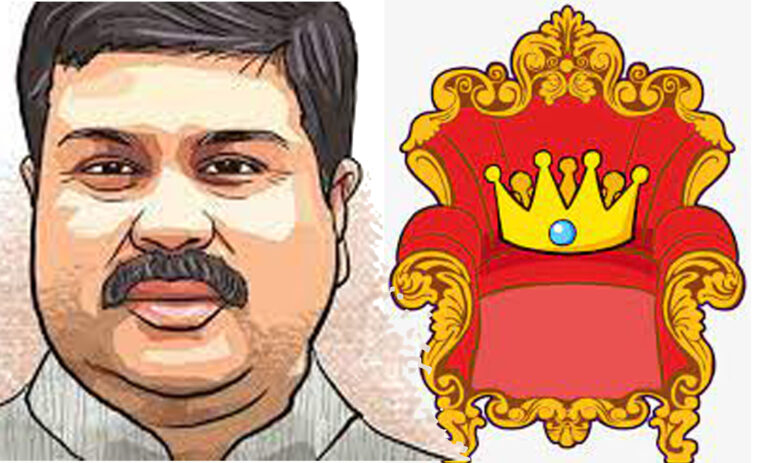
How Dharmendra Can Become CM?

0

Dharmendra Pradhan the BJP’s CM face for Odisha trying hard to install BJP in Odisha since 2016.  He makes the necessary changes in the organisational set up and made Basanta Panda the President of BJP Odisha in 2016.  He used all his forces to downsize his competitor in the party like Jual Oram and KV Singhdeo etc. BJP send many Union ministers many a time including their master election strategist Amit Shah. BJP’s slogan to dislodge BJD was “19 years of incapable and incompetent Naveen Sarkar”. But BJP got only 23 MLAs in 2019 election.

Within the end of one month of the election BJD voted BJP Rajy Sabha MP Ashwin Vaishnaw from Odisha. It was a clear compromise between both the parties that BJP will not harsh BJD with CBI, ED etc and BJD will support them in Rajy Sabha as well as in Lok Sabha. Now with this compromising political scenario no doubt both parties can get temporary benefits but BJP and Dharmendra cannot succeed to the throne.

BJP sources says that BJD will be weaker after Naveen Patnaik and party may collapse but I think they have little idea that his nephew Arun Patnaik will succeed him and at that time the political scenario will be very different from now. At that time Naveen babu will be an even larger poster figure than his father Biju babu. And there will be difficulties for BJP to capture Bhubneswar.

But BJP have few options. They may keep continue their aggressive campaigning like before the election time detaching all political tie up from BJD or either bifurcating the state into Utkal & Kosal region.

BJP need to understand that Odisha is not a cow belt. Ideas like Baba, Gomata, Ganga Mata etc will not work here. Odisha is affluent with adivasis with two major cultural regions; Utkal & Kosal. If Kosal is bifurcated out of Odisha then Kosal part will be leaderless for BJD. Definitely Naveen babu’s charisma will limited to Utkal region. And BJP may continue the power for a longer time in Kosal without any political thereat.

Saket Sreebhushan Sahu       

Guide to Your Baby’s First Year

0

Dr Saheb Sahu, FAAP, MPH.

I am a pediatrician. I just read a book by Alice Callahan, PHD, titled “The Science of Mom, A Research-Based Guide to Your Baby’s First Year (2021). Callahan does the work of sorting through the science of baby’s first year, so you don’t have to. Here are the some of the main points of the book.

1- Vaccinations

Give the baby all the vaccinations recommended by American Academy of Pediatrics, or Center of Disease Control (CDC) or WHO (World Health Organization). Vaccinations which are given during the first year are: Hepatitis B, Rotavirus (to prevent diarrhea), DTP (Diphtheria, Tetanus and Pertussis), Hemophilus influenza type b (Hib), Pneumococcal conjugate (Pcv-13), Inactivated polio and Influenza. Most of these vaccines are given at 2, 4, and 6 months of age and the booster dose at 9-15 months. (Source-Immunization page, Cdc.gov/vaccine).

2- Sleeping

SIDS- Sudden Infant Death Syndrome occurs in babies less than 12 months of age, but most death happen between 2 and 4 months, and 90 percent occur before 6 months of age.

 Safe sleep recommendations:

  •  Always put your baby down for sleep on his/her back and on a firm and flat mattress.
  • The safest place for your baby to sleep is in a crib or bassinet in your room.
  • Avoid sleeping with your baby in a couch or chair.
  • Don’t over bundle the baby; dress her just enough to stay warm.

3- Breast Feeding

Breast feeding is good for babies and mothers and science backs substantial benefits. Unfortunately, just about 44 percent of infants worldwide are exclusively breast fed until 5 months (UNICEF-2019). Most health organizations now recommend exclusive breastfeeding for first six months of a baby’s life.

 Breast milk is packed with hormones, growth factors, and stem cells, as well as immunoglobulins to ward off pathogens. Breastfed babies have lower incidence of gastrointestinal, respiratory, and ear infections. A 2015 meta-analysis of 17 studies found that breastfeeding was associated with an increase in 3.4 IQ points.

Breast milk contains very little Vitamin D. Exclusively breastfed infants should receive a daily dose of 400 international units of supplemental vitamin D, which is important for bone growth. Iron supplements is also recommended for exclusively breastfed babies around 4 months and continue until they start eating iron –rich solid foods.

 Studies consistently find that breastfeeding, especially for longer durations, is associated with a reduced risk of breast and ovarian cancer for the mother, as well as lower risk of high blood pressure (11% lower) and type-2 diabetes (30 % lower) later in life.

4- Starting Solid Foods

WHO recommends that all babies be exclusively breastfed—meaning no formula or solid food—for the first 6 months of life. Many other health organizations, recommend starting solid between 4 and 6 months of age.

 Choking on solid foods can be a life threatening problem. Take the following steps to prevent choking and be sure you’re prepared to respond:

  • Your baby should be sitting upright and always supervised during feeding. Test foods before they are offered to ensure they are soft.
  • Avoid foods with choking hazards: nuts and seeds, hot dogs, chunk of meat or cheese, whole grapes, hard candy or gum, popcorn, globs of peanut butter, and other round firm foods (raw fruits and vegetables).
  • Know the Heimlich maneuver and CPR (cardio pulmonary resuscitation) for babies, children and adults. (www.heart.org, American Heart Association online course).

 One of the goals of complimentary feeding is to introduce your baby to a variety of foods from all food groups. Benefits of dietary diversity in infancy include balanced nutritional intake and reduce risk of developing food allergy.

 There is little difference in the nutritional profile of organic and conventional milk and meat and both are safe for the baby. Make your own baby foods. Baby foods marketed by big companies often have added sugar, salt and filler ingredients. These meals are expensive and nutrient-poor and they don’t help your baby learn to eat real food. Check labels carefully.

Offer nutrient dense foods to meet nutrient needs like meat, fish, eggs, dairy products, vegetables and fruits. Introduce a variety of food. Let your baby explore many tastes and textures.

 Source

Alice Callahan, PHD. The Science of Mom, A Research-Based Guide to Your Baby’s First Year. 2nd Ed. John Hopkins University Press, Baltimore,2021

Assisted dying: A final Choice

0

Dr Saheb Sahu, MD, MPH

Assisted Dying

Assisted dying, also known as physician- assisted suicide or medical aid in dying, is suicide undertaken with the aid of another person. The term usually refers to physician-assisted suicide, which is suicide that is assisted by a physician or other healthcare provider.

Euthanasia

The word euthanasia comes from Greek euthanatos, (eu-easy, thanatos-death) which means easy death or good death. It is the intentional ending of life of a person suffering from an incurable or painful disease at his or her request.

The evolution of assisted dying

Many people object to assist dying on religious grounds: some faiths (Judaism, Christianity and Islam) deem suicide a sin. Others worry that safeguards will prove insufficient, or legalization is a slippery slope. Critics have long predicted that families exhausted by the demands of caring for the sick, elderly relatives will place undue pressure on them to end their lives.

 Yet such horrors do not seem to have come to pass. In much of the West public opinion has long favored assisted dying. In 2019, 71% of Spaniards (a deeply Catholic country) supported voluntary euthanasia. Change has been rapid. Assisted dying is now legal or decriminalized in at least a dozen of countries. But it is still rare.Most cases are cancer related, and the number of death is tiny. But they are nonetheless changing how people think about dying. In some countries assisted dying has been extended to those with mental disorders and dementia, even to old people who feel tired of life. A clandestine network of interested people who share methods to kill themselves has sprung up on the internet.

 Thirty years ago assisted dying was illegal everywhere except Switzerland. But in 1997 the American state of Oregon approved the Death with Dignity Act, initiating a spate of liberalization. In Oregon two doctors must agree that a patient is of sound mind and has less than six months to live before he or she can receive the lethal drugs. These drugs must be administered by the patients themselves (a physician prescribes it). Since 1997, around 2,000 people have taken advantage of the law in the state of Oregon (250 in 2020), with no wrongful deaths reported. Versions of the law are now on the books of ten American States and the District of Columbia.

 Oregon’s laws are being copied internationally, with some modifications. New Zealand’s Oregon-stylelaw came into effect on Nov, 2021. In Australia, the state of Victoria passed similar laws in 2017. Worldwide, euthanasia is legal in Belgium, Luxemburg, Canada, New Zealand, Spain, the Netherlands and Colombia and ten states in United States. In Britain similar laws passed the House of Commons and waiting to be passed in the House of Lords. Three quarters of Britons support a right to die.

 Canada offers a better model, because it provides more lee-way for individuals to make their own choices. Anyone whose suffering is unbearable can choose an assisted death. They do not have to be terminally ill. What constitutes “unbearable” suffering is for the patients themselves to decide, so long as they are of sound mind. There is a cooling-off period of ten days, in case they have second thoughts. In many cases, simply having the option of an assisted death gives people a sense of comfort and control. In Oregon a third of those people who receive the prescribed lethal drugs ultimately choose not to take it.

Assisted Suicide Methods

In general, once the requesting patient meets the criteria of the state law, a willing physician prescribes the lethal dose of the appropriate drug to assist in dying. The patient buys the drugs.An oral dose of antiemetic drug (to prevent from vomiting) is taken first,followed approximately half an hour later by a lethal doseof the sedative drug dissolved in a glass of water. The overdose of the drug depresses the central nervous system, causing the patient to become drowsy and fall asleep within 3-5 minutes of drinking it. From drowsiness the patient progresses to coma, followed by respiratory arrest and death which occurs within 30-40 minutes of ingesting the drug. The process is painless.

The Indian Context

Prayopavesa (Sanskrit: प्रायोपवेशनम्, IAST prāyopaveśanam, literally resolving to die through fasting) is a practice in Hinduism that denotes the suicide by fasting of a person who has no desire or ambition left, and no responsibilities remaining in life.Sallekhana also known as samadhi-marana or sanysana-marana is a supplementary vow in the ethical code of conduct of Jainism. It is the religious practice of voluntarily fasting to death by gradually reducing the intake of food and liquids. However, British legal codes had made all forms of suicide illegal in India including the horrible practice of sati.

Since March 2018, passive euthanasia (intentionally letting apatient die by withholding artificial life support such as a respirator or feeding tube) has been legal in India under strict guidelines. Patient must consent through a living will (a legal document expressing the wishes), must be terminally ill or in a vegetative state. The same judgement-law also asked for the scrapping of 309, the code which penalizes those who survive suicide –attempts.

Conclusion

No rules in this area of assisted dying are perfect. All should be subject to revision in the light of new evidence about how they work in practice, or take account medical advances. But the overall principle – that individuals are entitled to choose how they end their lives- is a sound one.  According to the Economist magazine (Nov, 2021), “The evidence from countries that allow assisted dying is real and substantial. It relieves suffering, restores a measure of dignity to people at the end of their lives”.

Longevity depends on our genes and our lifestyle. We have no control over what good or bad genes we inherit but we have some control over how we live our lives. Scientific studies are quite conclusive that age-related morbidity can be postponed and longevity can be increased if we live a healthier life style. According to National Institute of Aging, USA-“Finding a “fountain of youth” is a captivating story. The truth is that, to date, no ant-aging remedy has been found.” Hence, do what have been proven to work; do not smoke or drink, be physically active, eat a healthy diet (whole grains, lots of fruits and vegetables, fish and lean meat, low fat dairy products and few eggs a week) and maintain a normal body weight and have some friends.

Death is an event we cannot avoid. Why don’t we die the way we say we want to die? Advances in medicine have eased the line between saving a life and prolonging a dying. Dying is painful, messy, expensive and imperfect. Physician-assisted dying is not an option available to most people. We have no control over when we will die. However, we have some control over where and how we will die. To achieve the twin goals, it will take some advance planning on our parts. When we are old or suffering from a terminal illness, we should discuss with our loved ones about where we want to die, at home or in a hospital. Do we want unnecessary and costly treatments just to live few more months? The decision is ours. But we must let our family members and doctors know our wishes. Putting it in writing in a living will (also known as advance healthcare directive) is even better. As many wise people have said before: “There is no need to rage against the dying of the light. The only way to have a good death is to lead a good life”. Lead a life full of curiosity, compassion, and generosity.

But if you want to have some control over how and where you will die, Prayopavesa or Sallekhana, (a Jain vow) the practice of voluntarily fasting to death by gradually reducing the intake of food and liquidsare not bad options. The most frequently reported symptoms in the early days include thirst or dry mouth and occasional hunger. Wiping the mouth with a wet cloth or glycerin swab on regular basis can help ease symptoms of dry mouth. A person can live quite few days without eating depending on his /her nutritional status. But he /she does not drink any liquid, he or /she will die much sooner from dehydration as it happens in severe diarrhea like-cholera. Most peopleslip into come in 2 to 4 days (depending upon their prior nutritional status) and die in 10-14 days. The process is shorter ifthey do not drink any liquid. But the death is peaceful and painless.

 Source

 The Economist. Nov, 13-20, 2021

Wikipedia .org

The Doubters of God (gods) and Religion

0

Dr Saheb Sahu

Who knows whence this creation had its origin?

He, whether He fashioned it or whether He did not,

He, who surveys it all from the highest heaven,

He knows – or maybe even He does not know.

  • Rig Veda, X.129 C1500BCE?

“The only thing I know is that I know nothing”.

  • Socrates

What is Doubt?

Doubt is rather complex and multifaceted phenomenon. Both superficial and profound doubt exists. According to the cynics, everything and everybody must be constantly subjected to doubt, since nothing can be held to be true and trustworthy. I like the above quotation from the Rig-Veda- “Who knows- or may be even He does not know.” Rene Descartes said- “Everything ought to be subjected to doubt”.

One can doubt about big and important or small or unimportant thing. One can harbor doubts about one-self, or the world at large, or God or the universe. Doubt is particularly important in science. Without doubt science cannot progress. Doubt is particularly opposed to hasty judgment, prejudgment, and prejudice. Doubt and uncertainty pave the way to knowledge and truth.

What is God?

According to Mortimer J. Adler, ex- chairman of the Board of Editors of Encyclopedia Britannica-“Almost everyone uses the word God, but almost nobody can say what they mean by the word, especially if they are persons without religious beliefs. We have no experience of God, as we do have of cats or dogs. It is a theoretical construct”.

The word god refers to a “supreme being or deity”. The word god comes from the Proto-Germanic word Gaut. The Sanskrit word is “Deva”, the Greek word is “dios” (divine) and the Latin word is “deus”.  The original word “gaut” was of neutral gender. Later on, Christians made it a masculine gender.

 Some of the names for God had (has) been Adonai (Lord, Master), Yahweh (Lord, Jehovah), Elohim (God), Allah (God of Islam), Amon (Egyptian creator God), Anu (Mesopotamian God), Izanagi (creator God in Japan), Itzamna (Mayan creator God) Adroa (creator God of some parts of Africa), Vishnu, Brahma, and Shiva (India).

What is Religion?

Religion is a social-cultural system of designated behaviors and practices, morals, beliefs, worldviews, texts, sanctified places, prophecies, ethics, or organizations that relates humanity to supernatural, transcendental, and spiritual element; however, there is no scholarly consensus over what precisely constitute a religion. (Wikipedia)

Theist is a person who believes in the existence of a God or gods, specially a creator who intervenes in the universe. An atheist is a person who does not belief in the existence of a God or gods. An agnostic is a person who believes that nothing can be known of the existence or nature of God. A hereticis a person who does not believe in the orthodox doctrines of a religion.

 According to a 2021 survey, 90% of Chinese, 73% Swedish, 40% of British, 39% of American and 5 % Indian population consider themselves to be non-believers or atheists.

Doubters in History

India – 600 BCE-1C.E.

The Carvaka

The extraordinary materialist doctrine came into bloom in India in the seventh century BCE. It was called Lokayata and its adherents were the Carvaka. Their central text Brihaspati Sutra dates back to 600BCE, but no copy has survived. It seems it has been systematically destroyed by the Brahmin class, in defending their own dogma.

 The Carvaka believed that there is no afterlife whatsoever. They believed that our bodies think and feel, wear out and die. There can be nothing to live on after death. The whole universe was constructed of earth, water, fire and air. There was no spirit or life force. This, after all, is the only life we have, so we ought to enjoy it as much as possible. They proclaimed that there were no gods and there was no heaven or hell. They debunked Hinduism by arguing against the idea of gods, karma, and rebirth. They believed that the rituals of the Brahmins were useless, and the Vedas were untruth and full of self-contradictions.

“There is no heaven, no final liberation, nor any soul in another world

Nor do the actions of the four castes, orders, etc., produce any real effect

…While life remains let a man live happily, let him feed on ghee even though he runs in debt;

When once the body becomes ashes, how can it ever return again?

If he who departs from the body goes to another world,

How is that he comes not back again, restless for the love of his kindred?

Hence it is only as a means of livelihood that Brahmins have established

here all the ceremonies for the dead – there is no other fruit anywhere.

-The Sarva-Darsana-samgraha

Jainism and Buddhism

The great leaders of Jainism and Buddhism both lived in the sixth century BCE. Both of them rejected much of the Vedas. Both of them were influenced by the Carvakas.

 Mahavira, the 24th Tirthankara of Jainism, taught that the gods and goddesses, sacrifices and rituals of Hinduism were irrelevant. The Hindu gods were rejected and were not replaced by any supernatural force. Jainism is generally understood as an atheist religion.

 The Buddha denied a central Hindu notion, that of atman. The Buddha said: you are never going to find your atman. Why? Because there is no atman. Buddha doubted that starvation helped people to reach enlightenment although it was a technique common among Hindu ascetics. Instead, he proposed a middle ground between gluttony and starvation. He preached a doctrine devoid of rituals, traditions and speculations. For the attainment of enlightenment (Nirvana) Buddha pointed to the Four Noble Truths and the Eightfold Paths. One of Buddha’s most famous preaching to his disciples was:

“Do not believe in anything simply because you have heard it. Do not believe in anything simply because it is spoken and rumored by many. Do not believe in anything simply because it is found written in your religious books. Do not believe in anything merely on the authority of your teachers and elders. Do not believe in traditions because they have been handed down for many generations. But after observation and analysis, when you find that anything agrees with reason and is conducive to the good and benefit of one and all, then accept it and live up to it.”

 Buddha would have been a great scientist!

Greek Doubters (600BCE-1CE)

The Epicureans

The Greek philosopher Epicurus (341-271BCE) was a fascinating character in history of doubt. He answered fear of gods by simply insisting that gods do exist sort of, but that they are totally unconcerned with human affairs. He wanted to free humanity from idiosyncratic gods. The world was not made by the gods and it was not made for us. We may enjoy it in peace. His theories of astronomy denied the movement of stars had anything to do with gods. For Epicurus, living prudently was road to happiness. Accept the bad things in the knowledge that they are not really bad, get over the idea that the gods are watching you, and be happy.

The Skeptics

Skepticism began with Pyrrho of Elis, who lived from 365 BCE to about 275 BCE. Pyrrho believed that nothing can be known, because opposite of every statement could be asserted with plausibility. Since we know nothing for certain, we should attempt to have no opinion. We thus stand aloof from life and thereby attain peace of mind. In 334 BCE, Pyrrho travelled with Alexander to India, where he studied with the philosophers and ascetics of the Indus Valley.

 Skepticism became more important in the second century BCE when the philosopher Arcesilaus brought it into the Platonic Academy. Thus, many of the Greek philosophers put the gods or God into doubt.

Doubt and the Ancient Jews (600BCE-1CE)

Book of Job and Ecclesiastes (both of the Old Testament) are both rather antireligious and antidogmatic. We need a little background. Very early on their history, the Hebrews (Jews) had some extremely good fortune on the field of war and attributed that fortune to their powerful warrior God. Once they started losing wars, however, they built a theology that they had failed God and he was punishing them.

In 586 BCE Jerusalem was captured by the Babylonians and torched. Thousands of elites, professionals, and skilled workers were exiled to enrich the cities of Babylon. The Book of Job seems to have been written in this period, between 600BCE and 400 BCE. The biblical Job is a story faith, revolt, and doubt.

Ecclesiastes is a beautiful book of the Old Testament. The book was written in the third century BCE (250-225BCE). The author of the book Koheleth doubted every aspect of religion, from the very idea of righteousness, to the traditional idea of divine justice. One of the greatest doubting lines ever written was this:  “Under the sun, the race is not to the swift, nor the battle to the strong, nor bread to the neither wise, nor riches to the learned, nor favor to the skillful: but time and chance happens to them all.”

 Koheleth turns directly to the brute facts of death. He does not believe in after life.

“All go to one place; all are of the dust, and all return to dust again”.

 There was some relationship between Greek society and the rise of Jewish doubt. Historians differ whether Koheleth (author of Ecclesiastes) knew Epicurus, but all agree that their doctrines bear a family resemblance worth pondering.

Doubters in Rome, 50 BCE – 200CE

Lucretius (c99-55BCE) was a contemporary of Cicero and the great poet of Epicureanism. His famous poetry book On the Nature of Things, is a heroic poetry of doubt and disbelief. It celebrates Epicurus as then great champion of rational thought and as the conqueror of religion. Lucretius believed that soul dies with the body. He wrote:

“Death, then, is nothing to us, no concern,

Once we grant that the soul will also die.”

Marcus Aurelius

 The Roman emperor Marcus Aurelius (121-180CE) is often described as a philosophical agnostic and a practical atheist. In his famous book Meditation, Aurelius mentions that perhaps the universe has God, and meaning, and perhaps it does not.

Sextus Empiricus

Sextus Empiricus is the best exemplar of the skeptics of the Roman times. He lived from the mid second century through about the first quarter of the third. There are three serving works by Sextus, each in several volumes. They are all classic works of doubt- doubt of everything. He argued that it is impossible to prove the existence of something (god) that does not make itself apparent. He picks up Epicurus’s idea that a powerful god who knows all does not make sense in a world so full of evil as our own. He wrote:

“If [God] has the power of thought for all things, but not the will, he will be considered malicious. And if he has neither the will nor the power, he is both malicious and weak. But to say this about God is impiety. Therefore God has no forethought for the things in the world.

 But if he takes no thought for anything, and no work or product of his exists, a person will not be able to say where we get the idea that God exists, seeing that he neither appears of himself nor is apprehended by means of any of his products. For these reasons, then, it cannot be apprehended whether God exists”.

Christian Doubters 1-800CE

Doubt was an accepted aspect of Greek, Roman and Jewish life but not the center of it. With Christianity managing one’s doubt and faith, became the central drama.

 Jesus is a difficult historical figure. We have no indication that he wrote anything. The first three Gospels (Mathew, Mark and Luke) which are about his life and work were written about half a century after his death. Jesus, who would come to be understood as one with God of this new religion (Christianity) had a moment of doubt of his God. On the cross, suffering, after he has been there for many hours, he called out, “My God, my God, why have you forsaken me?”

 Apostle Thomas refused to believe that the resurrected Jesus had appeared to the other disciples, until he could see and feel the wounds received by Jesus on the cross. A doubting Thomas is a skeptic who refuses to believe without direct personal experience- a reference to Apostle Thomas. (John: 20).

 Christianity was a mix of the Greek culture and the Jewish tradition. Built right into the very nature of Christianity, then, were the doubts of both of these traditions.

Augustine (354-430CE)

Augustine is considered one of the greatest of the Latin Church fathers. He is famous for his two books: Confession (400CE) and The City of God (412-27). In Confession he spent five chapters of the book wrestling with his personal doubt and temptation. Speaking directly to God, Augustine asks God: “How did you make heaven and earth, and what machine did you use for so vast an operation?” Cicero had also asked God, the same question. In an odd twist, Augustine praised doubt as the road to knowledge.

Muslim Doubters

Ibn al- Rawandi

We do not know much about Ibn al- Rawandi. Some scholars’ think he died about 860 CE and others that he lived until 912 or so. He wrote many mainstream scholarly works and amazing amount of heretical works. In bold agreement with Aristotle, he supported the eternity of the world, though it meant that God did not create it. He also took such position as: “against the idea that God is wise”, “against the Koran”, “against Muhammad”, and “against all prophets”. His most important book was Kitab alZumurrand or The Book of the Emerald.  The book criticizes prayer, concern for ritual purity, and all the ceremonies of the hajj. Among his other books, Ibn al- Rawandi wrote Against the Koran and a little treatise called The Futility of Divine wisdom. He mocks the philosopher’s idea of God as “universal force” that does not know how to add two and four to get six.

 Even though al-Rawandi was radical in his doubt, he was tolerated by the establishment.

Abu Bakr al Razi (854-925CE)

Abu Bakr al Razi has been called “the greatest nonconformist in the whole history of Islam”. He was a doctor and has been called the most creative genius of medieval medicine. His three famous books are: The Prophet’s Fraudulent Tricks, The Stratagems of Those Who Claim to be Prophets, and On the Reformation of Revealed Religions.In them al- Razi asked ground breaking questions about prophets: “On what ground do you deem necessary that God should single out certain individuals by giving them prophecy that he should set them up above other people, that he should appoint them to be people’s guide, and make people dependent upon them?”

 Al –Razi thought the variety of religions was a good proof that none of them had it right. He was able to get away with this ruthless religious critique because he did so much more.

Abdullah al-Maarri (973-1057CE)

Abdullah al Maarri was born in Syria, contracted smallpox as a child, and eventually went blind from it. He was a fabulous character in the history of doubt. He specifically lauded doubt in God and other spirits. He believed people believe what they are brought to believe.

“Our young man grows up in the belief to which his father has accustomed him.

It is not Reason that makes him religious, but he is taught religion by his next of kin.”

“They recite their sacred books, although the fact informs me that there is a fiction from first to last.

O reason, though (alone) speaks the truth. Then perish the fools who forged the religious traditions or interpreted them.”

The other famous Muslim doubters were Avicenna (980-1037) and Al –Ghazzali (1058-111).

Doubters (1400-1600)

Renaissance and Reformation

Desiderius Erasmus (c1466-1536) was a Dutch humanist and scholar and one of the most influential Renaissance figures. In his book Praise of Folly he made fun of the scholars of the Church who praised the glory of the God. He asked: “Could God have taken on the form of a woman, a devil, a donkey, or a Flintstone?” He wrote that humans are too complex and obscure that nothing can be known for certain.

Giordano Bruno (1548-1600) the Italian philosopher and scientist, championed the Copernicus’s theory of earth rotating around the Sun (heliocentric). The theory was against the teachings of the Catholic Church. Bruno disagreed with the Church on countless points. The one that was most shocking was his complete conviction that the universe was infinite and filled with many other suns like ours. Bruno believed that Jesus Christ was not God but merely an unusually skillful magician. He also rejected Jesus’s virgin birth and resurrection (rising from his grave).

 Because Bruno’s views were against the teachings of the Church, he was sentenced to death by fire. He was invited to repent but he would not. In 1592, he was burned at the stake in Rome.

 Another great doubter was Lucilio Vanini (1585-1619). He was well educated by the Jesuits and earned a doctorate from Padua university. From the start he casts doubt on every aspect of Christianity. He insisted that there were no ghosts or spirits and independent human soul do not exist. He wrote that all religions, including Christianity, are human inventions, fictions cooked up by kings and clergy for the sake of power. He believed that allmiracles associated with prayer are just coincidences or have natural explanations. He was burnt to death by the order of the Christian Church, at the age of thirty-four in1619. The charge was blasphemy and atheism.

Doubters (1600-1800)

Baruch Spinoza (1632-77) was born in Amsterdam in 1632. His family had been Jewish. He was an admirer of Bruno and Descartes. He told people that the Torah (Jewish Holy Book) was not literally the word of God, that Jews were not God’s chosen people, and there is no immortal human soul. He was asked to recant but he would not back down and was excommunicated (kicked out of religion) from Judaism in 1656. Although Spinoza never said he was an atheist, he was known as one in his own country, and ever afterward. He was convinced that the Bible had multiple authors and he rejected divine authorship altogether.

Thomas Hobbs (1588-1679) was an English political philosopher. Hobbes is best known today for the political science of his master work, Leviathan. He wrote that without authoritarian government people’s lives would be “solitary, poor, nasty, brutish, and short”. Hobbes said that we do not know anything about God other than he exists. Like Spinoza, he believed that the Bible had multiple authors and not words of God. He believed that religion is there for people in power to control their subjects. In 1666, a bill against atheism was introduced in British House of Common that mentioned Leviathan by name. When a great wave of plague hit England, cry went out to burn Hobbes.

John Locke (1632-1704) studied at Oxford, where he became friends with Newton and Boyle. He went to France, where he met bright new minds of French philosophy and science. Then he went to Holland, where he wrote his Essay Concerning Human Understanding in1690.

 Locke had digested the doubt of the ancient philosophers (there were no anthropomorphic gods) and ancient skeptics (nothing could be known at all). By 1725, J.E.Reimann’s Universal History of Atheism included as atheists: Thomas Hobbes, John Tolland, Count Charles Blount, and Anthony Collins.

Enlightenment

Denis Diderot (1713-1784) and his friend the mathematician Jean d’Alembort (1717-1783) created the Enlightenment’s most famous project the Encyclopedia, a compendium of knowledge and know-how,the latest technology, and most scandalous new ideas. It was considered extremely antireligious. Diderot is often written as an atheist and a world-class doubter. Voltaire and Diderot were the most innovative philosophers of doubt in France.

American Founding Fathers

American Founding Fathers:  Benjamin Franklin, Thomas Paine, Thomas Jefferson were deists. Deists believe in the existence of a superior being, specifically of a creator who does not intervene in the universe.

Thomas Paine (1737-1809) was involved in American Independence as well as in French Revolution. While in France he wrote his major treatise on religion, The Age of Reason (1794). Paine was bold: “Every national Church or religion has established itself by pretending some special mission from God… Each of these Churches accuses the other of unbelief; and for my part, I disbelieve them all”.  He wrote: “I do not believe in the creed professed by any church. My mind is my own church… All preachers are pious frauds, always have been”.

 The Age of Reason wrecked his reputation in America. He was branded as an atheist and free –thinker and was ostracized by his friends.

Thomas Jefferson (1735-1826), the third president of the United Sates was a deist and a mellow doubter. In private letter to a friend, Jefferson wrote; “As you say of yourself, I too am an Epicurean. I consider the genuine doctrines of Epicurus as containing everything rational in moral philosophy which Greece and Rome have left us”. It was Jefferson who put together the bill for establishing religious freedom in the United Sates. This was his great contribution and he fought for it his whole life.

Age of Science and Reform: 1800-1900

The nineteenth century was easily the best documented moment of wide spread doubt in human history. The big new element was the reformists. They begin the century demanding an end to religious persecution. Many of the famous calls for reform-for an end to slavery, for women’s rights, for free speech-were made by doubters.  Doubters thus established the term of democracy. Quitea few of these reformist doubters were female.

 In this century, doubters of all stripes, from Elizabeth Cady Stanton (women’s voting right), to John Keats, to Karl Marx, were committed to their doubts. In an 1844 paper (on philosopher Hegel) Marx wrote: “Religion is the sigh of the oppressed creature, the heart of the heartless world, just as it is the spirit of a spiritless situation. It is the opium of the people”.

 Of all the great doubters among American reforming women, the greatest were Elizabeth Cady Stanton and her comrade in arms, Susan B. Anthony. Both were vocal doubters. Stanton spoke out on myriad of church-and-state issues and initiated feminist biblical criticism. As she proclaimed in 1882: “According to Church teaching, woman was an afterthought in the creation, the author of sin, being at once in collision with Satan. Her sex was made a crime, marriage a condition of slavery, owing obedience, maternity a curse, and the true position of all womankind one of inferiority and subjection to all men; and the same ideas are echoed in our pulpits today”.

Arthur Schopenhauer (1788-1860) was a German philosopher and avowed atheist. As he saw it, there is no God, nothing made the world, we are accidental animals, and our way of knowing creates the world as we know it. In 1813, Schopenhauer discovered Buddhism and Hinduism. He pointed out the similarities between his philosophy and the atheist religions of India.

 Another famous German philosopher and scholar, Friedrich Nietzsche (1844-1900) said: “God Is dead”.

Principles of Uncertainty, 1900

 The twentieth century began with a great variety of doubters: women’s rights and birth control activists, Russian communists, German materialists and many more.  In a 1909 speech Lenin said, “Marxism is materialism and as such relentlessly opposed to religion”. All the communists in the world followed his lead. Mao Zedong followed Marx and Lenin. Mao believed that religion drained resources from the state and deceived people. During the Cultural Revolution many monasteries and churches were destroyed in China.

 When the Ottoman Empire fell in 1923, Turkey was proclaimed a republic. Kemal Ataturk its first president said of religion, “I have no religion, and at times I wish all religions at the bottom of the sea”. In 1923 he abolished religious orders and made Turkey a secular country, a first among the Muslim countries.

In India, Gandhi was a believer but its first Prime Minister Nehru was an atheist. In 1950, India became a secular country.

 For doubters, the rise of Darwinism (the theory of evolution of species by natural selection advanced by Charles Darwin) was a triumph. Something similar happened in physics. Quantum mechanics holds that it is impossible to measure the position of a particular particle, at a particular moment. That is doubt. Albert Einstein said: “The word God is for me nothing more than the expression and product of human weaknesses, the Bible a collection of honorable, but still primitive, legends which are nevertheless pretty childish”.

Philosophers of Science

Twentieth-century philosopher and mathematician Bertrand Russell (1872-1970) was an outspoken and engaged doubter. In his essay “Why I Am Not a Christian” (a 1927 lecture), Russell revived an old approach: he enumerated the proofs of god and why they no longer held. He added a new voice of contented doubt. He said, “I believe that when I die I shall not, and nothing of ego will survive”.  Russell believed that doubt was nice and science was route to truth.

 Russell’s wife, Dora Black Russell (1894-1986), had becomea freethinker at a young age and joined local Heretic’s Society while still in high school. Her first book, Hypatia(1925), was about women’s reproductive and sexual freedom and a critique of Christianity.

The teachings of Vedas, Confucianism and Buddhism came to the west in later part of the nineteenth century. The Theosophical Society in New York was founded in 1875. By the 1960s meditation was growing in popularity, as were courses in Zen Buddhism. The famous Zen maxim, “Great doubt: great awakening. Little doubt: little awakening. No doubt: no awakening”.

 Some of the other famous doubters of twentieth century were A.J Ayer (British philosopher), Albert Camus (French philosopher and author), Simone de Beauvoir (French writer and feminist), George Santayana (philosopher, he called himself a Catholic atheist) and John Rawls (American political philosopher).

India

 Among the prominent Indian doubters of God and Religion were Debi Chattopadhyay (1918-1993) Marxist philosopher, Periyar E.V.Ramasamy (1879-1973), philosopher, social activist and founder of Dravidian movement, and Jawaharlal Nehru(1889-1964) the first Prime Minister of India.Nehru described himself as Hindu Agnostic. He thought that religious taboos were preventing India from going forward and adapting modern conditions: “No country or people who are slaves to dogma and dogmatic mentality can progress”. He also wrote: “The spectacle of what is called religion, or at any rate organized religion, in India and elsewhere has filled me with horror and I have frequently condemned it and wished to make a clean sweep of it. Almost always it seemed to stand for blind belief and reaction, dogma and bigotry, superstition, exploitation and the preservation of the vested interests”. During his entire long career as the Prime Minister of India, Nehru remained a secular leader.

Doubters of Late Twentieth and Early Twenty First Century

 Some of the well-known doubters of God and Religion in later part of the twentieth century are Edward Wilson, Professor of Biology at Harvard, Francis Crick and James Watson, co-discoverer of DNA and Nobel Laureates, Richard Dawkins, Professor of Biology at Oxford, Daniel Dennett, Professor of Philosophy at Tuft University, Peter Singer, Professor of Bioethics at Princeton, Christopher Hitchens (1949-2011), journalist, essayist and a world class debater.

Conclusion

 In the ancient world doubt emerged very early on.  The Rishis of Indian Rig-Veda (c1500BCE) said: “Who knows when the creation had its origin?” The Carvakas (7th century BCE) rejected God, gods, karma, and life after death and the concept of atman. They declared religion as a trap used by leaders and priests for power and money. Both Mahavira and Buddha taught that gods, goddesses, sacrifices and rituals were irrelevant.

 Greek philosopher Socrates said:” The onlything I know is that I know nothing”. Epicurus of Greece insisted that gods do not exist. Greek skeptic Pyrrho believed that nothing can be known for certain as our senses and memories are not reliable. Famous Roman doubters were Lucretius, Marcus Aurelius and Sextus Empiricus. Greek teachings influenced the Romans, Jews and Christians. Jewish books: Book of Job and Ecclesiastes of the Old Testament (7thCenturyBCE) both are anti-religious and anti-dogmatic. Jesus on the cross called out, “My God, my God, why have you forsaken me?” Apostle Thomas (doubting Thomas) refused to believe that the resurrected Jesus had appeared to the other apostles.

 Muslim doubters al- Rawandi and al -Razi (9th century CE) asked: “On what ground do you deem it necessary that God should single out certain individual as Prophet?”

From the 15th century onward, multiple philosophers, scholars and scientists from Desiderius Erasmus to Stephen Hawkins have argued against the existence of gods or God and usefulness of religion in human lives.Many of them believe that religion has been harmful for mankind.

The Jews have been persecuted by the Christians since the 4th century CE, even though Jesus was a Jew and both the religions came out of The Old Testament. Religious conflicts between the Shias and Sunnis have been documented from the beginning of Islam up until the present time. Europe in the 16th and 17th centuries was torn by bloody wars between Catholics and Protestants, a feud that still festered in 20th century Ireland. The Partition of India in 1947 was accompanied by violent Hindu-Muslim conflict with killing of 200,000 to 2 million and displacement of 10 to 20 million people. When communist Yugoslavia fell apart, Orthodox Christians and Muslims waged bloody war in the Balkan. Recently, Buddhists in Myanmar have killed more than 25,000 and displaced more than one million of Rohingya people (a Muslim minority group in Myanmar). The Muslim world is currently going through another cycle of Shias-Sunni conflict.

 But everything about religion is not bad. Religion can lead to better lives for is its followers. All religions emphasize ethics: treat others as you like to be treated, tell the truth, take care of your parents, and help the poor and so on. Many of the religious rituals are good for mental health. However,problem arises when the followers of any religion claim that: “Our religion is better than yours, our God is the only true God, and our scriptures are the only one with true words of God”.  It is “We vs “Them”. That leads to religious intolerance and conflict.

 I will conclude this article from a quote from the former Professor of Mathematics and Physics of Cambridge University, Stephen Hawking (1942-2018).In 2011, Professor Hawking kind of summarized the thinking of most modern scholars about God and Religion as:

We are free to believe what we want and it is my view that the simplest explanation is there is no God. No one created the universe and no one directs our fate. This leads me to a profound realization. There is probably no heaven and no afterlife either. We have this one life to appreciate the grand design of the universe, and for that, I am extremely grateful”.

Remember Buddha’s last message to his disciples: “Appo Deepo Bhava”, meaning “be light unto yourself”. 

Sources

1- Jennifer Michael Hecht. Doubt a history. New York: HarpersSanFrancisco, 2003

2-Peter Berger and Anton Zijderveld. In Praise of Doubt, How to Have Convictions without Becoming a Fanatic, New York: Harper One, 2009

3- Wikipedia.org-October 2021