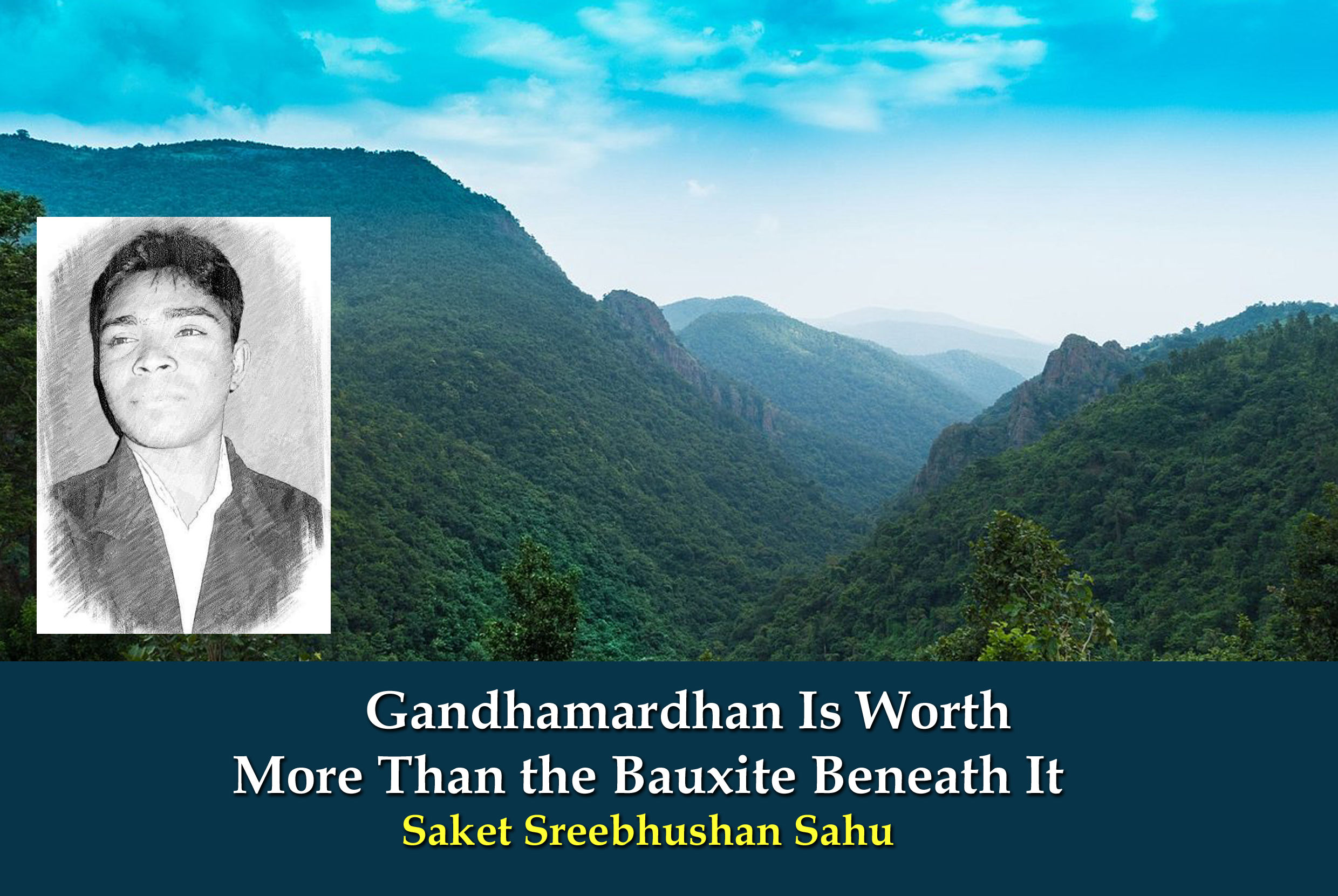
Saket Sreebhushan Sahu
The Odisha government’s recent decision to sign a Memorandum of Understanding (MoU) with Adani Enterprises for a ₹1.08 lakh crore greenfield aluminium project, in partnership with Abu Dhabi’s International Holding Company (IHC), marks one of the state’s biggest industrial commitments in recent years. Yet, for the people living around the Gandhamardhan Hills in western Odisha, the announcement has revived a decades-old fear: that the battle to save one of India’s richest ecological landscapes from bauxite mining is about to begin again.
The anxiety is not unfounded. Last year, Mahanadi Mines and Minerals Ltd. (MMML), an Adani Group subsidiary, acquired more than 45 hectares of land in villages around Gandhamardhan. The company says the land is meant for compensatory afforestation. Local communities are unconvinced. They see the acquisitions as the first step towards reopening mining in a region where an estimated 105 million tonnes of bauxite lie beneath forests that sustains far greater wealth above the ground.
The question confronting Odisha today is not whether aluminium is important. It undoubtedly is. Aluminium is essential for infrastructure, renewable energy, electric mobility and industrial development. The real question is whether every mineral deposit must inevitably be mined, regardless of what stands above it.
Gandhamardhan is not an ordinary hill range.
Spread across Bargarh and Balangir districts, the hills were declared a Biodiversity Heritage Site by the Odisha government in 2023, covering nearly 19,000 hectares. They are home to remarkable biodiversity, hundreds of medicinal plant species and the headwaters of 22 perennial and 54 seasonal streams, including the Ang and Suktel rivers that feed the Mahanadi basin. The forests support wildlife, recharge groundwater and help regulate the local climate across large parts of western Odisha.
Most importantly, they sustain people.
More than a million people depend directly or indirectly on Gandhamardhan’s forests. Communities have built thriving livelihoods around non-timber forest produce—mahua flowers, honey, bamboo, chironji, medicinal herbs, mushrooms and forest fruits. Many tribal households now earn several lakh rupees annually from these products.
This is a living economy, not an imagined one.
The forests also function as an immense food basket. More than 100 traditional paddy varieties continue to be cultivated alongside dozens of indigenous tubers, wild greens, mushrooms, pulses, oilseeds and fruits. During years of erratic rainfall and climate uncertainty, this diversity provides resilience that monoculture agriculture simply cannot match.
Equally significant is Gandhamardhan’s role as a living pharmacy. The Botanical Survey of India has documented around 220 medicinal plant species here, while traditional healers believe the actual number exceeds 500. Patients from Odisha, Chhattisgarh and Jharkhand continue to visit local healers whose knowledge has been refined over generations. Once destroyed, neither these forests nor this knowledge can be recreated through compensatory afforestation.
The people opposing mining are often portrayed as standing in the way of development. That interpretation ignores history.
During the 1980s, Bharat Aluminium Company (BALCO) attempted to mine Gandhamardhan. The proposal was defeated after a remarkable five-year mass movement led by tribal communities from nearly 200 villages under the banner of the Gandhamardan Yuva Suraksha Parishad. It remains one of India’s earliest and most successful environmental struggles.
Today’s protests echo that history. Demonstrations lasting 90 days at Paikamal and another 60 days at Khaprakhol are reminders that local opposition has not diminished. If anything, it has grown stronger because people now have even more to lose.
The forests have regenerated over the past two decades. Local livelihoods have diversified. Community incomes have increased. Ecological restoration has succeeded where extractive development once threatened irreversible damage.
This is precisely why Gandhamardhan deserves a different development model.
The debate should no longer be framed as forests versus industry. Odisha possesses substantial mineral resources elsewhere. It should instead ask which landscapes are simply too valuable to mine. Biodiversity Heritage Sites are created precisely because certain ecosystems possess exceptional ecological, cultural and scientific significance. If such recognition cannot protect Gandhamardhan, it raises uncomfortable questions about the practical value of these legal designations.
Development cannot be measured solely by the size of investment announcements. A ₹1.08 lakh crore project is impressive on paper, but the economic value of forests is rarely reflected in official calculations. Clean water, biodiversity, food security, climate resilience, traditional medicine and sustainable livelihoods do not appear on corporate balance sheets, yet they underpin the well-being of entire regions.
Once a mountain is mined, restoration can only approximate what has been lost. Ancient forests, perennial streams, medicinal ecosystems and indigenous knowledge systems cannot simply be rebuilt through plantation drives or environmental offsets.
For the Adivasi communities of Gandhamardhan, the hills are not merely a source of minerals. They are their market, pharmacy, granary, water source, place of worship and cultural identity. They have protected these forests for generations because their own survival depends upon them.
Odisha stands at an important crossroads. It can pursue industrial growth while recognising that not every ecological treasure should become an industrial asset. The true wealth of Gandhamardhan lies not in the 105 million tonnes of bauxite beneath its soil, but in the forests, rivers, biodiversity and communities that flourish above it.
The challenge before policymakers is therefore not whether Gandhamardhan can be mined. It is whether a state that has declared these hills a Biodiversity Heritage Site is prepared to honour the promise that designation was meant to represent.
The author comments on culture and politics.
E-mail: saket.sahu@gmail.com