Wednesday, April 29, 2026
Home Blog Page 32

International Opinion on Language Policy:Dr Joga Singh (IV)

IV. Contemporary Language Trends

Two trends are distinctly visible in the present day linguistic scenario – one, the diminishing usage, prestige and dominance of English and two, the rising importance of languages other than English in all domains of language use.

We have already seen above that in all the non-English speaking countries (except the Great India and her past sibling and present geo-cum-wisdom-neighbour Pakistan) where education was imparted in the English language, it is either phased out or is in the process of being phased out. Same is happening in other domains.

Around 2000, eighty per cent of internet content was in English; it has come down to below forty. Information now is available on the internet in tens of languages.

Coming to India, as per Microsoft, 95 per cent of commerce in India is in Indian languages and only 5 per cent in English.

The world has reached a linguistic state where you will be the last person to be offered a job by a company if you knew only English and didn’t know any other language. A recent article in a prestigious English magazine, The Economist,  stated that Britain are at a great disadvantage because they knew only English. The citation below provides an evidence for the linguistic direction the world is moving into:

Not only do today’s workers need to be able to communicate both orally and in writing in languages other than English, but they must be able to do so with persons who have not shared their own social and cultural experiences. @ (Stephanie Bell Rose, The Goldman Sachs Foundation; Vishakha Desai, The Asia Society, www).  

As other countries create funding and policies that promote, and even help prioritize, the study of foreign languages, experts say U.S. students are falling behind and could suffer in the global marketplace. @ (Asia Society News, 2nd April, 2009, www).

English loosing its monopolistic position….

“No single language will occupy the monopolistic position in the 21st century which English has – almost – achieved by the end of the 20th century.”

“It is thus clear that two trends will dominate the second wave of satellite broadcasting: other major world languages will increase their global reach and the larger providers will localise their services. Both trends indicate a more crowded and linguistically plural audio-visual landscape in 21st century.”

“The close association between English and information technology may prove a temporary phenomena….So whereas English speakers used to enjoy the best and latest technology, this is no longer so true.” @ (David Graddol. 2000 (1997). 

In almost all of the schools in the developed world are trying to teach their students other languages along with the mother tongue, and these other languages are not merely English.

Things have gone so far that you can now find Chinese medium schools even in the USA in which 90 per cent of students come from non-Chinese language background. (Though this policy is very much wrong, yet, this speaks volumes about the rise of Chinese language in the world). The number of  Chinese learners in the USA in 2007 were ten times more in comparison to 2000. (USA Today, 20th November, 2007)

“Panama is moving to make the teaching of Mandarin compulsory in all schools, in recognition of China’s growing importance in the world economy. @ BBC News (www) 6th December, 2007) 

Even in the countries which speak English mainly, more and more people whose mother tongue is not English are abandoning the use of English. During the 1990 census in the USA, 31.8 million persons recorded that they did not use English at home. The number had grown to 47 million in the 2000 census. This increase in number is far higher than the increase in population of the respective language groups. The number of such Spanish population alone had risen by 60 per cent. From 1980 to 2011, the number of persons who did not use English at home had risen by 140 per cent in the USA, though the US population had increased only by 40 per cent during these years. This means that the number of people who had abandoned English at home had doubled in absolute terms during these years. The Indian elite (the rashTar swamis, sans information in this information age) have completely abandoned national self-respect, not English, and don’t miss to pay daily obeisance to English morn, noon, and night.

The following figures from Argentina are a good evidence to show how English is being pushed out of the media in the former English colonies:  49 per cent of Argentine media in 1983 was from outside the country. The figure for 1996 was 22 per cent.

Thus, there should be no doubt left that English is diminishing in all the domains where it had held a dominant position earlier.

With the advent of numerous language based technologies (internet, computer, mobile telephony, e-books etc.), the commercial prospects of native languages cannot be overstated.

We also need to weigh the educational, economic, commercial, and cultural losses that English language has caused us. A brief account of these is given in the section below.

Joga Singh, Ph.D. (York, U.K.), Mobile: +91-9915709582; E-mail: jogasinghvirk@yahoo.co

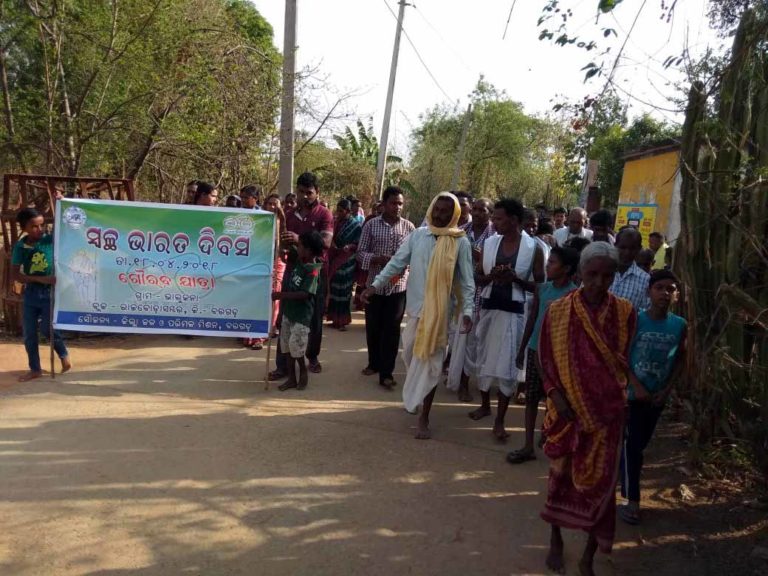
ସ୍ବଛ୍ଛ ଭାରତ ଦିବସ ଅବସରରେ ଗୌରବ ଯାତ୍ରା

ପଦ୍ମପୁର-ରାଜବୋଡାସମ୍ବର ବ୍ଳକ ଚାରପାଲି ଗ୍ରମପଞ୍ଚାୟତ ଅନ୍ତର୍ଗତ ଭାଲୁକନା ଗ୍ରାମ ଖୋଲା ମଳମୁକ୍ତ ଗ୍ରାମ ଭାବେ ଗ୍ରାମବାସୀଙ୍କ ମିଳିତ ସହଯୋଗ ଯୋଗୁଁ ସମ୍ଭବ ହୋଇଛି ।ଗତ ୧୮ତାରିଖ ସ୍ବଛ୍ଛ ଭାରତ ଦିବସ ଅବସରରେ ଗ୍ରାମବାସୀଙ୍କ ତରଫରୁ ଗୌରବ ଯାତ୍ରାରେ ଉନ୍ନୟନ ସଂସ୍ଥାର ପ୍ରକଳ୍ପ ନିର୍ଦେଶକ ଅଭିରାମ କେର୍କେଟା ମୁଖ୍ୟ ଅତିଥି ଭାବରେ ଯୋଗଦାନ କରି ଭାଲୁକନା ଗ୍ରାମବାସୀଙ୍କୁ ଅଭିନନ୍ଦନ ଜଣାଇବା ସହିତ ଶତ ପ୍ରତିଶତ ପାଇଖାନା ବ୍ୟବହାର ଉପରେ ଗୁରୁତ୍ବାରୋପ କରିଥିଲେ ।ସମ୍ମାନିତ ଅତିଥି ଭାବରେ ଜଳ ପରିମଳ ବିଭାଗର ସହକାରୀ ନିର୍ବାହୀଯନ୍ତ୍ରୀ ସରୋଜ କୁମାର ରଥ,ରାଜବୋଡାସମ୍ବର ବ୍ଳକ ଗ୍ରାମ୍ୟ ଜଳ ପରିମଳ ବିଭାଗ କନିଷ୍ଠ ଯନ୍ତ୍ରୀ ରବିନାରାୟଣ ମହାପାତ୍ର,ମାଷ୍ଟର ଟ୍ରେନର ମୀନକେତନ ସାହୁ,ବ୍ଳକ କୋଡିନେଟର ତରଣୀ ସେନ ମହଲା,ସରପଞ୍ଚ ଇନ୍ଦ୍ରତିତ ପ୍ରଧାନ ପ୍ରମୁଖ ଯୋଗଦାନ କରିଥିଲେ ।ଖାଲା ମଳମୁକ୍ତ ଅଭିଯାନକୁ ଆଗକୁ ନେବା ସହ ପାଇଖାନା ବ୍ୟବହାର ଉପରେ ତାଙ୍କର ମତାମତ ରଖିଥିଲେ ।ମୁଖ୍ୟ ବକ୍ତା ଭାବରେ ଗ୍ରାମ୍ୟ ଜଳ ପରିମଳ ବିଭାଗର ନିର୍ବାହୀ ଯନ୍ତ୍ରୀ ବିଦ୍ୟୁତ କୁମାର ପାଣିଗ୍ରାହୀ ଯୋଗଦାନ କରି ଏହି ଅଭିଯାନଟି ଅନ୍ୟ ଗ୍ରାମ ପାଇଁ ଉଦାହରଣ ସୄଷ୍ଟି କରିବ ବୋଲି କହିଥିଲେ ।ଏଥିସହ ଖୁବଶୀଘ୍ର ସୌର ଶକ୍ତି ସାହାଯ୍ୟରେ ଉକ୍ତ ଗ୍ରାମକୁ ପାନୀୟ ଜଳ ଯୋଗାଣ କରିବା ପାଇଁ ପ୍ରତିଶ୍ରୁତି ଦେଇଥିଲେ ।ଏହି କାର୍ଯ୍ୟକୁ ଜିଲ୍ଲା ଜଳ ପରିମଳ ମିଶନର ପ୍ରକଳ୍ପ ସଂଯୋଜକ ଦୀପ୍ତିରଞ୍ଜନ ପ୍ରଧାନ ସଂଯୋଜନା କରିଥିଲେ ।

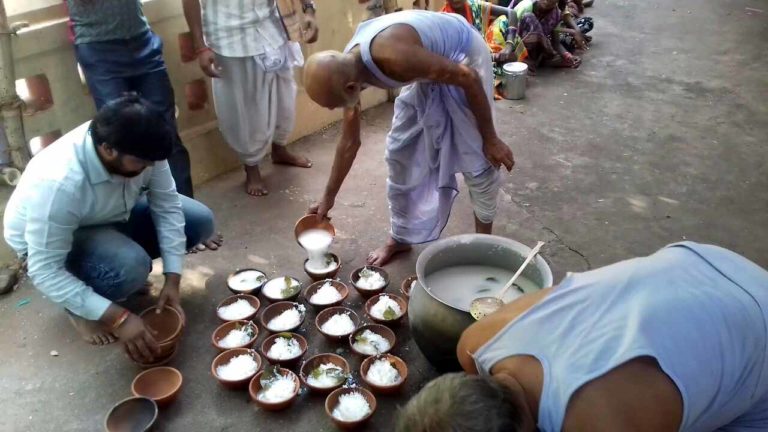
ନୄସିଂହନାଥ ପିଠରେ ଲାଗିଲା ପଖାଳ ଭୋଗ

0

ପଦ୍ମପୁର-ବରଗଡ଼ଜିଲ୍ଲା ପଦ୍ମପୁର ସଦରମହକୁମାରୁ ୩୫କି.ମି ଦୂରରେ ଅବସ୍ଥିତ ଶ୍ରୀ ଶ୍ରୀ ନୄସିଂହନାଥ ମହାପ୍ରଭୁଙ୍କ ମନ୍ଦିର ।ନୄସିଂହନାଥ ମନ୍ଦିରରେ ମହାପ୍ରଭୁଙ୍କ ଠାରେ ପ୍ରଚଣ୍ଡ ଗ୍ରୀଷ୍ମ ତାପ ଯୋଗୁଁ ପଖାଳ ଭୋଗ ଲଗା ଯାଇଥିଲା ।ଏହି ପଖାଳ ଭୋଗ ଲଗାଇବା ପରମ୍ପରା ପୂରାତନ କାଳରୁ ଚାଲି ଆସୁଛି ।ଏହା ସହିତ ଗ୍ରୀଷ୍ମରେ ମହାପ୍ରଭୁ ତଥା ପାର୍ଶ ଦେବାଦେବୀଙ୍କୁ ସିତଳତା ପ୍ରଦାନ କରିବା ପାଇଁ ପ୍ରତିମୂର୍ତ୍ତିଙ୍କ ମୁଣ୍ଡ ଉପରେ ଓଦା କପଡା ଓ ଚନ୍ଦନ ପ୍ରଲେପ ଦେବା ସହମାଟି କଲସିରେ ପାଣି ଦେବାର ନିଆରା ପରମ୍ପରା ରହିଛି ।ବୈଶାଖର ପ୍ରଚଣ୍ଡ ତାତିରେ ଅକ୍ଷୟତୄତୀୟା ଠାରୁ ଦଶମୀ ଯାଏଁ ସାତ ଦିନ ଧରି ମହାପ୍ରଭୁଙ୍କ ଠାରେ ଲଗା ଯାଉଥିବା ଏହି ପଖାଳ ଭୋଗରେ ଟଭା ପତ୍ର,ଆମ୍ବ,ଦହି ଆଦି ମିଶ୍ରଣ କରି ପ୍ରସାଦ ପ୍ରସ୍ତୁତ କରାଯାଇଥାଏ ।ମନୁଷ୍ୟ ଯେପରି ଗ୍ରୀଷ୍ମର ପ୍ରଭାବରୁ ରକ୍ଷା ପାଇଁ ନିଜର ଖାଦ୍ୟପେୟ ରେ ପରିବର୍ତ୍ତନ କରିଥାଏ ସେପରି ନୄସିଂହନାଥ ମହାପ୍ରଭୁଙ୍କୁ ମଧ୍ୟ ଗ୍ରୀଷ୍ମ ପ୍ରବାହରୁ ଆରାମ ପାଇଁ ବହୁ ପୁରାତନ କାଳରୁ ଏହି ନିଆରା ପରମ୍ପରା ଚାଲିଆସୁଛି ।ଏହି ପରମ୍ପରାର ସାକ୍ଷ ରହିବା ପାଇଁ ତଥା ମହାପ୍ରଭୁଙ୍କ ପଖାଳ ଭୋଗ ପାଇବା ପାଇଁ ରାଜ୍ୟ ତଥା ରାଜ୍ୟ ବାହାରୁ ମଧ୍ୟ ଶ୍ରଦ୍ଧାଳୁଙ୍କ ଭିଡ ଜମିଥାଏ ।

Haldhar Banabidyalaya: the school which teaches Kosali in primary level

In 2012, Janek Kuwanr, Head Master of Lokkabi Haldhar Avasik Banavidyalaya visited me along with renowned poet Padmasri Haldhar Nag.  They proposed to initiate teachings in Kosali in the school and they invited me to the school. It was hot summer, I visited the school. A mud house with 2 rooms attached with a veranda and surrounded by jungle, no boundary wall no other facilities. A colour faded signboard hanging to the roof. That was Lokkabi Haldhar Avasik Banavidyalaya. The school is situated at Kudopali near Sohela of Bargarh district.

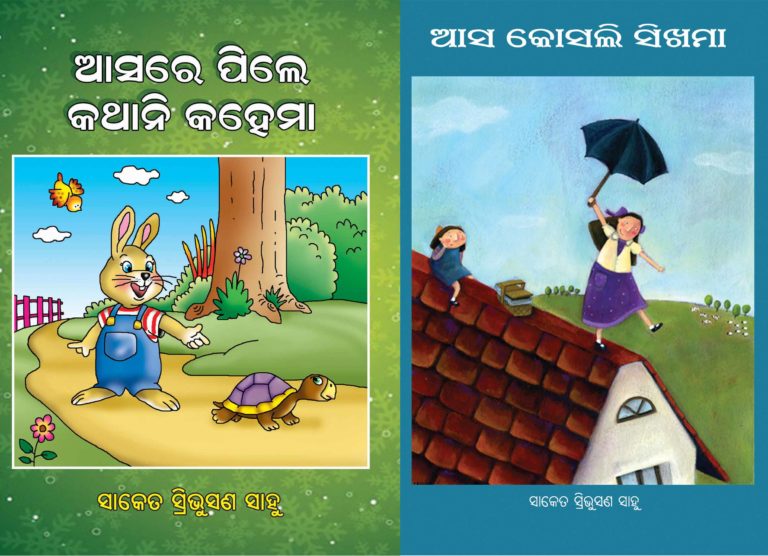
I discussed with many senior grammarians and wrote 2 books for the school; a grammar book and a story book. We released the primer “Aasa Kosali Sikhma” and “Aasare Pile Kathani Kahema”. The book was published by Beni group and supported by many well wishers.

When the CM wrote recommendation letter to the Union government urging to include Kosali in 8th Schedule, there in the letter too he has mention about the school.

Now the school is in bit better position with some financial assistance from government and other well wishers. But that not enough, the government should undertake it fully and continue teaching Kosali.

Saket Sreebhushan Sahu comments on culture and politics


Oral Narrative and Hindu Method of Assimilation: A Case of Marjarakesari in Narsinghnath (7)

According to the oral narrative, once upon a time Patna was a dependency of Borasambar. There was no chief and the council of eight Malliks (Asta-Malliks) ruled over Patna. It was a reign full of mishap and disturbances. What’s more, it was a seat of Tantrism and cruelest form of blood sacrifice i.e. human sacrifice was prevalent before its reigning goddess Pataneswari. Everyday a man was sacrificed to the deity. But it was practically difficult on the part of the Asta-Malliks to arrange a man daily for the deity. Consequently, a well thought out practice was made with the hidden intent of human sacrifice at the religious Pitha of Pataneswari.

As per the practice, these eight Malliks were electing a chief each day from the common mass and taking him to the temple of Pataneswari so that he could seek her blessings before ascending the throne. In fact, they had clear objective of letting the man to be the sacrificial article of the deity. They asked the so called newly elected or selected leader to pay obeisance to the deity. No sooner had he prostrated himself then he was beheaded by these Malliks and sacrificed before the deity. After that, the Asta-malliks pretended that the deity considered him unfit to sit on the throne and for that reason devoured him. As a result of this practice, day by day a man was elected chief and subsequently sacrificed pitilessly.

This narrative intends to transmit certain historical information in a distorted and hazy form that Patna (Patnagarh) was a seat of Tantrism where human sacrifice was once established. In this context, it may be said that there is satisfactory sign to demonstrate and consider that Patna was a seat of Tantrism that led to the institution of a Tantrik Pitha (site) at Patna. It may be noted here that still a few years ago Patna was widely known as Kuanri-Patna or Kaunri-Patna which means the seat of maidens who lived in this township for some period of time and accomplished esoteric rites.

Most probably, these Tantrik maidens were non-Brahmins by caste or they were popularly acknowledged by their assumed non-Brahmin names like Gangi Gauduni, Sua-Teluni, Jnanadei-Maluni, Nitei-Dhobani, Luhukuti-Luhurani, Sukuti-Chamaruni and Patrapindhi-Saharuni. This suggests us to believe that they were very admired and worshipped mostly amongst non-Brahmin and tribal sections of the west Orissan society. There are popular tales and traditions in west Orissa depicting the occult practices and Tantrik activities of these seven maidens, at times branded as Sat-Bahen (seven sisters). They appear to be the supporters and followers of Lakshminkara who has propounded the Sahajayana Buddhism in west Orissa in the ninth century A.D.

Apparently, Vaijala Dev-II (1520-1540 A.D.) of Chauhan dynasty was also a worshipper of Hari-Hara and his Guru was well versed in Logic and Tantra. As late as the sixteenth century, Patna Rajya was known as Kaunri-Patna after the name of the headquarters town of that name as known from the Nirguna Mahatmya of the poet Chaitanya Das (Senapati and Sahu, 1968:50-51,489; Senapati and Mahanti, 1971:49,531; Panda, 1992).

The oral narrative further reveals that there was a Brahmin in Patna. On one occasion, on his visit to Borasambar he learnt that the Binjhal chief of Borasambar had given shelter to a Chauhan princess and her son. On his request, the Borasambar chief allowed him to take the mother Asavati and her son Ramai Dev to Patnagarh and to keep in his house. After sometime, the Brahmin was elected by the Asta-Malliks to be the chief of Patna. Being afraid of the inevitable consequence of death he sent Ramai Dev to represent him for this purpose.

Chitrasen Pasayat is an OAS and comments on culture

International Opinion on Language Policy: Dr Joga Singh (III)

III. Foreign Language Learning and Mother Tongue Medium vs. Foreign Language Medium

It would be proper to start with a statement from the UNESCO:

“What seems to be standing in our way is a set of myths about language and learning, and these myths must be revealed as such to open people’s eyes. One such myth is that the best way to learn a second (read foreign – JS) language is to use it as a medium of instruction. (In fact, it is often more effective to learn additional languages as subjects of study.) Another is that to learn a second language you must start as early as possible. (Starting early might help learners to have a nice accent, but otherwise the advantage goes to learners who have a well developed first language.) A third is that the home language gets in the way of learning a second language. (Building a strong foundation in the first language results in a better learning of additional languages.) Clearly these myths are more false than true, yet they guide the way policymakers tend to think about how speakers of other languages must learn dominant or official languages.” @ (UNESCO, 2008:12).

This statement is based on studies from 12 countries spread over all continents. The study included India too and it was funded by the World Bank, not an opponent of English.

A similar study is based on Finish children who migrated to Sweden. This study showed, “Overwhelmingly, the better a student knew Finish (as a function of having attended school for several years in Finland), the better he learned Swedish. An examination of language skills of siblings found that who moved from Finland at an average age of 10 have preserved an almost normal Finnish language level, and they also approach the normal level in Swedish of Swedish pupils… The children who moved under the age of six, or who were born in Sweden, do not do as well. Their Swedish language development often stops at the age of about 12, evidently because of their poor grounding in the mother tongue.”  @ (Paulston, 1977:92-3).

“Strong demand for EMI (Englis as medium of instruction) as a means of promoting fluency in English conflates two distinct areas of practice: EMI and English as subject (EaS). The confusion of language learning (EaS) with language and learning has created difficulties for schoolchildren and can pose a barrier to inclusive and equitable quality education. There is little or no evidence to support the widely held view that EMI is a better or surer way to attain fluency in English than via quality EaS. Expert estimates are that it takes pupils six to eight years to develop the cognitive and academic language proficiency (CALP) needed to support learning across the curriculum. A move to EMI in or just after lower primary, commonly found in South Asia and Sub-Saharan Africa, yields too shallow a foundation of English to sustain learning across the curriculum from the upper primary years onwards. Early introduction of EMI is thus viewed as impairing learning in the formative years and limiting educational attainment.

The evidence-based position on MoI taken by major donors and development partners is one that supports a mother tongue-based multilingual education model of basic education. It rests on a wealth of data showing that children’s participation in well-designed multilingual programmes underpins learning in all subjects, including English, through use of the mother tongue or a familiar indigenous language. The British Council’s position on MoI likewise reflects a mother tongue-based multilingual education approach to basic education in low- and middle-income countries”. (pp.3).

British Council. 2017. English language and medium of instruction in basic education in low- and middle-income countries: a British Council perspective. London: The British Council.

Thus, it is clear that foreign languages are better learned by studying through mother tongue medium. The following tells why it is so:

“Butzkamm insists that we have to re-define the role of the native language as the major resource in foreign language learning and teaching. As children grow into their mother tongue, (1) they have learnt to conceptualize their world and have fully grasped the symbolic function of language; (2) they have learnt to communicate; (3) they have learnt to speak and use their voice; (4) they have acquired an intuitive understanding of grammar and have become aware of many of the finer points of language; (5) they have acquired the secondary skills of reading and writing. The mother tongue is therefore the greatest asset people bring to the task of foreign language learning. It provides an indispensable Language Acquisition Support System and makes instruction possible in the first place. @ (WIKIPEDIA).

“Successful learners capitalise on the vast amount of both linguistic skills and world knowledge they have already accumulated via the mother tongue. For the most part, they need not reconceptualise their world in the new language. They have acquired an L1 along with its accompanying discourse skills and pragmatic knowledge, which are directly available for incorporation into the target language system. For instance, they need not be told that requests, wishes or warnings can masquerade as statements. Also, the path breaking power of L1 grammar is not dependent on the fact that both languages share similar grammatical features. It is because all languages have evolved means of expressing abstract ideas such as possession, number, agent, instrument, negation, cause, condition, obligation etc., no matter how they do this; one natural language is enough to open the door for the grammars of other language because all languages are cut from the same conceptual cloth. In a deep sense, we only learn language once”. @ http://en.wikipedia.org/wiki/Wolfgang_Butzkamm

The facts described so far should suffice to take the blinders off the eyes and pull the deafening wax out of the Indian policy makers. However, it won’t do any harm to look into what is happening in the rest of the world language wise.

In fact, wherever English has been the medium of instruction, though it being a foreign language there, it has been phased out or is at least diminishing day in and day out. Few examples should suffice as evidence.

Uganda decided in 2007 that for the first three years the mother tongues should be used as medium of education and English should be taught as a subject. This has brought them success too. An appraisal done in 2008 itself showed that the new policy had contributed to improvement in literacy.

It needs to be particularly mentioned here that there are 52 language groups in Uganda. The change in Uganda was based on the idea that a student learnt a foreign language better if he had a good foundation in the mother tongue. Before this new policy, the school education in Uganda used to be in English medium from the very start. (See Kavuma, 2009 for these facts). 

Malaysia decided in 2009 to teach Math and Science in Bhasha Malasia in National schools and in Chinese and Tamil in the Local schools.

There can’t be a better comment on the illiteracy of Indian policy makers than that Malaysia finds it correct to teach science in Tamil medium to Tamils but it is considered almost a crime here in India. There is a proverb in Punjabi which means that ‘without sense, even wells go dry’. We may not know much about that, but the English infected Indian heads have certainly gone empty. Anyhow, it won’t be bad to have some more evidence here.

“New Zealand and Britain have shown more regard for their indigenous minority languages (though not for immigrant languages) in recent years, which also shows in their employment as the medium of instruction in schools. The recent history of New Zealand’s policy regarding the Maori language and culture is highlighted by S. May, with an optimistic outlook (pp. 21–41). Initial assessments of the newly institutionalised Maori elementary schools (Kura Kaupapa), with Maori medium instruction, ‘suggest that the academic progress of children ( . . . ) is comparable to their mainstream peers, while providing the added advantage of bilingualism’ (p. 35). In the case of Hong Kong there has been an increase in the use of Puntonghua, which has also been introduced as a widely taught school subject, while indigenous Cantonese still serves as the medium of instruction together with English. Malaysia, in contrast, has restrained the status and function of English and substituted it by Malay (Bahasa Malaysia) as the sole official language of the country and the sole medium of instruction in public schools and universities (S. Kaur Gill, pp. 135–152).” @ (Ammon, 2004)  

It is clear, thus, that all English infected nations of yester years are bidding it farewell. The reason seems to be that none wants to be a friend of ignorance (except us, the Indians, highly addicted to mental slavery, and ignorance).

But why is it happening in India, then? The real reason for this is the Indian Manuvaad; The Indian elite want to plunder all and deprive other Indians of everything through the instrument of English language. Therefore, we need to demolish the ideological bases which sustain this Indian Neo-Manuvaad in the digital age. These bases are some myths, which have been nicely unmasked in a Stockholm (Sweden) University Report (see Benson, 2005). Some of these myths are described below.

III.2. Some More Myths Surrounding Language

III.2.1. “The one nation—one language myth. The colonial concept that a nation-state requires

a single unifying language has influenced policy-makers in many parts of the world,

yet imposition of a so-called “neutral” foreign language has not necessarily resulted

in unity, nor have relatively monolingual countries like Somalia, Burundi or Rwanda

been guaranteed stability. In fact, government failure to accept ethnolinguistic

diversity has been a major destabilizing force in countries like Bangladesh, Pakistan,

Myanmar and Sri Lanka (Ouane 2003).” @ (Benson, 2009)  

III.2.2. “The myth that local languages cannot express modern concepts. Another colonial

concept is the supposed inherent worth of European languages in contrast to others,

but all human languages are equally able to express their speakers’ thoughts and can

develop new terms and structures as needed. Léopold Senghor once illustrated this by

translating Einstein’s Theory of Relativity into Wolof, a lingua franca of Senegal.

The difference lies in which languages have historically been chosen for

“intellectualization,” or development, through writing and publishing (Alexander

2003).”  @ (Benson, 2009)

As is made amply clear by the statements above, each language is capable of expressing any kind of concept. But such an ignorance prevails around in this regard that we need to go in a bit of detail.

No language can be dubbed rich or poor in terms of sentence formation. A cursory reading of  grammar books of any two languages should reveal this. Even a language without a grammar book is grammatically as rich as the ones with written grammars. So, sentence structure –wise, all languages are equally rich. It is the vocabulary which is root of all misconceptions about poverty or richness of any particular language.

It is often heard that our languages do not possess words for subjects like science and technology. But this view is based in a complete lack of knowledge about vocabulary.

Actually, each language has similar word power, because all words of a language are constructed from some basic elements called ‘roots’ and ‘affixes’.  And, there is no marked difference among languages in terms of the number of these basic elements. The following English words can illustrate this very easily:

  1. Haem. A prefix signifying blood.
  2. Haemacyte. A blood cell.
  3. Haemagogue. Medicine that promotes the catamenial and haemorrhoidal discharges.
  4. Haemal. Pertaining to the blood.
  5. Haemalopia. An effusion of the blood into the globe of the eye; bloodshot eye.
  6. Haemngiectasis. Dilatation of a blood vessel.
  7. Haemangioma. A malformation of a blood vessels which may occur in any part of the body.
  8. Haemarthrosis. The presence of blood in a joint cavity.
  9. Haematemesis. The vomiting of blood.
  10. Haematin. An iron-containing constituent of haemoglobin.
  11. Haematinic. An agent improving the blood-quality.
  12. Haematinuria. The presence of haematin in the urine.
  13. Haematocele. A swelling filled with blood; haematoma.
  14. Haematocolpos. Retention of the menses due to a congenital obstruction of vagina.
  15. Haematogenesis. The development of the blood.
  16. Haematoid. Having the nature or appearance of blood.
  17. Haematology. The science dealing with the formation, composition, functions and diseases of the blood.
  18. Haematolysis. Destruction of blood cells and liberation of haemoglobin.
  19. Haematoma. The blood tumour; H. Auris, the blood tumour of the external.”

( With thanks from Rawat, 1985)

At first sight, it would appear that our languages do not have words equivalent to these ones. But the truth is that all of the words above are derived by adding suffixes (endings) to the root (base) ‘Haem’, meaning ‘blood’. The following Hindi parallels, respectively, of these words will make it clear that either our languages have their equivalents or we can get them in no time.

  1. rakt 2. rakt-koshika 3. rakt-prerak 4. raktiya 5. raktiya-netr 6. raktvahini-pasar 7. rakt-massa 8. raktjor-vikar 9. rakt-vaaman 10. lauhraktiya 11. raktvardhak 12. raktmuutr 13. rakt-granthi/suujan 14. rakt-maasdharmrodh 15. rakt-utpaadan 16. raktruup 17. rakt-vigiyan 18. rakt-hraas 19. rakt-granthi

Thus, to state that our languages lack in vocabulary can only be a sound proof of one’s not being in a sound state of mind.

The English words cited above bring out another significant fact about the touted richness of English language; none of these words is an English one; all of them have been borrowed directly from Latin. It is a misconception, thus, to believe that one would understand the scientific vocabulary better if one were fluent in English, because most of the scientific vocabulary in English is either Latin or of Greek origin.

Another myth responsible for the chronic English infection is the misconception that fluency in English will open the doors to the whole world. It is essential, therefore, to know what is happening in the world around linguistically.

III.2.3. “The L2 as global language myth. The foreign L2 is often seen as necessary for

further education, work and other opportunities, yet, as Phillipson (1992) points out,

this has not happened in a political vacuum but is the result of deliberate promotion

by powerful countries or groups of their respective languages. Meanwhile,

employment in the informal sector of low-income countries involves 50 percent or

more of the population and is increasing, and primary schooling is still terminal for

most. The vast majority will not be integrated into the global marketplace and will

have little use for the L2 (Bruthiaux 2002).” @ (Benson, 2005)


Joga Singh, Ph.D. (York, U.K.), Mobile: +91-9915709582; E-mail: jogasinghvirk@yahoo.co

International Opinion on Language Policy: Dr Joga Singh(II)

0
  1. Mother Tongue, Other Tongue, and Education

It would be proper to first look at the international experience and scholarship with regard to relationship between language and education, the most important domain of present times, and with regard to the relationship between language and science and knowledge in general. The following statement from the book titled ‘The Use of Vernaculars in Education’ published by the United Nation’s Educational Scientific and Cultural Organization (UNESCO) in 1953; The book presents the essence of international research and wisdom on the issue:

“It is axiomatic that the best medium for teaching a child is his mother tongue. Psychologically, it is the system of meaningful signs that in his mind works automatically for expression and understanding. Sociologically, it is means of identification among the members of community to which he belongs. Educationally, he learns more quickly through it than through an unfamiliar linguistic medium.  @ (UNESCO, 1953:11)

This opinion of UNESCO was the result of a very comprehensive research. The UNESCO had stated this again in 1968:

“……..the use of mother tongue be extended to as late a stage of education as possible. @ (UNESCO, 1968:691)

The following is recorded in UN’s developmental report of 2004:

“In the Philippines students’ with the proficiency in the two languages of the bilingual education policy (Tagalog and English) outperformed students who did not speak Tagalog at home. @ (UNDP Report 2004:61)

The following statement is about the US, a country where the overwhelming majority speaks English:

“In the United States, Navajo students instructed throughout their primary school years in their first language (Navajo) as well as their second language (English) outperformed their Navajo-speaking peers educated only in English.” @ (UNDP Report 2004:61)

I would personally and earnestly request the Indian Anglo-maniacs to take the trouble to know in what a big number the non-English medium schools exist even in mainly English speaking countries such as the USA, Canada and New Zealand.  The statements presented below are from the studies carried out throughout the world on the issue :

“Thus, the results of research reported by Modiano (1968, 1973) in Mexico; by Skutnabb-Kangas (1965) in Finland; as well as those from diverse studies summarized by Gudschinsky (1975) for Latin America where a higher proportion of children who are introduced to schooling in their vernacular and later bridged into the second language, develop literacy in their mother tongue, achieve higher level of content mastery and second language proficiency and remain longer in school than children who are schooled exclusively in the second language. @ (Tucker, 1977:3). (Read ‘second language’ as ‘foreign language’).

The following citation is from the study carried out on the Finish children who had migrated to Sweden:

“The Finish-language skills shown by the test results are fairly closely connected with the grade in mathematics. In the upper level, Finnish seems to be even more important for achievement in mathematics than Swedish — in spite of the fact that mathematics, too, is taught in Swedish. This result supports the concept that the abstraction level of the mother tongue is important for mastering the conceptual operations connected with mathematics…. Subjects such as biology, chemistry and physics also require conceptual thinking, and in these subjects migrant children with a good mastery of their mother tongue succeeded significantly better than those who knew their mother tongue poorly. @ (Skutnabb-Kangas and Toukomaa, 1976).” (quoted in Paulston, 1977:94)

Let us have a look at another statement about the USA :

“Likewise, in the United States, there has seemed to emerge a gradual awareness that many non-English residents are not best served by being submerged in a monolingual English education system where no attention is paid to the development of their native language.” @ (Tucker, 1977:3) 

This one is from a study on Ghana:

“Bokamla and Tlou (1977:45) report that in Ghana only 5 percent of all children who leave elementary school go on to secondary school. In Zaire, only 30 percent of the children who enter elementary school complete the first four grades. The authors attribute this to inability to master the language of instruction. @ (Fasold, 1984:306)

Further, “It is not true, however, that students will not learn science and mathematics if they do not know English. The ideas of science are not bound by one language and one culture. The Russians, Germans, and French boast of excellent scientific discoveries without using English. The top five performers in the 2003 Trends in International Mathematics and Science Study (TIMMS), namely Singapore, Republic of Korea, Hong Kong, Chinese Taipei, and Japan, are countries where English is not the first language.” @ (Ricardo and Nolasco, 2009:6). In 2012 again, none of the top ten performing countries was the one where English was the first language.

All of us know that ancient India and the Arab world held a proud place in the field of knowledge without English. In a sense, English was not even born then.

The Norway’s Global Monitoring Report (Benson, 2005) states thus:

“The Six-Year Yoruba Medium Primary Project (Fafunwa et al. 1975;  Akinnaso 1993;  see Adegbiya 2003 for other references) demonstrated unequivocally that a full six-year primary education in the mother tongue with the L2 taught as a subject was not only viable but gave better results than all-English schooling.  It also suggested that teachers should be allowed to specialize in L2 instruction.”

“More recent work demonstrates similar findings and goes beyond these to illustrate the positive aspects of mother tongue-based bilingual programs listed above….” @ (Benson, 2005). (The mother tongue-based bilingual education means that the education be imparted in mother tongue and the foreign/second language be taught as a subject).

Thus, we find that it is proved time and again throughout the world that the success in education which can be achieved through mother tongue medium cannot be achieved at all through a foreign language medium. Hence, it is not incorrect to state that successful education is possible only when it is mother tongue based. The following statement brings out some of the reasons for this:

“One’s own language enables a child to express him/herself easily, as there is no fear of making mistakes. MLE (multilingual education – the education method where mother tongue is the medium of instruction and other language(s) are taught as a subject – JS) encourages active participation by children in the learning process because they understand what is being discussed and what is being asked of them. They can immediately use the L1 to construct and explain their world, articulate their thoughts and add new concepts to what they already know. MLE empowers the teachers as well, particularly when they are more fluent and adept in the local language than in the languages of wider communication. Because the students can express themselves, the teachers can more accurately assess what has been learned and identify areas where students need further assistance, MLE creates the conditions for the integration of the people’s community knowledge—the knowledge that informs their lives and give them meaning—into the school system. MLE makes it possible for the community to produce its own culturally relevant reading materials and teaching aids, together with the local writers, illustrators, cultural groups and other stakeholders in the community. MLE also empowers the parents who can take an active part in the education of their children because the school’s and the community’s language are also their language. MLE brings the community closer to the school and its programs.” (Ricardo and Nolasco, 2009:4)

The experts on language and on education opine that if the child’s mother tongue is not the medium of  education, child wastes many of his/her years in learning the language, because in this way,“…the young learners and their teachers will concentrate on the language, not on Science and Math and literacy (that is more fundamental to learning). The best way to learn basic science and math, problem solving skills, and reasoning skills is through the L1. @ (Ricardo and Nolasco, 2009:11) 

We have seen above that the worldwide research and the expert opinions provide a definitive proof that success in education is possible only through the mother tongue medium. But, here in India, the people in control of language and education policies are hell bent on English and are keeping their eyes and ears shut. They are ruining India’s education, language and culture beyond redemption. As we have stated behind, a humble aim of this write up is to remove the blinders off their eyes and the thick wax off their ears.

The findings of the international research being described below will further help in piercing this dastardly ignorance. These findings show that the mother tongue medium is essential for success not only in education, it is better than foreign language medium even for learning a foreign language.

Joga Singh, Ph.D. (York, U.K.), Mobile: +91-9915709582; E-mail: jogasinghvirk@yahoo.co

Oral Narrative and Hindu Method of Assimilation: A Case of Marjarakesari in Narsinghnath (6)

0

The following oral narrative connected with this Pitha attests this reality. There is a pool called Haran-Papa in the bed of stream close to the Narsinghnath temple. The natural springs, which come down the Narsinghnath hills, create a pool of water at the foot of the hill close to Narsinghnath temple. The pool is called Haran-papa, the water of which is competent to wash away all sins.

As per the existing narrative, Lord Siva after killing the Go-Daitya (cow demon) could not liberate himself from his sin anywhere in the world. Lord Brahma informed Lord Siva about the manifestation of Ganga Devi in the shape of a stream in Gandhagiri and recommended him to take a holy dip in its water. Consequently, Lord Siva arrived here and took a dip in the holy water. Amazingly, Lord Siva got himself released of the stigma at this Tirtha (Senapati and Mahanti, 1971:14). Particularly, matching story is found related with the river Baitarani in other parts of Orissa. All the same, this narrative intends to communicate some information about specific event; provided that it can be correctly dated and appropriately interpreted as potential source of certain kinds of historical information. But dating and interpretation present a lot of difficulties. Nevertheless, the above narrative does suggest us to consider that Saivism was once popular and enjoyed predominance in this place.

There is an oral narrative concerning the formation of Chauhan Rajya in Patnagarh in the medieval period. By the time the Sultan of Delhi conquered Rajputana, a Rani of one of the Rajput houses fled away to save her honour and dignity after her husband was assassinated in the battle. This Rani is recognized as Ashavati and her husband is identified as Hammir Dev who lived near Mainpur in north India and was killed by the Sultan of Delhi. Subsequently, Asavati reached Borasambar, a small Binjhal Rajya. Borasambar was numerically dominated by the aborigines like the Binjhals and was a seat of tribal power. The Binjhal tribal chief of Borasambar took pity on the mother and gave her shelter, where she gave birth to a son named Ramai Dev who afterward became the originator of Chauhan dynasty in Patna.

Reportedly, Binjhals are Dravidian in origin. They worship swords, spears and arrows. They worship mother-Goddess specifically Lakheswari (the Goddess of Archery) and Dangar-Devta (the mountain deity). Possibly, the Binjhals are a hunting and martial tribe. They particularly worship Bindhyabasini who is their principal deity and Narsinghnath. They do not employ Brahmins in any ritual observance. They have their Binjhal priests for this purpose. Moreover, Bairagis or Vaisnavas are taken as Mantra-Guru. Almost every Binjhal takes Karna-Mantra that is, Mantras whispered in the ear (Karna). It may be understood that Binjhals seek to assert their interest and identities against Brahmins or power and authority of the Brahmins in the Hindu society. This reminds us one of the protests of Buddhism in opposition to caste prejudices or Brahminism. In addition, they worship deities of the Hindu pantheon along with their own deities, which may be accredited to the process of Hinduisation or Sanskritisation taken place afterward (Senapati and Sahu, 1968:103; Senapati and Mahanti, 1971:121; Senapati and Kuanr, 1980:93-94).

Chitrasen Pasayat is an OAS comments on culture

ବୁଢାସମ୍ବର ସାହିତ୍ୟ ଓ ସାଂସ୍କୃତିକ ଅନୁଷ୍ଠାନର ସିରଜିନା ଉଛ୍ଛବ ୨୦୧୮ ଅନୁଷ୍ଠିତ ହୋଇଛି

0

ପଦ୍ମପୁର(୧୯/୦୪/୨୦୧୮)-ଅକ୍ଷୟତୄତୀୟା ବୁଧବାର ଦିନ ଶ୍ରୀଯୁକ୍ତ ସଂଜୟ କୁମାର ବହିଦାରଙ୍କ ସଭାପତିତ୍ୱରେ ବୁଢାସମ୍ବର ସାହିତ୍ୟ ଓ ସାଂସ୍କୃତିକ ଅନୁଷ୍ଠାନ ପଦ୍ମପୁରର ବାର୍ଷିକ ଉତ୍ସବ  ସିରଜିନା ଉଛ୍ଛବ ୨୦୧୮ ପାଲିତ ହୋଇଯାଇଛି ।ମା ସମଲେଶ୍ବରୀଙ୍କ ପୂଜାର୍ଚନା ପରେ ସଭାକାର୍ଯ୍ୟ ଅନୁଷ୍ଠିତ ହୋଇଥିଲା ।ସର୍ବପ୍ରଥମେ ସ୍ବର୍ଗତ ଖଗେଶ୍ବର ସେଠ ଓ ସ୍ବର୍ଗତ ସଂଜୀବ ବଣିଆଙ୍କୁ ଶ୍ରଦ୍ଧାଞ୍ଜଳି ଅର୍ପଣ କରାଯାଇଥିଲା ।କବି ଖଗେଶ୍ବର ସେଠଙ୍କ ସାହିତ୍ୟ କୄତ ଉପରେ ଡ.ମାନଭଞ୍ଜନ ପ୍ରଧାନ ଓ ସୁଶ୍ରୀ ଜିତେଶ୍ବରୀ ଦାଶ ଭାବଗର୍ଭିକ ଭାଷଣ ପ୍ରଦାନ କରିଥିଲେ ।ନାଟ୍ୟକାର ଅଶୋକ କୁମାର ବହିଦାରଙ୍କ ସଂଯୋଜନାରେ ଏକ ମନୋତ୍ତ କବିତା ପାଠୋତ୍ସବ ଅନୁଷ୍ଠିତ ହୋଇଥିଲା ।ପ୍ରତିବର୍ଷ ପରି ଏହି ବର୍ଷ ବର୍ଷୀୟାନ କଳାକାର ଶ୍ରୀଯୁକ୍ତ ସତ୍ୟନାରାୟଣ ଦାସ(ପଦ୍ମପୁର),ଶ୍ରୀଯୁକ୍ତବେଣୁମାଧବ ଦୋରା(ପଦ୍ମପୁର),ଶ୍ରୀମାନ ମଧୁସୂଦନ ସରାଫ(ପଦ୍ମପୁର),ଶ୍ରୀଯୁକ୍ତ ଲିଟୁ ମହାନ୍ତି(ବରଗଡ଼),ଡ.ତପସ୍ବିନୀ ଗୁରୁ(ବରଗଡ଼) ଙ୍କୁ ସିରଜିନା ଅଭିନୟ ସମ୍ମାନରେ ସମ୍ମାନିତ କରାଗଲା ଏବଂ ଶ୍ରୀଯୁକ୍ତ କୄଷ୍ଣଚନ୍ଦ୍ର ଭୋଇ (ଗନିଆପାଲି) ଓ ନିହି ପ୍ରକାଶନୀ(ପଦ୍ମପୁର)ଙ୍କୁ  ସିରଜିନା ସାହିତ୍ୟ ସମ୍ମାନରେ ସମ୍ମାନିତ କରାଗଲା ।ସାହିତ୍ୟ ଓ ସାଂସ୍କୃତିକ ସମାରୋହରେ ସମ୍ବଲପୁରୀ/କୋଶଲୀ ପତ୍ରିକା ‘ସିରଜିନା’ ଓ ‘ନିହି’ ଲୋକାର୍ପିତ ହୋଇଥିଲା ।ଏହି ପବିତ୍ର ଉତ୍ସବରେ ନାଟ୍ୟକାର ରାଜେନ୍ଦ୍ର କୁମାର ମହାନ୍ତିସମ୍ପାଦକୀୟ ବିବରଣୀ ପ୍ରଦାନ କରିଥିଲେ ।ସେ ପଦ୍ମପୁର ସହରରର ଏକ ସୁନ୍ଦର ମଞ୍ଚ ନିର୍ମାଣ ପାଇଁ ମୁଖ୍ୟ ଅତିଥି ପଦ୍ମପୁର ବିଧାୟକ ପ୍ରଦୀପ ପୁରୋହିତଙ୍କୁ ଅନୁରୋଧ ଜଣାଇଥିଲେ ।ଏହାର ଉତ୍ତରରେ ଶ୍ରୀଯୁକ୍ତ ପୁରୋହିତ ପେଟ୍ରୋଲିୟମ ମନ୍ତ୍ରୀଙ୍କ ଅନୁଦାନରୁ ୪୦ଲକ୍ଷ ଟଙ୍କାର ଏକ କାର୍ଯ୍ୟକ୍ରମ ହାତକୁ ନେବାପାଇଁ ପ୍ରତିଶ୍ରୁତି ଦେଇଛନ୍ତି ।ସଭାପତି ସଂଜୟ କୁମାର ବହିଦାର ମଧ୍ୟ ବିଧାୟକଙ୍କୁ ଏହି ମର୍ମରେ ସଭାପତୀୟ ଭାଷଣ ପ୍ରଦାନ କରିଥିଲେ ।ଏହି କାର୍ଯ୍ୟକ୍ରମରେ ଶିଶୁ ନୄତ୍ୟଶିଳ୍ପୀ ଆଭାରାଣୀ ସାହୁ ଓ ନୄତ୍ୟଶିଳ୍ପୀ ବନ୍ଦନାଙ୍କ ନୄତ୍ୟ ବିଶେଷ ଆକର୍ଷଣୀୟ ହୋଇଥିଲା ।ସବାଶେଷରେ ନାଟ୍ୟକାର ରାଜେନ୍ଦ୍ର କୁମାର ମହାନ୍ତିଙ୍କ ଦ୍ବାରା ଲିଖିତ ଓ ନିର୍ଦେଶିତ ନାଟକ “ଆକବରୀ ଗଡୁ”  ମଞ୍ଚସ୍ଥ ହୋଇଥିଲା ।ସହସମ୍ପାଦକ କିଶୋର ଦାସ ଧନ୍ୟବାଦ ଅର୍ପଣ କରିଥିଲେ ।ସାସ୍କୃତିକ ସମ୍ପାଦକ ଭଗବାନ ମଲ୍ଲିକ,କୈଲାସ କୁମ୍ଭାର,ବିଶ୍ରାମ ମେହେର,ନିଳ ଦୀପ,ସୁରଜ ସାହୁ,ନିଶୀଥ ରଞ୍ଜନ ମହାନ୍ତି,ଆଶିଷ ବୈକାର,ଶିବ ମେହେର,ଅଧିକାରୀ ସା ପ୍ରମୁଖ ସହଯୋଗ କରିଥିଲେ ।

International Opinion on Language Policy: Dr Joga Singh (1)

  1. About this Document

Last month, the Government of India issued a notification which included retrograde provisions for Indian languages for central civil services examinations. The notification also added further weightage to English by proposing to include marks scored in the English compulsory paper to calculate merit. This has stirred up the linguistic debate once again. This document was written in response to the situation arising out of the Indian government’s issuing of the notification, a la ignorance par excellence.

The government withdrew the notification on the 15th of March due to a very stiff indictment by language experts and a strong opposition from various political circles. The discriminatory attitude of Indian elite towards Indian languages in India, however, is still worse even than their colonial siblings. The language question is inseparably tied with education, scientific development, knowledge in general, culture, heritage, and, very importantly, with the issue of the proper method of learning a foreign language. This document is an effort to provide a synopsis of professional international opinion on these matters.

Though the Indian languages have never been granted their rightful and essentially required status even after the British left, their plight has been further worsening at a faster pace for the past 30 years or so. The English language is pushing Indian languages out even as medium of education in schools. Though the real reason for this are the Indian elite’s misconceived vested interests, the following kind of false arguments are concoted in support of this irrationality:

  1. That English is the language of science and knowledge and the mastery of English, therefore, is essential to make progress in these fields;
  2. English is the language of international communication and business and no international exchange is possible without it.

The above kinds of arguments are a result of total ignorance about the relationship between language and science, education, knowledge in general, and about the international linguistic scene. The aim of this document is to pull the mask off this ignorance.

Joga Singh, Ph.D. (York, U.K.),  Mobile: +91-9915709582; E-mail: jogasinghvirk@yahoo.co