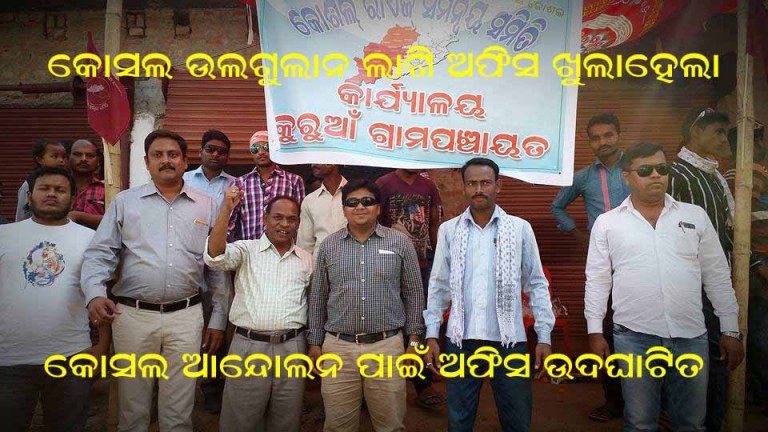
Office of the Koshal State Coordination Committee has been inaugurated at Kuruan Gram Panchayat. This office will regulate and coordinate the separate state movement at the Panchayat level in Kuruan gram panchayat of Attabira. Pramod Jhankar inaugurated the office in presence of Sunil Purohit, Lipsit Mishra, Deepak Dash, Amit Panda, Suramya Mishra, Rakhal Karna, Rajesh , Manas , Nirbhaya, Suresu atc and villagers of Kuruan and Koshal supporters.
Gap in success and target in check dam projects
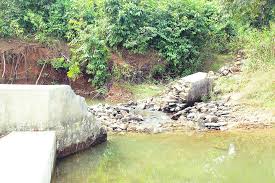
Check dam projects were initiated in 2010-11 to conserve water from small water sources and use them further for irrigation. Odisha government had target of construction of 15000 projects from 2010 to 2015 but 8090 projects were sanctioned and only 5926 could been completed. This information has been disclosed in the state assembly while presenting CAG report.
According to the report, within five years from 2010 to 2015, the state government had a target of construction of 15000 projects but the Chief Engineer of the Minor Irrigation Division Odisha sanctioned 1318.12 crore for 8090 projects, but the state government allotted 971.53 crore in the budget for the project. In 5 years out of the total sanctioned projects only 5926 could be completed till 2015 and 884.88 crore have been used.
In the year 2010-2011, total 1366 projects were sanctioned but only 417 have been completed.
Similarly, 2011-2012, total 3046 check dam projects were sanctioned but only 1133 check dam projects have been constructed completely.
In 2012-2013 construction of 3000 check dam projects was in target but 1181 projects were sanctioned and total 1848 check dam constructions was complete including old projects.
In the year 2013- 2014 out of the total 2380 sanctioned check dam projects only 913 have been completed.
In 2014 -2015 total 1619 check dam projects could been completed and including this in last 5 years total 5926 check dam projects have been completed out of the total sanctioned 8090 projects.
According to the CAG report many projects are pending incomplete due to dispute in site selection, not getting reply about the tender, less quotation price of the tender, unavailability of technical officer for inspection.
But when CAG inspected a few sites found that, the locals were not involved in selecting the site according to the rules and out of 4050 check dams project Pani Panchayat have not been instituted in 2825 check dams. Further, installation of door in the concrete gap is necessary to preserve the water but at the time of inspection of papers of 8 divisions out of 2825 check dams there were no shutter in 1409 check dams and the objectives of check dam construction has failed and investment of 166.21 crore was wasted. Despite of this, no action was taken against associated executive engineers.
GHUMRA DACE
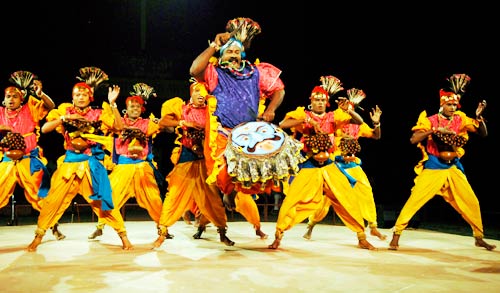
The contribution of Kalahandi to the art and culture of Odisha is immense, and the most significant is the Ghumra dance. The dance has been instrumental in giving Kalahandi a special identity of its own. Though it is considered as the folk dance, characteristics of classical form prevail in every aspect of the dance—such as in the singer, dancer and in the beats of Nissan player. Researchers have also proved that classical dance forms, which are cited in Natyashatra, are found in this dance.
This is a group dance. It was performed by specific tribes such as Paika or Bankapaika, but now-a-days it is open to all. Nissan, Jhanj, Muhri, Mardal are some of the musical instruments accompanied with the dance.
Many researchers and historians have tried to unfold the history of this dance form. It is said that, it was the heroic dance of Lankagarh and was the war-musical instrument of Ravana. Another story depicts that while Devi Durga was fighting with Mahishasur, the followers of the goddess were playing many musical instruments – of which Ghumra was a part. Another story explains that master craftsman Chandradhwaja was the father of Ghumra and he kept it at Kuberpuri after creating it.
However, apart from the mythology, archaeological facts also suggest that the history of this dance is old. In the past, it was performed at many Shaktipitha of Dakshin Kosal. This dance was found in the excavation of Nehenar. Also, in 1005 A. D, while Lankeswari deity was brought to Jenabalipatna (modern Junagarh near Bhawanipatna), Ghumra was played to welcome the deity. The stone carving of Ghumra in the Bhimashwara temple, one of the oldest temples in Bhubaneswar, proves that the history of Ghumra is ancient.
Ghumra plays an important role at the time of different cultural and religious festivals in Kalahandi and Kosal region. It is customary to perform Ghumra in the festivals of different deities like Lankeswari, Manikeswari, Dakeswari, Dukuri Devi, Raktambari, Khmbeswari, Budharaja etc.
The popularity of this dance is not limited to Western Odisha region only; Ghumra dancers have displayed their skills and have taken the fame of the dance to many countries.
BANABADI DANCE
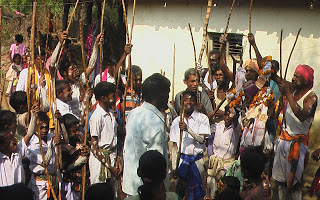
Banabadi is a traditional dance of Gour caste in Kalahandi district. It is performed with two players in a competitive manner and also played with a group of eight to ten. 32 sanghad or techniques are used in this dance form.
The sticks used by the dancers are made up of log of kendu (tendu) wood. First the upper crust of the stick is removed and polished then a kind of grass cord (laha /latta) is wind up in a crafty manner with a definite gap on the sticks. Then it is lightly burnt by the straw of rice and the cords unwind. The burnt part turns into black colour while the rest remains white, making a lovely design on the sticks. The sticks look as if tattooed with black and white. Tattoo is locally known as Bana so the dance is called Banabadi Dance. A dancer uses two such sticks while dancing.
Baensi, dhol, jhumka etc. are some instruments used by the dancers. The dancers make tattoo with rice pest (pithau) on their body.
This dance is seen after some days of Deepawali, during the festival of Kanha Bhairo, the presiding deity of Gour caste. Few lines which sung during this dance are:
“Kanha bhai lachmi ghena mo dayini
Jayama jadavakula maudamani
Jaye chandi samalai maa thakurani
Sankata tarini maa durgati nasini
Bipade aapade maago heu agrani
Jaya maa jadavakula maudamani”
This dance form resembles to a duel. The two dancers hold the sticks in their two hands and attack and defense themselves from their counterpart. And the song goes as follows:
“Dwapar jugare prabhu nandanandana
Gopa gopalanka sange mela hoina
Bajai range dhola tamaka bansuri
Shirare paga bandhi kendubadi dhari
Karuthile e tandaba dharma lekhani
Jaya maa jadavakula maudamani”
The history of the caste is related with the dance. There is startling citation of Banabadi in Haribansa Puran. Banabadi song provides information regarding the 16 types of Gour caste which is referred in Haribansa Puran:
“Bhojpuri, Goppuri, Shoal khandia
Magadha, Gokul, Lahoria, Jharia
Nanda, Dravida, Jachaka, Duta, Koria
Ahir, Abada, Asak, Kosalia
Ae shoal jadavakula maa patarani
Jaya maa jadavakula maudamani”
An instance of Banabadi is also cited in Birat Parba of Mahabharat. During the Agyantbasa period of Pandavas, Sahadev was the caretaker of the cattle of Virat king and while he was trying to dispose those cattle king Virat rescued with Banabadi. Apart from this, citations are also found in Chittabodha, Nrusingha Puran etc.
This dance form is found in almost all parts of Kalahandi, whereas the affluent areas are Koksara, Junagarh, Dharmagarh, Madanpur Rampur, Bhawanipatna and Jaipatna.
KARMA DANCE
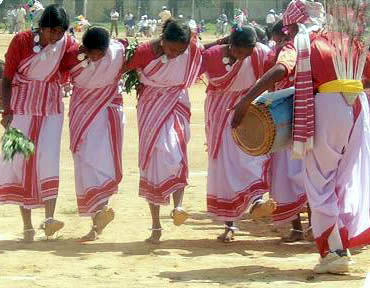
Karma is a group dance. Generally this dance is celebrated for three days from the tenth day of the bright moon of the month of Bhadra to twelevth day. A small branch of Rengal or Halan tree is used as the Karma dal. Karma dal is brought to the puja pandal or karma gudi performing a special puja by the dehri accompanied with the beats of karma mandal and kubja. Then the karma daal is customarily planted and then follow the worship of karamsani and rituals. Karam or Karma literally means ‘fate’.
This pastoral dance is performed during the worship of the God or Goddess of fate (Karam Devta or Karamsani Devi), whom the people consider the cause of good and bad fortune. People with badiyan (personal wishes) came to urge their problems to karamsani and on behalf of karamsani, the dehri suggests them the solution at times. The dehri is believed as karamsani – the deity who bestows children and good crops-in person on that day.
The puja rituals are followed by the stories of karamsani. There are many stories of karamsani like the Dharam Karam brothers, Wealthy Saudagar, The Old Sadhab etc. And the completion of the story is followed by the dance.
The Karama dance continues till dawn. Group after group perform alternately throughout the night. The technique of the dance varies slightly from tribe to tribe. Tribes such as Kharias, Kisans and Oraons dance in a circular pattern, where men and women dance together. It is always headed by a leader and generally a male person leads the line. Only the best of dancers join next to or near him. Young girls and children join in at the tail-end to learn the steps.
When the dance becomes more vigorous, the dancers of the tail-end withdraw to let the true dancers show their skill. The dancers hold hands in different ways in different dances. Sometimes they simply hold hands and sometimes hands are placed on the neighbor’s waist band or are crossed.
It is the legs and the feets which play the principal role in the dance. The dance begins lightly with simple steps – forward and backward, left and right – then gradually the steps grow smaller and faster, enthusiasm accelerates until the dance reaches its height. Then it again returns the first steps as the music leads to give the dancers some rest. The dancers have no special costume for the occasion. They dance with their usual attires which they wear in their life.
In the morning the dehri carries the karma daal and visits each house of the village singing and dancing. Further the karma daal is ceremonially immersed in the village pond or river.
This dance is popular among tribes such as Binjhal, Kharia, Kisan and Kol.
Bismilla Khan youth award for election campaign
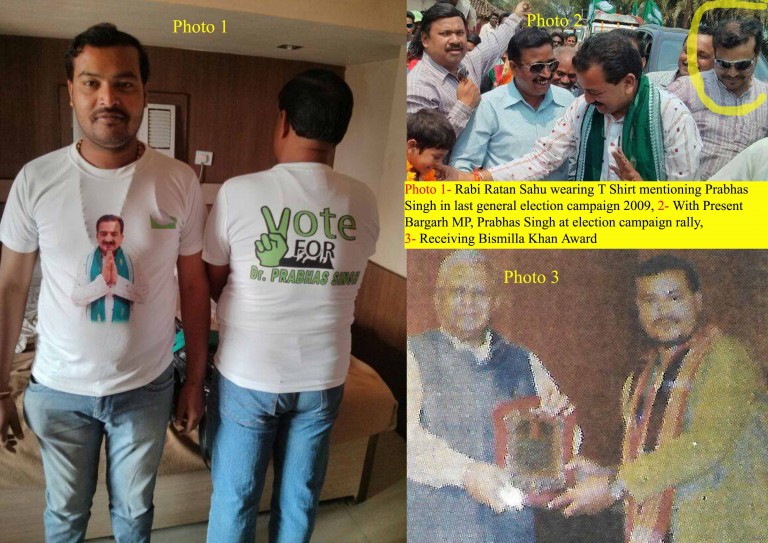
Seven young artists from Odisha have been awarded with Bismilla Khan National Youth Award for the year 2013-14 by Kendra Sangit Natak Academy. Rabi Ratan Sahu 35 from Bargarh district, Gaisilat block Buromunda village is one among them. Rabi Ratan has been awarded for his contribution to Sambalpuri folk dance but we investigated about the Folk Academy at Buromunda for which he has received the award but our team could not find any Sambalpuri Folk Academy at Buromunda.
Further investigation revealed that after he was unsuccessful in his +2 examination he did DMLT course and started working at pathology. Later on moved to Bhubaneswar and came in contact with Prabhas Singh present Bargarh MP who was working as the state museum as curator. Rabi started working as a cultural broker for cultural troupe and people of western Odisha.
He was actively involved in the election propagation campaign of Prabhs Singh in 2014 which is proved from the photo posted. Now this photo speaks volume about how Rabi has been appeased with National Youth Award by Bargarh MP Prabhas Singh after acquiring power. Sri Singh has misused his power and position and helped his worker to get the award. And this is how many true artists from the region have been denied recognition and benefits.
BPUT and affiliated colleges running short of staff
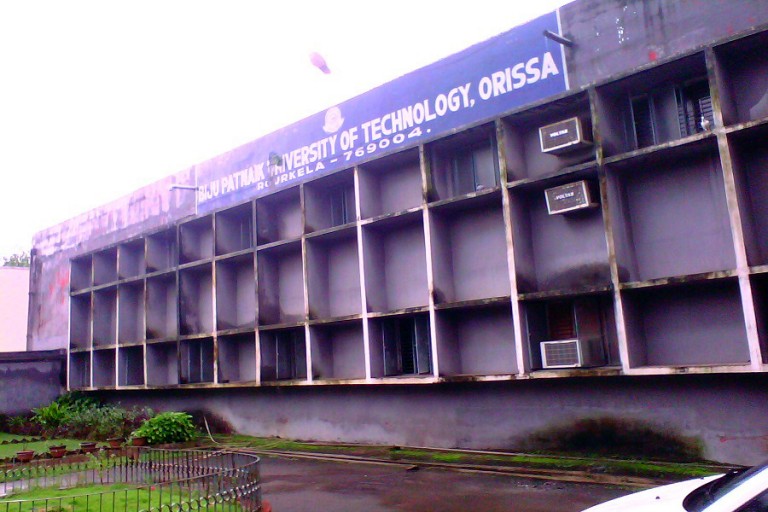
A large number of sanctioned teaching and non-teaching posts are lying vacant in the Biju Patnaik University of Technology (BPUT). Twenty three out of 25 number of sanctioned teaching posts lying vacant in BPUT. Similarly, more than 200 teacher posts are lying vacant in different colleges affiliated to the university.
The Minister informed that BPUT has five Professor posts, 15 Reader posts and five lecturer posts, out of them only two lecturers are on the job and the rest 23 posts are lying vacant. Out of the 10 administrative posts, the Deputy Registrar Post and the Information Officer post are lying vacant. Similarly, 26 of 57 Class III and IV posts are lying vacant in the university.
The status of vacancy in affiliated colleges of the BPUT is also high. Seventeen Professor, 48 Associate Professor and 26 Assistant Professor posts are lying vacant in CET, Bhubaneswar. In the PMEC, Berhampur, 10 Professor, 17 Associate Professor and 36 Assistant Professor posts are lying vacant. Likewise 6 Professor, 10 Associate Professor, and 26 Assistant Professor posts are lying vacant in Government College of Engineering, Keonjhar.
While five posts in each category are lying unfilled in the IMIT Cuttack, 7 Professor, 12 Associate Professor and 13 Assistant Professor posts are lying vacant in the Kalahandi Government Engineering College.
While there are 50 sanctioned Professor posts in these five Government colleges, the CET has only five Professors working now, and all professor posts are lying vacant in the rest four colleges.
Similarly, large numbers of sanctioned non-teaching staff posts are lying vacant in these colleges. According to information released by Dasburma, out of 96 sanctioned non-teaching staffs 31 posts are lying vacant in CET Bhubaneswar. Similarly, 8 out of 13 sanctioned posts in PMEC Berhampur, 10 out of 13 sanctioned posts in GEC Kalahandi, 17 out of 29 in GCE Keonjhar and 10 out of 24 in IMIT Cuttack are lying vacant.
Examining Irrigation in Odisha
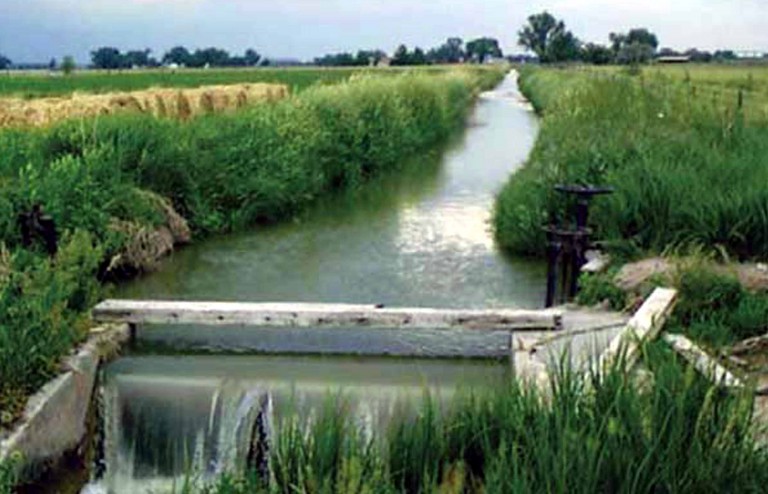
We have an agrarian economy. Supporting agriculture and making it sustainable is indispensable. To encourage agriculture, availing facilities of irrigation and market for agri-product are vital. But contrary to it the government has failed to provide necessary amenities and ignored the farming community. To explore more about the situation we investigated irrigation facilities at block level of Bargarh district.
Bargarh district is known as the rice bowl of Odisha as it is the largest paddy producing district of Odisha. The district also cultivates pulses, oilseeds, and vegetable. Bargarh comprises two types of land, irrigated and non-irrigated. While blocks of Bargarh, Attabira, Bheden and parts of Barpali are irrigated under Hirakud Dam project, the remaining blocks comprising Bhatli, Bijepur, Sohela, Ambabhona, Padampur, Paikmal, Gaiselet and Jharbandh are rain-fed. We investigated Gaisilat block of Bargarh district as a sample.
Gaisilat block comprises 102 villages under 19 Panchayats. Out of the total 35260 Hectares of the geographical area 23710 Hectares are cultivated. Gaisilet is not benefitted by any major irrigation project. Solely it depends on the gambling monsoon for Kharip crop. Most of the lands are dry types. Hardly any cultivation found in Ravi crop. Lands are fertile but irrigation facilities are not available. The State Government has initiated many projects for irrigations but those are unsuccessful and useless. Funds have been allocated from WODC for check-dam projects in Maedhanumunda, Babebahal, Natapur, Sansahajbahal, Kandagarh villages but due to low quality work these check-dams have become dysfunctional. A few check-dams at BadDunguripali, Dangbahal, Jammal, and Gaisilet are affected by flood hits in 2002 and yet not repaired.
There is a continuous and long pending demand to connect Malken Nala and Darpan Jor. This project may help in shedding a huge area of land. The proposed Mega lift irrigation project on river Ong at Jamutpali, will irrigate lands of Jamutpali, kendubhata, Halankanasi, etc. Apart from this there are more than 500 ponds and water reservoirs which need excavation to increase the storage capacity. There are 42 watershed projects going on in the block but hardly any in use.
We investigated further that this situation in the area is due to corruption mentality of the officers and local politicians. As there is no other resources to earn a livelihood and no major business in the area, after the harvesting of Kharip season folks from this region migrate to different parts of India like Tamil Nadu and Chattisgarh for their bread and butter.
Lecturers shortage in Odisha
Recently the Higher Education Minister spoke in a function that from the coming education year there will not be shortage of lecturers in universities and colleges of the state. But investigating the facts we can conclude the speech of the minister. He said, in junior colleges employment of 272 lecturer posts are going on. A few have already joined, and some are going to join soon. For Degree Colleges total 354 posts have been finalized. But as the matter is in the court so there is delay in posting. Proposals have been given to create new post for new universities including GM University. After acceptance of the proposal new employment will be given and the problem of vacant lecture issue will be sorted out, said the minister.
But the question arises how all the vacant post in government degree colleges will be filled if 354 lecturers will be employed. There are 46 government degree colleges including the universities in the state. Till lecturers are not posted in the new universities, degree college lecturers will be employed there in an arrangement basis. In all these colleges half of the posts are lying vacant. Let examine the situation of some colleges of western Odisha.
In GM University got approval of 119 lecturers post. Including all posts at present the strength of GM University is 61 and still 58 posts are lying vacant. There is no professor in the university and the status of research can be assessed. Rajendra Autonomus College Balangir has been approved 63 posts and now the strength of lectures is 27 and 36 posts are lying vacant. Bhawanipatna Autonomous College has been approved 59 but at present the strength of lectures is 23 and 36 posts is lying vacant. Similarly, Panchayat College Bargarh has been approved 60 posts but 29 are employed and 31 lying vacant. Earlier numbers of approved posts of all these colleges were more comparatively now. In these 4 major institutions of western Odisha total posts lying vacant are 161. Now, after a few months again a few posts will get vacant due to retirement of some lecturers. So the number of vacant posts is increasing. Now in this situation how the vacated posts will be fulfilled with 354 lecturers in 46 colleges.
The situations of junior colleges are a bit better than degree colleges. Though lecturers post lying vacant in junior colleges of the state is comparatively less than the degree college. Approved post in GM Junior College is 44 and strength is 39. Rajendra College Balangir has got approval of 29 posts and present strength is 23. 5 Posts are lying vacant out of 25 approved posts at Bhawanipatana College. Similarly, 8 posts are lying vacant at Panchayat College Bargarh out of 26 approved posts.
Sambalpur set to face water crisis in summer
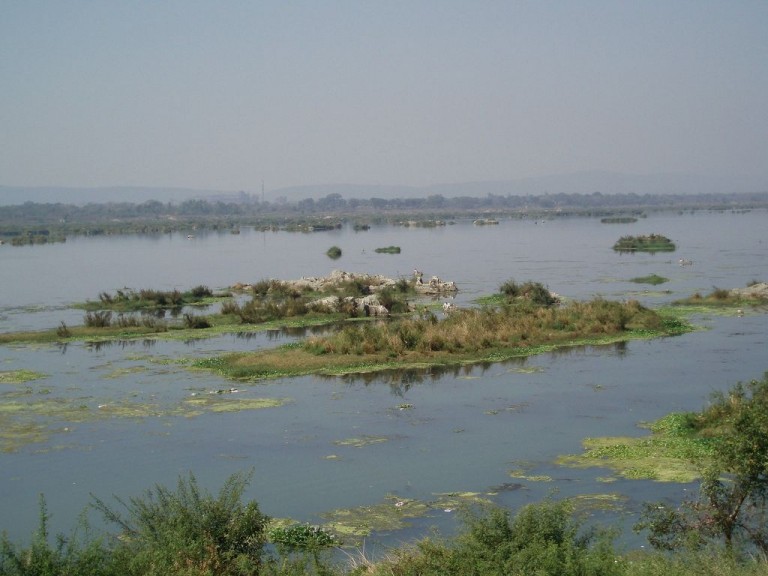
Sambalpur in problem for rising temperature. It may continue for a period creating water crisis for the city. Sambalpur needs 29 million liters per day and the requirement meted out from different sources. Water supply projects are incomplete. A few projects are pending due to tender. The development work of 11 million liters capacity water treatment plant at Mudipara is in halfway. The filter attached in the treatment plant is of 1957. Earlier water of Balibandha from Mahanadi used to filter here. This plant supply water to Sambalpur. But when Sambalpur was affected due to jaundice question rose about its cleanness at the jaundice review meeting. It was complained that the capacity of the plant has also decreased to 4-5 million liters. Decision was taken for the revival and modernization of the plant. According to the plan, instead of lifting water from Balibandha, it was connected from Bareipali check point to Mudipada. The pipeline work is in final stage and at the time of jaundice new pipes were connected at 11 colonies. Though the health department had initiated a move in December to make all illegal connections to legal still it is a matter of concern. 2681 connections were made legal. But still thousands connections are illegally connected. Though there is sufficient supply of water but due to these illegal connections Motijharan, Durgapali, Ambiranagar, Bhutapada, Sunapali, Bhatra, Kuluthkani, and more colonies are not getting sufficient water. A.N Guha lane getting water once a day though PHD water supply is there but it is not helpful as the connections lines are at high. Apart from this the water reservoirs and ponds of the city needs excavation.