Tuesday, May 19, 2026
Home Blog Page 31

Death: A Necessary End Will Come When It Will Come: Dr Saheb Sahu (9)

0

Chapter – 9 

THE MOMENT OF DEATH 

He took one immensely long,

Gurgling breath, and died.

                                                         – Sherwin Nuland Becomes a Doctor.1953.

The physiological changes that occur at the time of death are usually straightforward to the doctors: the heart stops pumping blood and cells of the body no longer receive oxygen or nutrients, so they begin to die. What worries most people is not as much the moment the heart stops as the prospect of knowing when their own death is imminent. “It is not the moment that matters, but the moment before the moment,” says Dr. Nuland.

Physically, that fleeting moment is characterized by the appearance of physical struggle, although the dying person is not aware of the struggle. Without oxygen, cells die and organs die. The body’s ultimate response to the lack of oxygen is visible in what is called the “agonal moment,” immediately before the clinical death, (heart stoppage) occurs. The declining oxygen content in the blood may cause muscle spasm. Normal breathing may be replaced by gasps. A brief convulsion may wrack the body. Then it’s over. Some people go from relatively delirium state to sleepy to lethargic to obtunded to semi comatose to comatose and then death.

By the time the agonal moment arrives, even a person who has anticipating death for months is not likely to be aware of the quick struggle. Whether a person is at this moment aware of anything is unknown. The cause of death corresponds to the consciousness of death. Some people who die suddenly in accidents no doubt have no idea that their last conscious moment is their last. Those who experience a more prolonged death may indeed be aware of the moment is upon them.

Near Death Experience 

A near-death experience (NDE) refers to personal experiences associated with impending death, encompassing multiple possible sensations including detachment from the body, feeling of total serenity, security, warmth, the experience of absolute dissolution, and presence of light. These phenomena are usually reported after an individual has been pronounced clinically dead or has been close to death. With the recent improvement in cardiac resuscitation (CPR) techniques, the number of reported NDE has increased.

Characteristics of NDE

The traits of a classic NDE are as follows:

  • A sense of being dead.
  • A sense of peace, well-being and painlessness. Positive emotions. A sense of removal from the world.
  • An out-of-body experience. A perception of one’s body from an outside position. Sometimes observing doctors and nurses performing resuscitation.
  • A “funnel experience.” A sense of moving up, or through, a passage way or tunnel or staircase.
  • A rapid movement toward and or sudden immersion in a powerful light.
  • An intense feeling of un-conditional love.
  • Receiving knowledge about one’s life and the nature of the universe.
  • A sense of going across a bridge where the dead relatives are calling.

Harvesting of Organs for Transplant

As soon after the moment of death as possible, any organs (cornea, heart, lungs, kidneys etc.) destined for transplantation must be removed. The removal of organs for transplant is like routine surgical operation, known as “harvesting”. The removal implies all the abundance and nourishment of a literal harvest, for it offers the recipient life.

Surgeons carry out the procedure in a sterile operating room in which the donor is hooked to life-support machines to keep the heart beating. Because of the life-support system, the organs continue to receive oxygen through the blood. The sequence of the operation depends on the number of organs the deceased is donating. When multiple organs are being removed successive teams of surgeons from appropriate specialty, move in and harvest the organs separately.

At times, the recipient of the organ waits, prepped for surgery, in a nearby operating room. More often however, the organ must be packed up and transported as quickly as possible to the recipient hospital. The need for speedy transport means that most donated organs go to waiting recipients who live nearby. How long an organ remains viable for transplant depends on the organ.

A heart-lung combination must reach the recipient in four to five hours, while in kidney transplants the interval may extend as long as 48 to 72 hours. A heart alone may be transplanted six to eight hours later and lungs alone up to 12 hours later.

Tissue donation is equally important but less urgent process. A tissue may be removed after the physicians turn off the life-support system and kept for much longer before being transplanted. These include corneas, bones, skin, veins and heart valves.

Death, Disposal and Contagion 

Any tissues of the dead that will not be transplanted from a corpse into a living recipient must be disposed of in some manner. Such disposal and the manner in which it is carried out depend on cultural tradition. Although many cultures and religions view dead bodies as unclean, today’s dead posing no threat to the health of the living except in highly unusual circumstances like Ebola.

Although investigations have shown that some germs do survive in the body for sometimes after death, the chances that a person who has normal contact with the dead might be infected is extremely low. Corpses of those had been infected with deadly viruses like – Ebola, and HIV, pose no particular risk if handled with adequate protection – gloves, masks, and rigorous cleaning.

The Sequel to Death

Depending on the manner of its disposal and, if applicable, on how much time elapses between death and cremation or embalming, a dead body undergoes a number of distinct changes. Those that take place soon after birth are readily detectable by sight or with simple instruments. The dust-to-dust process that we call decomposition are initially invisible to the naked eye, but soon become very evident indeed. The first three signs that life has fled (beyond cessation of heart beat and breathing) are changes in body temperature, color and rigidity.

Algor Mortis (Temperature of Death)

Body temperature drops in a phenomenon called algor mortis or temperature of death. How quickly the body cools depends on how warm the living body was at death. Body temperature drops about one degree (Farenheight or 5/9C) per hour until it reaches that of the air surrounding it. For example, if a person died with a normal body temperature of 98.6F, the dead body would have a temperature of 96.6F two hours later. In case of abnormal circumstances – like drowning death in freezing water, or high fever before death, the medical examiner cannot accurately determine the exact time of death as the cadavor’s temperature is variable.

Liver Mortis (Color of Death)

Blood has two major components – red blood cells and plasma. When the heart stops, the mixing up of the red blood cells and plasma stops. As a result the red blood cells settle to the lowest part of the body, such as the back if the corpse is lying on its back. The process is called liver mortis or color of death. The rest of the skin grows correspondingly pale as the red blood cells sink. After about two hours, the settling becomes visible; the skin becomes reddish where the red cells are concentrated. Eight hours after death, the red cells break down and the color becomes permanent. The resulting reddish-purpose discoloration is known by morticians as postmortem stain.

Rigor Mortis (Rigidity of Death)

The word rigor mortis means the rigidity of death. Immediately after death, the body relaxes completely. The face loses expression as muscle stop controlling the skin, which then sags. In normal circumstances, rigor (stiffness) begins to set in about two hours after death, sooner in a cold environment. Rigor mortis occurs first in the face, then moves to the trunk, limbs and internal organs. The stiffness peaks after twelve hours before the body gradually become limp again as rigor fades, then vanishes entirely within 24 to 48 hours, depending on temperature and other variables. The cause of rigor mortis is uncertain. It may be the result of the coagulation of muscle protein or metabolic processes that continuous in some cells after death.

Decomposition 

At cellular level, autolysis (cell self-destruction) breaks the body down, if the body is not treated by chemicals of embalming. Embalming is the preservation of the corpse from decay by using spices and chemicals. The cells receive no nutrients after the heart stops beating and begin to die. They die in increment. Packs of destructive acids break loose within the cell and finish it off.

The first visible sign of rotting (putrefaction) appears two or three days after death. The gas produced by the intestinal bacteria, which contains sulphur, accounts for the rotten smell. The gas also gives a bloated appearance to the body. Most internal organs rupture and eventually liquefy within two to four weeks (depending on the environment). What essentially remains of a dead body is a skeleton with skin. In high altitude of cold and dry environment the dead body can be preserved for several hundred years.

Autopsy 

Autopsy or postmortem, is the dissection of the dead body to find the cause and  manner of death. Whether performed shortly after death or after decomposition has progressed-the autopsy is the most important tool for determining when, why and how a person died. It can also yield information that can save other lives. Observations made during autopsy have in some cases have saved thousands of lives or helped to characterize a new disease. Doctors and medical examiners learn a lot from autopsy.

The first systemic dissections of the human body to determine the cause of death began in University of Bologna, Italy, around the beginning of the 14th century. Since then it has been a teaching tool for the medical students and doctors. Even though many family members are unwilling to give consent for an autopsy, in many instances, autopsy can provide a measure of comfort to families by providing them the exact cause of the death of their loved one. Many times the diagnosis written on the death certificate immediately after death is not necessarily correct. Many times people die in mysterious circumstances without being outwardly being sick. There can also be discrepancies between the medical findings before death and autopsy findings. Hence, an autopsy is essential when the nature and modality of the death is uncertain.

These days pathologists doing the autopsy are quite sensitive to cosmetic issue. They do their best to preserve the outer appearance of the dead bodies. A limited autopsy excludes the head but includes the rest of the body. In a selective autopsy, the pathologist examines only the relevant areas. Medico legal autopsies are mandatory when death occurs under unexplained, suspicious or criminal circumstances. 

Conclusion

There is a passage in the Buddhist sutra on mindfulness called the Nine Cemetery Contemplations. Apprentice monks are instructed to meditate on a series of decomposing bodies in the burial ground, starting with a body “swollen and blue and festering,” progressing to one being eaten by …. Different kinds of worms, and moving on to the skeleton. The monks are told to keep meditating until they were calm and a smile appeared on their faces. The idea is to come to peace with the transient nature of our bodily existence, to overcome the revulsion and fear.

You are dust, and to dust you shall return.

– Book of Genesis, (Bible) 800 B.C


Death: A Necessary End Will Come When It Will Come:Dr Saheb Sahu (8)

0

Chapter – 8 

SUICIDE 

To be, or not to be; that is the question:

Whether ‘It is nobler in the mind to suffer.

The slings and arrows of outrageous fortune,

Or to take arms against a sea of trouble

And, by opposing, end them. To die, to sleep-

No more, and by a sleep to say we end.

The heartache and the thousand natural shocks.

That flesh is heir to – tis a consummation

Devoutedly to be wished. To die, to sleep.

                                                                                                  -William Shakespeare. “Hemlet”

There is only one serious philosophical of problem, and that is suicide

                                                                                                   -Albert Camus, French novelist

The thought of suicide us a great consolation: by means of it one gets successfully through many bad nights.

                                                                                                                  – Friedrich Nietzche

Suicide (Latin – suicidium, from Sui Cadere, “to kill oneself) is the act of causing one’s own death. Suicide is often committed out of despair, the cause of which is frequently attributed to a mental disorder, alcoholism, or drug abuse, health and relationship problems, and financial difficulties. Common methods include: hanging, pesticide poisoning and firearms. It is estimated that 10 to 20 million people worldwide attempt suicide every year. Around 1 million of them succeed.

Attempted suicide is self-injury with a desire to end one’s life that does not result in death. Assisted suicide is when one individual helps another bring about their own death indirectly via providing the means to the end. This is in contrast to euthanasia, where another person takes a more active role in bringing about a person’s death.

Risk Factors For Suicide

Factors that affect the risk of suicide include psychiatric disorders, drug misuse, psychological states, cultural, family and social situations, and genetics. Mental illness and drug abuse frequently co-exist. Other risk factors include having previous attempted suicide, the ready availability of a means to commit the act (example – pesticides, firearms), a family history of suicide, or the presence of traumatic brain injury. For example, suicide rates have been found to be greater in households with firearms than those without them. Social-economic factors such as unemployment, poverty, and discrimination may trigger suicidal thoughts. Genetics appears to account for between 38% and 50% of suicidal behaviors. Only 15-40% of people leave suicide note.

Rational Suicide 

Rational suicide is the reasoned taking of one’s own life, although some feel that suicide is never rational. The act of taking one’s life for the benefit of others is known as altruistic suicide. An example of this is an elder ending his or her life to leave greater amount of food for the younger people in the community. Suicide in some Eskimo cultures has been seen as an act of respect, courage or wisdom.

Some commit suicide as an act of political protest against injustice. Some suicide bombers are motivated by a desire to obtain martyrdoms (Kamikaze missions). Mass suicides are often performed under social pressure where members give up autonomy to a leader. In extenuating situations where continuing to live would be intolerable, some people use suicide as a means of escape. Some inmates of Nazi concentration camps are known to have killed themselves by deliberately touching the electric fences.

Methods 

The leading method of suicide varies between countries. The leading methods in different regions include hanging, pesticide poisoning, and firearms. These differences are believed to be in part due to availability of different methods. Hanging is the most common method in most countries, accounting for 53% of the male suicides and 39% of the female suicides. Worldwide 30% of suicide are from ingestion of pesticide. Males die three to four times more often by means of suicide than do females, although females attempt suicide four times more often.

Prevention 

Reducing access to certain methods such as firearms or toxins and pesticides reduces risk. Treatment of drug and alcohol addiction, depression, and those who have attempted suicide in the past may also be effective. In young adults who have recently thought about suicide, cognitive behavior therapy (a form of psychotherapy) appears to improve outcomes. Poverty reduction measures may be able to decrease suicide rates. Although suicide prevention crisis hot lines are common, there is little scientific evidence to support or refute their effectiveness.

Religious and Philosophical Thoughts on Suicide

Suicide has been a focus of religious and philosophical thoughts both in the East and in the West, since the sixth century B.C.

Hinduism 

Hinduism accepts a man’s right to end one’s life, through non-violent practice of fasting to death. Gandhi used this tactic against the British effectively during India’s struggle for independence. According to scholar Benjamin Walker, the author of Hindu World, “Suicide was once very commonly practiced in India by all classes of people. Those who took their lives were not regarded as having committed sin, but on the contrary as having performed a meritorious  act, and the record of their deed was often preserved in stone or metal…. Suicide by starvation was regarded as particularly meritorious by both Hindus and Jains.

Another method of suicide entailed going on endless pilgrimage, being constantly on the road, from one holy place to another, till one died of starvation and exhaustion. The reasons quoted in the ancient texts for committing suicide were many: old age, disease, incapacity and were oppressed with the purposelessness of living.”

Jainism 

Jainism is one of the most ancient of Indian religions. Mahavira (467BCE) is regarded as its historical founder. The Jains are strict believers of non-violence. The Jain must never kill or sacrifice or harm any life even an insect. The only life he may take his own. Jainism approves of suicide, especially by slow starvation towards the end of life; a jain will often transfer his worldly responsibilities and wealth to his children and starves himself to death. Even today, some Jains, in India, die this way. The practice of non-violent fasting to death by Jains is termed Santhava.

Buddhism 

A central tenet of Buddhism is captured in the word mujo meaning impermanence. Life is impermanence. Life is impermanence and full of suffering (dukha). According to mujo, cherry blossoms will fade, summer days will pass, golden autumn leaves will fall and blanket of snow will melt with morning sun light. So, too, will life fade to death. For Buddhists, since the first precept is to refrain from destruction of life (like the Jains), including one’s self, suicide is seen as a negative act. However, unlike Christianity, Buddhism does not condemn suicide. Buddhist traditions help to explain the acceptance of suicide in Japan. Under certain conditions Japanese people even glorify the act of suicide like; hara-kiri, Kamikaze acts. The Buddhists like the Hindus, also believe in reincarnation. The prospect of worldly life after death may make it easier for the Hindus and the Buddhists to treat death as just another phase of existence.

Ancient Greeks and Romans 

In the Greek world each philosophical school had its own positive on suicide. Pythagoreans opposed it, but the Epicureans and the stoics welcome it. Greek history is studded with famous suicides, both historical and semi-legendary. The reasons behind these suicides varied: Isocrates and Demothenes out of remorse, Democritus and Speusippus in order to avoid the decrepitude of old age and Sappho for love. Zeno, Diogenes and Epicurus committed philosophical suicide to show their scorn for life. Epicureans teach that one should commit suicide without fuss when life becomes intolerable.

Plato and Aristotle, the two giants of Greek Philosophy and thought, disagreed on suicide. Plato was generally against it except three exceptions: (1) condemnation by the state, (2) painful and incurable illness and (3) miseries of fate, which might cover a broad range of situations from poverty to shame. His student Aristotle, considered suicide counters to virtue and an act of cowardice in face of responsibilities. His work exerted tremendous influence on medieval philosophy through St. Aquinas and Averrois.

There was no legal or religious prohibition of suicide for free men in Rome. For obvious economic reasons suicide was forbidden among slaves and soldiers. Roman history offers many examples of famous suicides including Cicero, and Cato. Seneca justified suicide in the old age. Stoic emperor Marcus Aurelius (121-180 A.D) recommended suicide if one is unable to lead the life he desires (Minois).

Judaism 

The Old Testament offers a strictly neutral report of several voluntary deaths. After King Saul had lost a battle with the Philistines, he asked his armor-bearer to kill him and he refused. So “Saul took his own sword, and fell upon it.” (1-Sam 31.4). In A. D. 73, after a prolonged resistance to roman attack, 960-strong Jewish community at Masada collectively committed suicide. Among the Ten Commandments of Mosaic law obviously prohibits killing (Thou shalt not kill). However, it does not specify whether that prohibition applies also to taking one’s own life. Suicide is sometimes acceptable in Jewish law. Most authorities hold that it is not permissible to hasten death to avoid pain if one is dying, but the Talmnd is somewhat unclear on the matter. Thus the later Christian condemnation of suicide did not come from the Old Testament.

Christianity 

In the New Testament, there is no direct discussion of suicide. Was Jesus’s death a suicide? John quotes Jesus as saying “I lay my life for the sheep.” No one takes it from me, but I lay it down myself” (John 10:15 and 10:18). Jesus knew what waited him when he entered Jerusalem. The first generation of Christians willingly gave themselves over to martyrdoms (suffering death for faith). The example of Christ was followed by many willing martyrs, to the point that the church became concerned.

St. Augustine (354-430 A.D), the greatest of the Latin Church Fathers, in his monumental work “The City of God” considered suicide a sin and argued against it. The Roman Catholic Church adopted St. Augustine’s views and made suicide a sin, and prohibited it. Moralists and poets threw the weight of their talents onto the balance. Dante in Canto 13 of Inferno reserved a special place for suicide in the seventh circle of hell. Canon law, (12th Century) refused Christian burial to the excommunicated, to heretics, and to those who committed suicide. Civil laws added its vigor to those of Canon laws (religious laws). In many countries in Europe the properties of the persons who committed suicide were also confiscated by the Church/or the State.

Eastern orthodoxy, on the other hand, has never made any absolute statement about people who commit suicide. Orthodox Christians leave the fate of suicide victims up to God and avoid making judgments (Minois).

Islam 

Muslim teachings on suicide closely parallels Jewish and Roman Catholic thoughts. Islam views suicide as one of the greatest sins. A verse in Quran states; “And do not kill yourselves, surely God is most Merciful to you: – Quran, Sura 4 (An-Nisa), ayat29 Most Muslim scholars and clerics consider suicide forbidden, including suicide bombing.

Evolution of Attitude Toward Suicide

Around 15th century, the attitude towards suicide began to change. John Donne, an English poet, preacher and the Chaplain to the King of England wrote “Biathanatos” in 1610. In it he presented Biblical examples of Jesus, Samson and Saul and argued that suicide might not be a grave sin. During the enlightenment traditional religious attitudes toward suicide were questioned. David Hume denied that suicide was a crime. In his 17701 Essays on Suicide and Immortality of the Soul he rhetorically asked, “Why should I prolong a miserable existence, because of some frivolous advantage which the public may receive from me?” The Time of London, in 1786 initiated a spirited debate on the motion. Is suicide an act of courage?”

In Europe, by 19th century, the act of suicide had shifted from being viewed as caused by sin to being caused by insanity. By 1879, English law began to distinguish between suicide and homicide although suicide still resulted in forfeiture of estate. By mid 20th century, suicide had become legal in much of the western world.

In most Western countries, suicide is no longer a crime. Most of Muslim majority nations label it a criminal offense.

Euthanasia 

Euthanasia (from Greek – eu “weu” or good, thantos – ‘death’) or good death, refers to the practice of intentionally ending life in order to relieve pain and suffering. The word “euthanasia” was first used in a medical context by Francis Bacon in the 17th century, to refer to an easy, painless, happy death.

Euthanasia can be divided into passive and active. Passive euthanasia entails the withholding of common treatments, such as antibiotics or respirator (breathing mechanism necessary for the continuance of life). Active euthanasia entails the use of lethal substance (poison) to kill the person.

History of Euthanasia

Euthanasia was practiced in Ancient Greece and Rome. Hamlock, a poison was employed by the Greeks as a means of hastening death. Socrates died from drinking hemlock. Euthanasia was supported by Socrates, Plato and Seneca the elder (Roman) in the ancient world. Hippocrates, the Greek physician appears to have spoken against the practice, writing – “I will not prescribe a deadly drug to please someone, nor give advice that may cause death.” This has been incorporated as a part of “Hippocratic oath” modern physicians take upon graduation from medical school.

Euthanasia was strongly opposed in the Judeo – Christian tradition. Thomas Aquinas and many other Christian theologians and philosophers opposed it. However English theologian and clergy John Donne, wrote in favor of it. In the mid-1800, the use of morphine to treat “the pain of death” was recommended by John Warren (1848). The Voluntary Euthanasia Legalization Society was founded in Great Britain in 1935 and in 1938 in America. In United States Robert Ingersoll argued for euthanasia, stating in 1894 that where someone is suffering from a terminal illness, such as terminal cancer, they should have a right to end their pain through suicide.

Eugenics 

Eugenics (from Greek eu, meaning “good/well”, and – genes, meaning born) is the belief and practice of improving the genetic quality of human population. It is a social philosophy advocating the improvement of human genetic traits through the promotion of higher reproduction of people with desired traits, and reduced reproduction of people with less desired traits.

Francis Galton (1822-1911), English scientist, cousin of Charles Darwin, believed that desirable traits were hereditary based on biographical studies. In 1883, one year after Darwin’s death, Galton gave his research a name: “eugenics”.

Throughout its recent history, eugenics has remained a controversial concept. As a social movement, eugenic reached its greatest popularity in the early decades of 20th century. Many Western countries enacted various eugenic policies and programs. Some of the methods involved identifying individuals and families including poor, mentally ill, mentally retarded, homosexual and racial groups.

Compulsory sterilization, forced abortion, euthanasia and genocide (by Nazis) were carried out to eliminate these individuals and groups. Eugenics became an academic discipline at many colleges and universities. At its peak of popularity, eugenics was supported by a variety of prominent people, including Winston Churchill, George Bernard Sahw, John Maynard Keynes, Margaret Sanger, Theodore Roosevelt, and Nobel laureate American scientist Linus Pauling. It’s most infamous proponent and practitioner was, however Adolf Hitler and his Nazis. They killed more than 3 million so called “undesirable people,” including Jews to make their Aryan race purer.

Modern Euthanasia Movement 

Killing of large number of innocent and disable children and undesirable adults by the Nazis, in the name of mercy killing, gave euthanasia a bad odor from which it has not yet recovered. Advances in medicine and changes in society during the 1950s and 1960s made people think once more about euthanasia.

Elisabeth Kubler Ross’s book “On Death Dying” 1969, became a best seller (in America), and host of similar books and articles followed. In 1980, journalist, Derek Humphrey, founded the Hemlock society. The Hemlock Society’s purpose was to help people attain peaceful death by – “providing a climate of public opinion which is tolerant of the right of people who are terminally ill to end their lives in a planned manner.” There is now, a strong movement for euthanasia and physician – assisted suicide. Philosophers, ethicists, medical and legal experts and some politicians are paying attention to these issues.

Some governments around the world have legalized voluntary euthanasia. In the Netherlands, Belgium, Luxenburg and four states in America (Oregon, Washington State, Montana and Vermont) physician – assisted suicide is already legal. In 2009 study in the United Kingdom showed a 64% support for assisted dying in cases where a patient has an incurable and painful disease.

Now, there are multiple organizations around the world that educate people on assisted suicide. Some of them are: Compassion and Choice, Death With Dignity National Center, Dignitas, Euthanasia Research and Guidance Organization (ERGO), Final Exit Network, World Federation of Right to Die Societies and many more.

Physician – Assisted Death

Physician – assisted death is a controversial topic all over the world. Assisted suicide may be a new question for lawyers, ethicists and policy-makers but for doctors it goes back to antiquity. The Hippocratic Oath, taken by all doctors during their graduation ceremony, specifically forbids doctors to give patient fatal dose of medicine, even if requested. When Hadrin, a Roman emperor, asked his doctor to help him commit suicide, the doctor in distress, killed himself. However, later on, in the first century, it became more acceptable for doctors to help patients to end their lives. That tradition till continues all over the world. Doctors have always knowingly given patients overdose of medicine like morphine to alleviate pain and in the process patients have died. Studies show that physicians assist terminally ill to die, everyday and in every country, even though it is illegal to do so in most countries.

Pros and Cons 

Advocates of physician – assisted suicide believe that people have the right to control – and to choose to end their own lives. The right to ‘life’, “liberty” and “pursuit of happiness” is mentioned in the American Declaration of Independence, 1776. Other argue from a “quality of life” prospective: when a person’s life is no longer worth living, either because of extreme pain or because he or she can no longer do the things that have made her/his life meaningful. Still others believe it is permissible only when a person is nearly brain – dead and shows no possibility of recovery. Medical advances have made this scenario all too common. Patients in vegetative states or brain dead are being kept alive unnecessarily by medical life-support system.

Opponents of the right to die argue from a variety of positions. Some believe that killing is always wrong – “Though shalt not kill” – others citing the Hippocratic Oath, say that doctors in particular are professionally bound always to side with life, never death. Some worry about the abuses: Can depressed people with terminal illnesses be trusted to act in their best interests? There is also the “Slippery-Slope” argument. This argument encompasses the apprehension that once physician-assisted suicide is initiated for the terminally ill, it will progress to others vulnerable (disable) groups. However, recent studies from the Netherlands and the State of Oregon (USA) do not support the “Slippery Slope” argument. The evidence shows that legalization of physician –assisted suicide actually decreased the prevalence of involuntary euthanasia.

Some organizations opposed to assisted suicides are: United States Conference of Catholic Bishops, Euthanasia Prevention Coalition and Care Not Killing. The most important reasons for requesting assistance with suicide among patients were desire to control the circumstances of death, a desire to die at home, the belief that continuing to live was pointless and being ready to die. In a nurses study depression, lack of social support and concern about being a financial drain were found to be relatively unimportant.

Conclusion 

In his illuminating book “History of Suicide”, George Minois, addresses a wide range of question drawn from theology, law, literature, science and medicine. He concludes with comment on the most recent turn on this long and complex history – the emotional debate over euthanasia, assisted suicide and the right to die. He writes in the Epiloque : “Voluntary death continues to disturb us. Hamlet’s question – “To be or not to be” is ceaselessly reborn from its ashes. The humane sciences and medicine both search for an explanation of a behavior that bewilders us but also intrigues us. Suicide inspires horror, but it remains the supreme solution to life’s problems. It is within the reach of all, and no law, no power in the world, has proven strongly enough to prohibit it.”

International Opinion on Language Policy: Dr Joga Singh(VII)

VII. An appeal

This document is prepared from some parts of my forthcoming book on language policy. The book was taking some time but I realized that the issue required an immediate response. I thought that the international opinion on the language issue needs to be immediately brought to the notice of Indian citizens. Hence, I decided to publish this booklet. A lot of this booklet has already been published in Punjabi in the Punjabi media. It has also been presented by me in a number of lectures at various places in Punjab. This booklet is being published in Punjabi, Hindi, and English versions (and possibly other Indian languages too), so that it could reach wider audiences. Therefore, I request all Indian people who love their mother languages and who are convinced that India cannot make progress as a modern nation without the foundation of mother tongues, to bring this booklet to the notice of other Indians. An essential task is to translate this document into various Indian languages.  Whoever can do this for whichever language, please do this. I shall be thankful to the core of my heart. Since some persons have already taken the responsibility for some languages, please get in touch with me before you translate it. Along with the reasons described behind, the wisdom of thousands of years preserved in our mother tongues needs to be imbibed and passed on to the coming generations. This is our utmost moral responsibility. A little late can result in civilizational losses.

I have added a relatively longer bibliographic section here so that anybody anyone interested in a further investigation on the issue could make use of it.

Acknowledgement: A large number of citations from the research work of numerous scholars have been used in this document. I express my heartiest thanks for all of them. Their hard labour and commitment only has provided the strong ideological support for the mother tongues.

Web Link: This document is available in Punjabi (in Gurmukhi and Shahmukhi/Urdu scripts), Hindi, Tamil, Telugu, Kannada, Dogri and Maithili and can be accessed at: http://punjabiuniversity.academia.edu/JogaSingh/papers

An 18 minute English video providing a gist of this document can be watched at: https://www.youtube.com/watch?v=Xaio_TyWAAY&feature=youtu.be

Victory to the Mother Tongues!

Joga Singh, Ph.D. (York, U.K.), Mobile: +91-9915709582; E-mail: jogasinghvirk@yahoo.co

ବରଗଡ଼ ଜିଲ୍ଲାପାଳଙ୍କ ରାଜବୋଡାସମ୍ବର ବ୍ଳକର ବିଭିନ୍ନ ପ୍ରକଳ୍ପ ପରିଦର୍ଶନ ଓ ସମୀକ୍ଷା

ପଦ୍ମପୁର-ବରଗଡ଼ ଜିଲ୍ଲାପାଳ ଶ୍ରୀଯୁକ୍ତ ଇନ୍ଦ୍ରମଣି ତ୍ରୀପାଠୀ ଆଜି ରାଜବୋଡାସମ୍ବର ବ୍ଳକ ପରିଦର୍ଶନରେ ଆସି ବିଭିନ୍ନ ପଞ୍ଚାୟତ ଅନ୍ତର୍ଗତ ଗ୍ରାମଗୁଡିକରେ ସରକାରୀ ସ୍ତରରେ କାର୍ଯ୍ୟକାରୀ କରାଯାଉଥିବା ବିଭିନ୍ନ ପ୍ରକଳ୍ପ ଗୁଡିକ ପରିଦର୍ଶନ କରିବା ସହିତ ହିତାଧିକାରୀ ତଥା ଗ୍ରାମବାସୀମାନଙ୍କ ଠାରୁ ପ୍ରକଳ୍ପର ଅଗ୍ରଗତି,କାର୍ଯ୍ୟକାରିତା ତଥା ପାଣ୍ଠିଆବଣ୍ଟନ ଉପରେ ପଚାରି ବୁଝିଥିଲେ ।ପ୍ରାପ୍ତ ସୂଚନା ଅନୁଯାୟୀ ଜିଲ୍ଲାପାଳ ଗନିଆପାଲି ଗ୍ରାମରେ ନିର୍ମାଣଧିନ ଖଲିଆବନ୍ଧ ପରିଦର୍ଶନ କରିବା ସହିତ ଏହାର ଅଗ୍ରଗତି ସମ୍ପର୍କରେ ବିଭାଗୀୟ ଅଧିକାରୀଙ୍କ ଠାରୁ ପଚାରି ବୁଝିବା ସହ ନିର୍ଦ୍ଦିଷ୍ଟ ସମୟସିମା ମଧ୍ୟରେ କାର୍ଯ୍ୟ ସମ୍ପୂର୍ଣ୍ଣ କରିବା ପାଇଁ ନିର୍ଦ୍ଦେଶ ଦେଇଥିଲେ ।

ଗଇଲଗୁଡା ଠାରେ ଗ୍ରାମବାସୀ ତଥା ମହିଳା ସ୍ବୟଂସହାୟକ ସଦସ୍ୟାମାନେ ପାନୀୟ ଜଳ ଯୋଗାଣ,ବାର୍ଦ୍ଧକ୍ୟ ଭତ୍ତା,ବିଧବା ଭତ୍ତାପ୍ରଦାନ, ଓ ଅନ୍ୟାନ୍ୟ ଅସୁବିଧା ଉପରେ ଜିଲ୍ଲାପାଳଙ ଦୄଷ୍ଟିଆକର୍ଷଣ କରିଥିଲେ ।

ଏହାପରେ ଜିଲ୍ଲାପାଳ ଖଲିଆପାଲି ଗ୍ରାମପାଞ୍ଚାୟତ ଅନର୍ଗତ ଚକମକଯୋରୀ ଗ୍ରାମକୁ ଯାଇ ପ୍ରଧାନମନ୍ତ୍ରୀ ଆବାସ ଯୋଜନା ତରଫରୁ କୀର୍ତ୍ତି ସୁନା ଓ ବିଶିକେଶନ ସୁନାଙ୍କ ନିର୍ମାଣଧିନ ଘର ବୁଲି ଦେଖିବା ସହିତ ହିତାଧିକାରୀଙ୍କୁ ସୁବିଧା ଅସୁବିଧା ପଚାରି ବୁଝିଥିଲେ ।ସେହିପରି ଜଳବିଭାଜିକା ତରଫରୁ ମହାତ୍ମାଗାନ୍ଧୀ ନିଶ୍ଚିତ କର୍ମ ନିଯୁକ୍ତି ଯୋଜନା ମାଧ୍ୟମରେ ଖୋଳାଯାଇଥିବା ସୀତାରାମ ମଲ୍ଲିକ ଓ ମକରଧ୍ବଜ ମଲ୍ଲିକଙ୍କ କୂପ ପରିଦର୍ଶନ କରିବା ସହିତ ହିତାଧିକାରୀଙ୍କୁ ସୁବିଧା ଅସୁବିଧା ବିଷୟରେ ବୁଝିଥିଲେ ।ତାପରେ ଦହିତା ଗ୍ରାମରେ ହିତାଧିକାରୀ ପଞ୍ଚାନନ କାମାତି ଓ ଦୁଆରୁ ବରିହାଙ୍କ ଦ୍ବାରା ପ୍ରାୟ ୬ ଏକର ଚାଷ ଜମିରେ ଉଦ୍ୟାନ ବିଭାଗ ଅନୁଦାନରୁ ନିର୍ମିତ ଆମ୍ବବଗିଚାର ପରିଦର୍ଶନ କରିଥିଲେ ।ଜମରତଲା ଗ୍ରାମପାୟତ ଅନ୍ତର୍ଗତ କଣ୍ଠେଶ୍ବରପୁର ଝରନନାଲା ଉପରେ ନିର୍ମିତ ଚେକଡ୍ୟାମ ପରିଦର୍ଶନ କରିବା ସହିତ ଯଥାଶୀଘ୍ର ପ୍ରକଳ୍ପ କାମ ଶେଷ କରିବା ପାଇଁ ନିର୍ଦ୍ଦେଶ ଦେଇଥିଲେ ।ବିଭିନ୍ନ କ୍ଷେତ୍ର ପରିଦର୍ଶନ କରିବା ପରେ ବ୍ଳକ ସମ୍ମିଳନୀ କକ୍ଷରେ ଏକ ସମୀକ୍ଷା ବୈଠକ ଜିଲ୍ଲାପାଳଙ୍କ ଅଧ୍ୟକ୍ଷତାରେ ହୋଇଥିଲା ।ଏହି ସଭାରେ ବ୍ଳକରେ କାର୍ଯ୍ୟକାରୀ ହେଉଥିବା ଗ୍ରାମୀଣ ଆବାସ ଯୋଜନାର କାର୍ଯ୍ୟକାରିତା ଉପରେ ପଞ୍ଚାୟତୱ।ରୀ ସମୀକ୍ଷା କରାଯାଇ ନିର୍ଦ୍ଦିଷ୍ଟ ସମୟସୀମା ମଧ୍ୟରେ କାର୍ଯ୍ୟ ଶେଷ କରିବା ପାଇଁ ଜିଲ୍ଲାପାଳ ନିର୍ଦ୍ଦେଶ ଦେଇଥିଲେ ।ଏତଦ ବ୍ୟତୀତ ବ୍ଳକ ସ୍ତରରେ ହେଉଥିବା ଅନ୍ୟାନ୍ୟ ଯୋଜନାର ସଫଲରୁପାୟନ ତଥା ପ୍ରକୃତ ହିତାଧିକାରୀ ଚିହ୍ନଟ ଉପରେ ଗୁରୁତ୍ୱରୋପ କରିଥିଲେ ।ଜିଲ୍ଲାପାଳଙ୍କ କ୍ଷେତ୍ର ପରିଦର୍ଶନ ତଥା ସମୀକ୍ଷା ବୈଠକରେ ଜିଲ୍ଲା ଉନ୍ନୟନ ପ୍ରକଳ୍ପ ନିର୍ଦ୍ଦେଶକ ଶ୍ରୀଯୁକ୍ତ ଅଭିରାମ କେର୍କେଟା,ପଦ୍ମପୁର ଉପଜିଲ୍ଲାପାଳ ଶ୍ରୀଯୁକ୍ତ ଦୈଲତ ଚନ୍ଦ୍ରକାର,ଗୋଷ୍ଠୀଉନ୍ନୟନ ଅଧିକାରୀ ଶ୍ରୀମତୀ ମଧୁଛନ୍ଦା ସାହୁ,ରାଜବୋଡାସମ୍ବର ବ୍ଳକର ସହକାରୀ ନିର୍ବାହୀଯନ୍ତ୍ରୀ,କନିଷ୍ଠ ଯନ୍ତ୍ରୀ,ବ୍ଳକ ସାମାଜିକ ସୁରକ୍ଷା ଅଧିକାରୀ,ବିଭିନ୍ନ ପଞ୍ଚାୟତର ସରପଞ୍ଚ,ନିର୍ବାହୀ ଅଧିକାରୀ,ଉପଖଣ୍ଡ ସୂଚନା ଓ ଲୋକସମ୍ପର୍କ ଅଧିକାରୀ ଶ୍ରୀଯୁକ୍ତ ପୂର୍ଣ୍ଣଚନ୍ଦ୍ର ପାଣିଗ୍ରାହୀ ପ୍ରମୁଖ ଉପସ୍ଥିତ ଥିଲେ ।

Death: A Necessary End Will Come When It Will Come:Dr Saheb Sahu (7)

0

Chapter-7 

A GOOD DEATH 

Francis Bacon in 17th century used the term euthanasia (Greek Eu-good, thantos death) or good death referring to an easy, painless, happy death. There is no single definition of what constitutes a good death. The definition of a good death will vary for each person.

What is a “good death”?

Poets, philosophers, religious scholars and plain folks all have spoken and written about what makes a “good death”. Some people would say there is no such thing as a “good death” – all deaths, are unnecessarily unwanted and unwelcome. That may well be true when you are young, health, physically and mentally intact or, if not all the above, at least still able to enjoy the good things and people in your life.

But what if you are very old and sick and no longer able to care for yourself? What if you have a incurable and painful illness? What if you have become demented and no longer able to recognize your family and friends? At such points, death might be a welcome exit to some. Each person is unique and so is his or her death. As Dr. Nuland points out in his book “How We Die” : “deaths are nearly as unique as the lives that come before them –shaped by attitudes, physical conditions, medical treatment and mixed of people involved.”

Still, many have pointed to a few common factors that can help a death seem good – and even inspiring – as opposed to frightening, tortuous, and sad. By most standards, a good death is one in which a person dies on his own terms, relatively free from pain, in a supported and dignified setting, surrounded by family and friends.

In 1997, The Institute of Medicine (IOM) of America defined a good death as: “free from avoidable distress and suffering for patients, families, and care givers; in general accord with patient’s family’s wishes; and reasonably consistent with clinical, cultural and ethical standards.” According Institute of Medicine, factors important for a good death include:

  • Control of symptoms
  • Preparing for death
  • Opportunity for closure or “sense of completion” of life
  • Good relationship with caregivers.

A central concept to a “good death” is one that allows a person to die on his / her own terms relatively pain free with dignity. An appropriate death is often considered to be one that occurs naturally and in old age, one that follows the natural order of things e.g. older members die before younger ones. Perhaps the best definition of an appropriate death is a death that someone might choose for himself or herself if he/she had the choice. Annals of Internal Medicine’s study (May 16, 2000) identified six components of a good death:

  • Pain and symptom management

Patients are afraid of pain and do not want a painful death. A patient with AIDS described how he relieved his anxiety about painful death: “I don’t want to be in pain, and I’ve discussed it with my doctor. He said, “Oh, don’t worry about pain. We’ll put you on a morphine drip.” That sort of eased my mind.”

There are plenty of medicines to ease pain. Doctors are being trainees to treat pain aggressively. With the help of his/her caregivers, a terminal patient can expect a reasonably pain-free death. However, too much pain medicines will make the dying person drowsy or even unconscious, so that is a choice the patient and his family have to make in advance.

  • Clear decision making

Patients want to have a say in his/her treatment decisions. The patient wants to have a say on whether he wants to continue painful chemo or radiation or other medical or surgical treatments for few more months of living. He wants to have inputs on all his medical care and caregivers should honor his wishes.

  • Preparation for death

Too often, physicians and family members avoid talking about the end of life with people who are dying because they are afraid it will destroy their hope. Yet most patients who are dying want to know the truth and not the sugar coated truth.

  • Completion

When patients recognize that the end is near, the time has come for many of them to tie all loose end. Resolving conflicts, spending time with family and friends, and saying good-bye become important. Spirituality also becomes important to some at the end of their life.

  • Contribution to others

This can take the form of material or spiritual gifts or transmission of wisdom. For some, it means to give their organs to others whose lives depend on a transplant. Some donate their bodies to science. Many people want to share their wisdom with others-especially with the younger generation. Many of them try to mend their relationship with others prior to their death.

  • Affirmation of the whole person

No patient, and especially someone who is dying, wants to be treated as “ a disease” or “the patient in room 101”. The dying person wants to be treated like a unique and whole person and being understood in the context of his life, value and preferences.

The Annal’s research team reported that descriptions of bad deaths “frequently included scenarios in which treatment preferences were unclear. Patients felt disregarded, family members felt perplexed and concerned about suffering. Decisions that had not previously been discussed usually had to be made during a crisis, when emotional reserves were very low.”

The researchers’ bottom line, “There is no single formula for a good death. Rather, they concluded, most of the time people choose to die the way they lived, “in character.” They may be angry, critical or mellow, dignified, at war, or at peace. (Brady).

Dr. Nuland in the Epilogue of his book “How we die” put it this way: “Life is dappled with periods of pain, and for some of us is suffused with it. In the course of ordinary living, the pain is mitigated by periods of peace and times of joy. In dying, however, there is only affliction. Its brief respites and ebbs are known always to be fleeting and soon succeed by a recurrence of the travail. The peace and sometimes the joy, that many come occurs with the release. In this sense, there is often a serenity – sometimes even a dignity-in the act of death, but rarely in the process of dying. The dignity that we seek in dying must be found in the dignity with which we have lived our lives. Ars moriendi is ars Vivendi. “The art of dying is the art of living”. One cannot express it any better!

International Opinion on Language Policy: Dr Joga Singh(VI)

VI. The Death of a Language

In a recent article (Joga Singh, 2013), I had stated that even language like Punjabi, which has a literary history older (and perhaps richer too) than English ,  is the 10th largest spoken language of the world and is first official language of India’s Punjab state, has entered the process which ultimately leads to the death of a language. The condition of other scheduled Indian languages is almost the same. Hindi too can be included in this list. Less said the better about the non-scheduled languages. A number of them are on verge of extinction. I request the readers to read UNESCO (2003) document `Language Vitality and Endangerment’ to make assessment of Indian languages themselves. I will not go into more details on this. The following statements will, however, provide an indication of the direction Indian languages are moving into.

“This mirrors the typical process of language death; people become ashamed of their own language and abandon it in favour of a more prestigious one. Eventually, they no longer pass on their native tongue to their children so that ‘[t]he minority language is then effectively deserted by its speakers, becoming appropriate for use in fewer and fewer contexts, until it is entirely supplanted by the incoming language’ (McMahon,1994:285)”. @ (Eckert, T et al, 2006)

“However language loss… is also due to the absence of local languages in educational system. Schools play key role in preserving minority languages and consequently their culture. @  (Eckert. T et al, 2006). The Indian elite would close all mother tongue medium schools tomorrow, if they could. The Indian Knowledge Commission (a la Monek Singh Ahluwalia) is the most ignorant agency in this regard. To find the truth, you please read the Knowledge Commission’s recommendations on English language yourself.

Joga Singh, Ph.D. (York, U.K.), Mobile: +91-9915709582; E-mail: jogasinghvirk@yahoo.co

Death: A Necessary End Will Come When It Will Come: Dr Saheb Sahu

0

Chapter – 6 

HOW WE DIE 

…… death hath ten thousand several doors

For men to take their exits.

                                                                          -John Webster, The Duchess of Malfi, 1612

In 2011, according to World Health Organization (WHO), 55 million people died worldwide. Non communicable diseases (-NCD, – those that cannot be passed from one person to another) are responsible for two-thirds of all global death.

The top five causes of non communicable diseases are heart disease, stroke, cancer, diabetes and chronic obstructive lung disease (COPD). Diseases caused by infections, death related to pregnancy and birth and malnutrition, collectively were responsible for a quarter of global death. 9% of all deaths were from injuries. In high-income countries, 7 in every 10 deaths are among people aged 70 or elder and 1 in 100 deaths is among children under 15 years. The picture is much different in low-income (poorer) countries. Nearly 4 in every 10 deaths are among children under 15 years and only 2 in every 10 deaths are among people aged 70 and older. Thus, in poorer countries more young people, especially children under 15 die, and in richer countries mostly old people die. Infectious diseases, malaria, tuberculosis collectively account for almost one third of all deaths in these countries. Complication of child birth due to prematurity and birth asphyxia (lack of oxygen during the birth place) and birth trauma claim the lives of many newborns and infants.

Dr. Sherwin B. Nuland in his powerful and sensitive, Pulitzer Prize winning book “How We die” writes in 1993 : “Poet, essayist, chroniclers, wagss, and wise men write often about death but have rarely seen it. Physicians and nurses, who see it often, rarely write about it. Most people see it once or twice in lifetime, in situations where they are too entangled in its emotional significance to retain dependable memories.” He goes on to say in his introduction to the book: “Every life is different from any that has gone before it, and so is every death. The uniqueness of each of us extends to the way we die. … Not death but disease is the real enemy, disease the malign force that requires confrontation.”  

Top Causes of Death World Wide 

In 2011, 55 million people died worldwide. The top ten causes of death were: heart disease, stroke, lower respiratory infection, chronic obstructive lung disease (COPD), diarrhea, HIV/AIDS tracheal and bronchial disease, diabetes, road injury and hypertensive.

Ischemic Heart Disease (IHD) or Coronary Artery Disease (CAD)

In 2011, 7million people worldwide died from heart disease. It is the number one cause of death in all countries – developed and developing. Ischemia is a term chosen by Rudolf Virchow (1821-1902), a professor of pathology at the University of Berlin. The world Ischaimos meaning holding in check of the flow of blood. Limitation of the blood flow to the heart causes Ischemia. Ischemia of the heart muscle causes a heart attack or myocardial infarction (MI). Untreated or even treated heart attack can lead to death, if one is little lucky to the scarring of the heart muscle. The normal heart which is an efficient pump, becomes a weaker pump leading to congestive heart failure (CHF). Chronic high-grade narrowing of the arteries supplying blood to the heart muscle, leading to ventricular arrhythmic (-Irregular and inefficient very rapid beating of the heart) and death.

The most common risk factors for heart disease are –smoking, family history of heart attack, high blood pressure, obesity, diabetes, high alcohol use, lack of exercise, stress and high level of blood cholesterol.

Typically, ischemic heart disease occurs when part of the smooth, elastic lining inside a coronary artery (-the arteries that supply blood to the heart muscle) develops atherosclerosis. With atherosclerosis, the artery’s lining becomes hardened, stiffened, and swollen with all sorts of “gunge” – including calcium deposits, fat deposits, and inflamed cells to form a plaque. Plaques protrude into the channel of an artery, causing partial obstruction to the blood flow. The final stoppage is caused by a dislodged blood clot which plugs the arteries and starving the heart muscle of blood and oxygen. Without oxygen, the normal rhythm of the heart contraction becomes chaotic, sending the heart into ventricular fibrillation (-very high heart rate) and then complete stoppage. When the heart stops completely, unless restarted quickly, (CPR) the person dies.

The onset of heart attack is often sudden and severe. There is a crushing pressure on the chest, radiating down the left arm or up to into the neck and jaw. The sufferer is likely break out into cold sweat, feel nauseated or even vomit. There is often shortness of breath. The sensation is frightening even to those who had experienced it before. Some 20 percent of the sufferers will die during such a heart attack if prompt medical care is not provided to restore the blood flow.

Eventually about 50 to 60 percent of people with ischemic heart disease will die within an hour of one of their heart attacks. Those who survive their heart attack or attacks will eventually die from the gradual weakening of their heart ability to pump blood (congestive heart failure) because of heart muscle’s death and scarring. The failing heart continues to fail. Heart failure begets heart failure and the owner of that heart is beginning to die.

Patients with heart failure become increasingly short of breath even with minimal exertion. They can hardly breathe. Heart failure leads to kidneys, lungs and liver failure. Half of the patients with congestive heart failure die from abnormal rhythm of the heart (-ventricular fibrillation). It is not a pleasant death (Nuland).

Stroke 

It takes a great deal of energy to keep the brain’s engine running efficiently. A stroke, sometime referred to as a cerebral vascular accident (CVA), is the rapid loss of brain function due to disturbance in the blood supply to the brain. This can be due to lack of blood flow (ischemia) caused by blockage or a bleeding (- hemorrhage). As a result, the affected area of the brain cannot function. That might result in an inability to move one or more limbs on one side of the body, inability to speak clearly or an inability to see on one side of the visual field. The onset of a stroke is abrupt. It is a medical emergency and can cause permanent brain and nerves damage and even death.

Risk factors for stroke are very similar to the risk factors for ischemic heart disease: old age, high blood-pressure, diabetes, high cholesterol, tobacco smoking and atrial fibrillation (-abnormal heart rhythm). A previous stroke makes an individual more susceptible to additional stroke. A silent stroke is a stroke that does not have any outward symptoms and the patients are typically unaware that they have suffered a stroke. Despite not causing identifiable symptoms, a silent stroke still causes damage to the brain. People with silent stroke are at much greater risk of having a major stroke. High blood pressure is the most modifiable risk factor of stroke.

Stroke is the second leading cause of death worldwide, taking 6.2 million lives in 2011. High blood pressure accounts for 35-50% of stroke risk. Blood pressure reduction of 10mmHg systolic or 5 mmHg diastolic reduces the risk of stroke by 40%. Lowering the blood pressure has been conclusively shown to prevent stroke. Diabetes increases the risk of stroke by 2 to 3 times. Well control blood sugar in diabetic patients reduces the risk of stroke.

Large stroke often results in coma. If brain damage is massive enough, all kinds of normal bodily controls go away. Pre-existing diabetes can go out of control. Lungs do not work well because of paralysis of chest muscles. Patients with stroke easily get pneumonia and die from it. Whether the terminal event is pneumonia, heart failure or uncontrolled diabetes or massive blood infection, stroke kills. And it kills large number of people worldwide-especially older people.

Patients with COPD complain of excessive chronic cough (-cough lasting years), excessive sputum and shortness of breath. The condition progresses with time. Pneumonia, pulmonary hypertension (high pressure in the blood vessels of the lungs), heart failure and breathing failure characterize the late stage of COPD. Death usually occurs during an exacerbation of illness in association with breathing failure.

Worldwide, COPD affects 330 million people or nearly 5% of the population. The number of death from COPD is projected to increase due to higher smoking rates and aging population – especially in developing countries. Most cases of COPD are potentially preventable through decreasing exposure to smoke and improving air quality. Keeping people from starting smoking is key to preventing COPD.

Diarrheal Diseases 

Diarrhea is the condition of having three or more loose or liquid stools per day. Acute diarrhea is defined by WHO, as diarrhea lasting less than 14 days. Diarrhea lasting for more than 14 days is termed “chronic diarrhea.” Diarrhea is the second most common cause of death in developing countries, and number 5 causes of death, worldwide.

Diarrhea is most commonly due to a viral infection called the rotavirus, which accounts for 40% of cases in children. Other causes of diarrhea are bacterial infections: typhoid, cholera, dysentery and E.coli. Chronic diarrhea (lasting more than 14 days) is caused by parasites, and medical conditions like-irritable bowel syndrome, colitis and celiac disease.

In many cases of acute diarrhea, replacing lost bodily fluids and salts is the only treatment needed. This is usually by mouth-oral rehydration solution (ORS) – or in severe cases by intravenously.

Worldwide 2.5 billion cases of diarrhea occurred in 2011, resulting in 1.9 million deaths. Diarrhea remains the second leading cause of death among children under five, after pneumonia. Most of these deaths can be prevented by provision of prolonged breast feeding, provision of safe drinking water, food rotavirus vaccination, homemade ORS, and timely treatment of severe dehydration in children.

HIV / AIDS 

Human immune deficiency virus (HIV)/acquired immune deficiency syndrome (AIDS) is a disease of the human immune system caused by infection with human immune deficiency virus (HIV). Human immune cells are responsible for fighting infections. When they are infected with HIV virus, their fighting ability is compromised. With immunity compromised AIDS patient suffer from various forms of infections. In 2011, HIV/AIDS was the sixth most common cause of death, killing 1.6 million people worldwide.

HIV is transmitted by three main routes: sexual contact with an infected person, exposure to infected body fluids or tissues (needles) and from mother to child during pregnancy, delivery or breast feeding (vertical transmission). There is no risk of acquiring HIV if exposed to feces, nasal secretions, saliva, sputum sweat, tear, urine or vomit.

There are three main stages of HIV infection: acute infection, clinical latency and AIDS. In the acute infection stage, many individuals develop an influenza like illness which can last 2-11 weeks, while others have no symptoms. The symptoms include fever, sore throat, enlarged and painful lymphnodes, skin rash, headache and/or sores of the mouth and genitalias. Symptoms occur in 40-90% of cases and usually last for one to two weeks.

The initial symptoms are followed by a stage of clinical latency, asymptomatic HIV, or chronic HIV. Without treatment this stage can last from 3 to 20 years (average 8 years). While typically there are few symptoms at first, near the end of this stage many people experience fever, weight loss, bowel problems and muscle pains.

In absence of specific treatment, around half the people infected with HIV develop AIDS within ten years. The most common initial conditions that alert to the presence of AIDS are pneumocystics pneumonia (40%), cachexia (-extreme weight loss) and fungal infection of the food pipe and recurrent respiratory tract infections. Other opportunistic infections may be caused by bacteria, viruses, fungi and parasites that are normally controlled by body’s immune system.

The primary cause of death from HIV/AIDS are opportunistic infections and cancer (Kaposis sarcoma), both of which are frequently the result of immune system failure. Tuberculosis co-infection is one of the leading causes of sickness and death in those with HIV/AIDS.

HIV/AIDS is considered a pandemic – a disease outbreak which is present over a large part of the world. As of 2012, approximately 35 million people have HIV worldwide. At present (2014), there is no effective vaccine for HIV/AIDS. Consistent condom use reduces the risk of HIV transmission by 80% over long term. Programs to prevent mothers to children transmission (-vertical transmission) can reduce the rate of transmission by 92 to 99%.

Diabetes 

There are two types of diabetes – type 1, seen in children and type 2 seen in adults. Type-2 diabetes accounts for 90% of all diabetes. It ranks as number 8 as the cause of death, killing 1.4 million people worldwide.

The classic symptoms of diabetes are frequent urination (polyuria), increased thirst (polydipsia), increased hunger (polyphasia), and weight loss. Other symptoms that are commonly present at diagnosis include: a history of blurred vision, itchiness, recurrent vaginal infection, poor wound healing, peripheral numbness, and fatigue. Many people, however have no symptoms during first few years and are diagnosed only during a routine testing of blood sugar.

Type-2 diabetes is caused by a combination of lifestyle and genetic factors. The life style factors those are known to be important to the development of diabetes are, lack of physical activity, obesity (BMI-greater than 30), poor diet, and excessive body fat around the abdomen. Most cases of diabetes involve many genes. As of 2011, more 36 genes have been found that contribute to the risk of type-2 diabetes. Diabetes is common in both developed and developing countries.

Globally, it is estimated that close to 300 million people suffer from diabetes. This is equivalent to about 6% of the world’s adult population. The number is definitely high than present estimation, as many people who have it, do not know that they have it.

Type-2 diabetes is a classic chronic disease associated with a ten-year shorter lifespan. This is partly due to a number of complications with which it is associated including; two to four times risk of heart attack and stroke; a 20 fold increase in lower limp amputation (because gangrene) and increased rates of hospitalizations. It is the largest cause of blindness and kidney failure. It is also associated with significant increase in the risk of dementia (cognitive impairment) sexual dysfunction and general infections.

Onset of type-2 diabetes can be delayed or prevented through proper nutrition, regular exercise and weight control. Intensive life style measures may reduce the risk by over half. The benefit of exercise occurs regardless of the person’s initial weight or subsequent weight loss. Many of the complications of diabetes can also be reduced by exercise, control of blood sugar, blood pressure, cholesterol and timely medical care.

Road Injuries 

Road injuries rank no. 9 among the top ten causes of death worldwide. In 2011, 1.3 million people died from road injuries. It is predicted by WHO that, by 2020 road traffic deaths and injuries will exceed HIV/AIDS as burden of death and disability worldwide. Over 90% of the world’s fatalities on the roads occur in low-income and middle-income countries, which have only 50% of the world’s registered vehicles.

A number of factors contribute to the risk of collision, including driver’s skill and / or impairment, vehicle design, speed of operation, road design and road environment. Studies have found that 57% of crashes were due solely to driver factors. Driver error, intoxication and other human factors contribute wholly or partly to about 93% of the crashes. A large body of knowledge has been amassed to prevent car crashes, and reduce severity of those that do occur. Some of them are drivers’ training and licensing, restrictions on driving under the influence of alcohol and drugs, compulsory use of seat belts, restriction on cell phone use while driving and compulsory use of helmet by all motorcyclists. Helmets use can reduce death by almost 40%.

Prematurity (Premature Birth)

Every year 15 million babies are born premature (preterm) around the world, accounting for one in 10 births. A baby is considered premature, if he or she is born before 37 weeks of pregnancy. In 2011, 1.2 million premature babies died, ranking it as the 10th common cause of death worldwide.

In normal human fetus, several human organ systems mature between 34 and 37 weeks of pregnancy. One of the main organs greatly affected by premature birth is the lungs. The lungs are one of the last organs to mature in the womb: because of this, many premature babies develop breathing difficulties soon after birth. Without proper medical care, they are likely to die. Premature babies are also at risk of developing bleeding into the brain, pneumonia, blood infection, rupture of the bowels and die from it.

The exact cause of premature birth is unsolved at present. In fact, the cause of 50% of premature birth is never determined. A number of factors have been identified that are linked to a higher risk of premature birth: mother age more than 35 and less than 18, poor nutrition and multiple pregnancies (twins, triples etc). Infections play a major role and may account for 25 to 40% of preterm birth.

In developing countries, maternal deaths, and under-five childhood mortality are also major problems. In 2011, approximately 300,000 mothers died from childbirth complications worldwide. Most of these deaths are preventable. All women need is access to antenatal care (care during pregnancy), skilled care during childbirth, and care and support in the weeks after childbirth.

Globally, 10 millions infants and children die each year before their fifth birthday. 99% of these deaths occur in developing countries. Most of these deaths are preventable. Seven out of ten childhood deaths are due to infectious diseases – acute respiratory infection, diarrhea, measles and malaria. Malnutrition makes these children more susceptible to death.

Cancer

Cancer is a broad group of diseases involving unregulated cell growth. In cancer, cells divide and grow uncontrollably, forming malignant tumors, and invading nearby parts. The cancer may also spread to the distance parts of the body through the lymphatic system or the blood stream (metastasis).

The causes of cancer are diverse, complex, and only partially understood. Many things are known to increase the risk of cancer, including tobacco use, exposure to radiation, environmental pollutants, dietary factors, lack of physical activity, obesity and certain infections. Approximately 5-10% of the cancer can be traced directly to inherited genes. When cancer begins it invariably produces no symptoms, only appearing later when the mass continues to grow. The findings (signs and symptoms) depend on the type and location of cancer.

Cancer is called the “great imitator”. Oncologist and author Dr. Mukharjee calls it “Emperor of melodies”. Initially it grows unsuspected and painless. Mass may be felt in the breast or in the testicles or little bit of blood may be passed in the stool (colon cancer) without any pain. General symptoms occur due to distant effects of the cancer. These may include weight loss, fever, being excessively tired and changes to the skin (jaundice or yellow discoloration of the skin). Most cancers are initially recognized when patients see a doctor because of their symptoms. Some cancers are diagnosed during routine screening like – mammography and prostate exams. People with suspected cancer are investigated with medical tests. These commonly include – blood tests, x-rays, MRI and CT scans, endoscopy and tissue biopsy. Cancer has a reputation as a deadly disease. But all cancers are not deadly. There are many treatment options for cancer including: surgery, radiation and chemotherapy. Which treatments are to be used depends upon the type location and grade of the cancer as well as the person’s health and wishes. Taken as a whole, about half of patients receiving treatment for invasive cancer die from cancer or its complications. Survival is much worse in developing countries. In developed countries, patients with terminal cancer can get palliative or comfort care.

The most significant risk factor for developing cancer is old age. According to cancer researcher Robert Weinberg, “If we lived long enough sooner or later we all would get cancer.” The most common cancers in adults are – lung cancer, liver cancer, stomach cancer, colorectal cancer, prostate cancer in men and breast cancer mostly in women. The three most common cancers in children are – leukemia (blood cancer), brain tumor, and lymphoma (lymph node cancer). Though many diseases (such as heart failure) may have worse outlook than most cases of cancer, cancer is the subject of widespread fear and taboos. Most people view diagnosis of cancer as a death sentence even though many cancers if diagnosis and treated early are curable. Cancer is regarded as a disease that must be “fought” to the end.

By the twin forces of local invasion and distant metastasis (spread), a cancer gradually interferes with the functioning of the various organs of the body. Nutritional depletion is common. Cancer patients in advance stages have poor appetite, weight loss, wasting of the muscle and general mental debilitation (cancer cachexia). Since most people with cancer are in older age group, they may also suffer from heart failure, diabetes and stroke. Because most of the chemo medicines suppress the infection fighting immune systems, most cancer patients die of pneumonia and blood infection (sepsis) at the end.

International Opinion on Language Policy: Dr Joga Singh (V)

0

Other Serious Losses Due to Keeping all Eggs in the English Basket

Due to the impelling commercial necessities, almost all countries of the world are presently engaged in learning the languages of other countries. But, we keep moon walking in the English cemetery, day and night. We are not paying any attention to need for learning of other languages. Due to this, we are suffering great economic and commercial losses. We will be left in complete isolation in the near future if we didn’t learn the languages of other countries. Today, Chinese and Spanish should be more important to us than English. But we are completely blind not only to the near future but to the present as well. The English is being phased out throughout the world of all the mother tongue domains, which it had occupied earlier. But we are increasingly handing over all our education, culture and communication spaces to the English language. A cursory look at the decreasing Indian share in the world trade should be enough to know how much it has benefitted us. In 1950, the Indian share in world trade was 1.78 per cent. It has now come down to 1.50 per cent. The increase in the spread of English in India during these years is pretty obvious to all ones. This constant decrease in India’s share in the world trade tells that the Indian policy makers’ English ride is a fine children’s story of ‘one eyed mare and the blind rider’ (kaani ghoRi andha svaar). A few days back, the honourable minister Mr. Shashi Tharoor, of  UNO fame, had stated that English was the key to India’s progress. Had he read some UNO document on language, while he was at the UNO at least, he would have never said that. But why should an Indian minister read when illiteracy pays better dividends!

Less said the better about the cultural losses the English language has caused us and still continues to cause increasingly. A farmyard generation is being raised, a generation who neither have any intimate connection with their language, literature, culture, history, religion, knowledge or even science and nor they can have any deep sensibility for higher artistic creation or appreciation. The Indian elite who flirted with the Persian language were called ‘malechhas’ (the fallen one) by Baba Nanak at that time. Now, when the present Indian elite had buried even Baba Nanak’s message deep, who will listen to Gandhi Mahatma. He wore ‘dhoti’ only. The things would have been different had he pronounced Bye-Bye to Indian culture and worn tie-vie.

Joga Singh, Ph.D. (York, U.K.), Mobile: +91-9915709582; E-mail: jogasinghvirk@yahoo.co

Oral Narrative and Hindu Method of Assimilation: A Case of Marjarakesari in Narsinghnath(10)

According to the oral narrative, once upon a time a certain Rishi was performing Tapasya (religious austerity or penance) on the bank of the river Godavari in the Ramayana or Satya-Yuga. He had an attractive daughter named Malati. During this period, Ravana was the king of Lanka. On one occasion, Malati happened to be out when Ravana came to visit that place and saw her. He was smitten with the charm of Malati and could not resist his sexual urge. He ravished her and she became unconscious. Subsequently, Ravana threw Malati into the river Godavari. She was in danger of losing her life. However, Godavari protected her as if a mother naturally feels protective towards her child and brought her back safely to the bank.

When Malati regained her consciousnes, she was dumbfounded finding herself in a strange place. She did not find her father and started weeping helplessly. At that time, Musika (mouse), the Vahana (vehicle) of Lord Ganapati heard the moans of offended Malati. He came up to her and asked what she was moaning about. Malati narrated her misfortune. Musika consoled her with the thought that it might have been worse. He promised to help her also. Consequently, face of Malati radiated with joy and hope. She was now at the mercy of Musiaka. But the irony of her fate or circumstance was that Malati was deceived into believing that Musika would help her. Finally, Musika also enjoyed her. As a consequence, from Ravana and Musika was born of her a male child called Musika-datta.

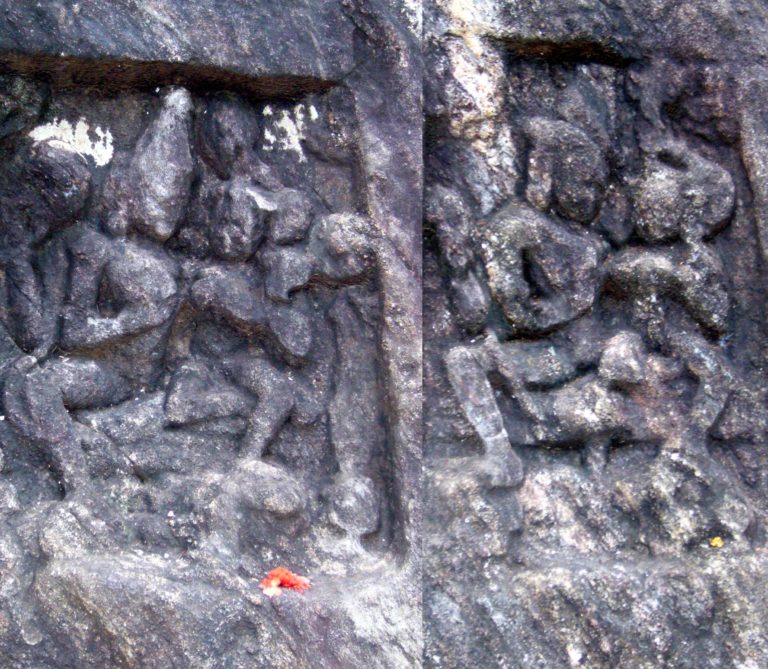
When the child grew up, he became a threat to his own mother. He devoured his mother mercilessly. After that, he performed Tapasya rigorously and pleased Lord Siva. The deity conferred on him Bara (boon) that he would have cause for fear from none but Narasingha of the Satya-Yuga. This narrative informs us the occurrence of Saivism in this site. In other words, this indicates that the prevailing society believed in or required the synthesis between Saivism and Vaisnavism in this area. However, Musika-datta became most powerful and a source of trouble and discontentment to the deities of Swarga (heaven). The helpless deities surrendered to Ramachandra and threw themselves on his mercy. Assuming the appearance of Lord Narasingha, Ramachandra came to annihilate Musika-datta who fled in fear of his life. Narasingha also followed him. Musika-datta arrived at Gandhagiri in fear and trembling. He approached the Gandhagiri to give him protection. When the refuge was granted, Musika-datta assumed the form of Musika (mouse) and entered the mountain Gandhagiri. So, Lord Narasingha also assumed the form of a Marjara (cat) and pursued him. But Gandhagiri and other deities interceded and requested Lord Visnu to establish himself there in that feline form i.e. Marjara-Kesari so that he could devour Musika-datta when he came out. This narrative also informs us the existence of Ganapati cult in this site. Ganapati-Ghat and rock-cut sculpture available in Narsinghnath site establish this fact.

A significant feature of this Tirtha is Hari-Hara-Pangat, which undoubtedly confirms that Vaisnavism and Saivism headed towards a synthesis in this site. In reality, however, it was a synthesis between Buddhism, Vaisnavism (Hari) and Saivism (Hara) in the Narasingha Pitha. Both the low caste as well as high caste people sit on the floor together and eat Anna Prasad cooked in the house of this popular deity. Hari-Hara-Pangat stands for the casteless, classless and secular aspect of this Tirtha. People never dare to abstain from Hari-Hara- Pangat or Hari-Hara-Bhoga on caste point of view. They acknowledge Prasad without hesitation. In other words, while taking or sharing of cooked food among various castes and communities is stringently forbidden under traditional Hindu caste system, eating of Bhoga at Hari-Hara-Pangat is not at all forbidden. The eradication of caste rules in regard to the Hari-Hara-Bhoga i.e. the sacred food cooked in the temple reminds us one of the important protests of Buddhism against caste prejudices. Also, the typical catlike form of the deity with the head of a cat and body of a lion is a terrific idol, which recommends some influence of or connection with Tantra. It is a fact that this place was some time a seat of Tantrik Buddhism. Scholars strongly advocate that the Gandhagiri or Gandhamardana hill has to be explored for ancient Buddhist relics. This has led the world by founding Vajrayana Buddhism in the eighth century A.D. In view of the above, nonappearance of caste restriction in Hari-Hara-Pangat and the typical feline form of Marjara-Kesari may be attributed to the Buddhist Tantrik tradition, which some time ago flourished here.

Moreover, this also equates with the Mahaprasad Sevana at Ananda Bazar of the Lord Jagannath Temple, Puri, which for some scholars represents the coalition of Brahmin and Buddhist doctrines. It is believed that originally the image of Lord Jagannath was the image of Lord Buddha containing his relics and Buddhist mode of worship are traced in the rituals of Lord Jagannath (O’Malley, 1908:90). It may be understood here that Narsinghanath Pitha powerfully emerged as a Vaisnava Pitha during Chauhan rule. Vaisnavism triumphed over Buddhism as well as Saivism in this Pitha and Buddhism absolutely lost its identity. As it has been said earlier, from about fourteenth century Borasambar area came under the Chauhan reign of Patnagarh. The finish of the Buddhist and Saiva faiths in Narsinghnath site may tentatively be traced to this period.

It may be suggested to consider that the aboriginal people who were the original worshippers of this deity earlier richly inhabited this region. The catlike form of deity was probably a non-Hindu deity, which does not match with any of the form of Devi or Devata icon of the Hindu iconography. Further, the image does not resemble any other deity found in Orissa. The antiquity of Marjara-Kesari cannot be pushed back to the Vedic period. During the Vedic period, the four Vedas do not refer to the worship of Marjara-Kesari. What’s more, Marjara-Kesari does not find a place in the congregation of Vedic deities. Most probably, Marjara-Kesari was initiated into the Brahminical pantheon in Narsinghnath Tirtha at a later period during the Chauhan rule. The non-Hindu image of Marjara-Kesari is probably a Buddhist one, worshipped in the beginning by the ancient tribal people of this area. The original name of this deity was obscured by the Sanskritik / Hindu name of Marjara-Kesari conferred on him. This name was befitting to the image of the deity with the head of a cat and body of a lion. It was easier to recognize Marjara-Kesari with the Hindu deity Nara-Singha with the head of a lion and body of a male human being. This was established by manufacturing a narrative of Malati and Musika-datta involving Ravana, Musika, the vehicle of Lord Ganesa and Ramachandra. Subsequently, this story was accepted far and wide by both the Hindus and non-Hindus of this area. In addition, the myth helped to incorporate the deity as a form of incarnation of Lord Visnu into the Hindu fold.

In all probability, this process of Sanskritisation or Hinduisation of the aboriginal deity took place in the medieval period during the State formation in Patnagarh. It was essentially required to integrate the indigenous communities into one fold under the umbrella of Hinduism in the process of the building of a unified Patna Rajya. So, Marjara-Kesari was accepted and exalted as Lord Visnu in order to appease the local subjects so that the ruling class could consolidate their power over the natives and exercise their authority over this area. In this context, it would not be out of place to mention here that the Binjhals are a primitive race, which appears to have been among the earliest inhabitants of this area. The entire area was a part of the Borasambar zamindari belonging to the Binjhal family. As discussed elsewhere, they were a hunting and martial tribe. But they were converted into settled agriculturists during the Chauhan reigns. Even today, majority of them are cultivators and rests are farm servants or field labourers. Those who are settled in the plains have taken to improved methods of rice cultivation (Senapati and Sahu, 1968:103). From the military point of view i.e. security of the State and political point of view, the Binjhals / Bhinjawal zamindar of Borasambar held an important position. His lands were situated alone on the north side of the Gandhagiri, which form part of the northern frontier of Patna, and accordingly he could hold the approaches through these hills to Patna for or against any hostile force (5). The zamindar of Borasambar enjoyed the most privileged position like right of affixing the Ticca to the Rajas of Patnagarh on their accession. Conspicuously, the more advanced Binjhals boast of an alliance with Rajputs and call themselves Barihas, which is a title originally borne by small hill chiefs. But the common Binjhals do not claim such Rajput / Kshatriya status and descent. Nonetheless, it may be noted here that the management of the Narasinghanath temple has been directly or indirectly controlled by the Padampur / Borasambar zamindar family since time immemorial.


Chitrasen Pasayat is an OAS comments on culture

Kosal Vyasha Dr Nila Madhab Panigrahi: A Rebel Genius

Dr. Nila Madhab Panigrahi born on 14 November 1919 at Gulunda near Sambalpur is the most eminent vatary of the Kosali/Sambalpuri language; an essayist, literateur, poet-author of many books, editor of ‘Nishan’ & many other literary works. Designated as ‘Kosal-Vyasha’ for having single-handedly composed the epic ‘Mahabharatar Katha’, published by Sambalpur University, he was in the pursuit of literature till his last breath.

He received ‘D. Litt’ from Sambalpur University for his lifetime works in the field of literature. He floated an honour & reward of Rs. 10,000 which is given by Sambalpur University every year for translation of any Sanskrit work into the Kosali/Sambalpuri language. He co-authored the ‘Sambalpuri-Kosali Grammar’ book with Dr. Prafulla Tripathy, which was also published by Sambalpur University. He is honoured by many cultural & literary organisations, but because of his intense love for Sambalpuri/Kosali language, he refused the ‘Sarala Samman’ which was to be given by IMFA Group, because it was awarded by an Odia-lover. He was the convenor of the ‘Kosal Sammellan’, along with Mr. P.R. Dubey & Pandit Prayag Datta Joshi, which spearheaded the socio-linguistic movement in the Kosal region. He sat on a hunger strike, demanding primers (primary school books), for a literacy campaign, be made in the ‘Sambalpuri/Kosali’ language. He is an erstwhile Sanskrit & Odia scholar who has abandoned writing in the Oriya language for about three decades. He is also a prominent personality in India in the field of Indian classical music and was the principal of ‘Gandharva Viswa-Vidyalaya’, U.P.

He breathed his last on 28th November 2012 at his native Gulunda village.

Saket Sreebhushan Sahu comments on culture and politics