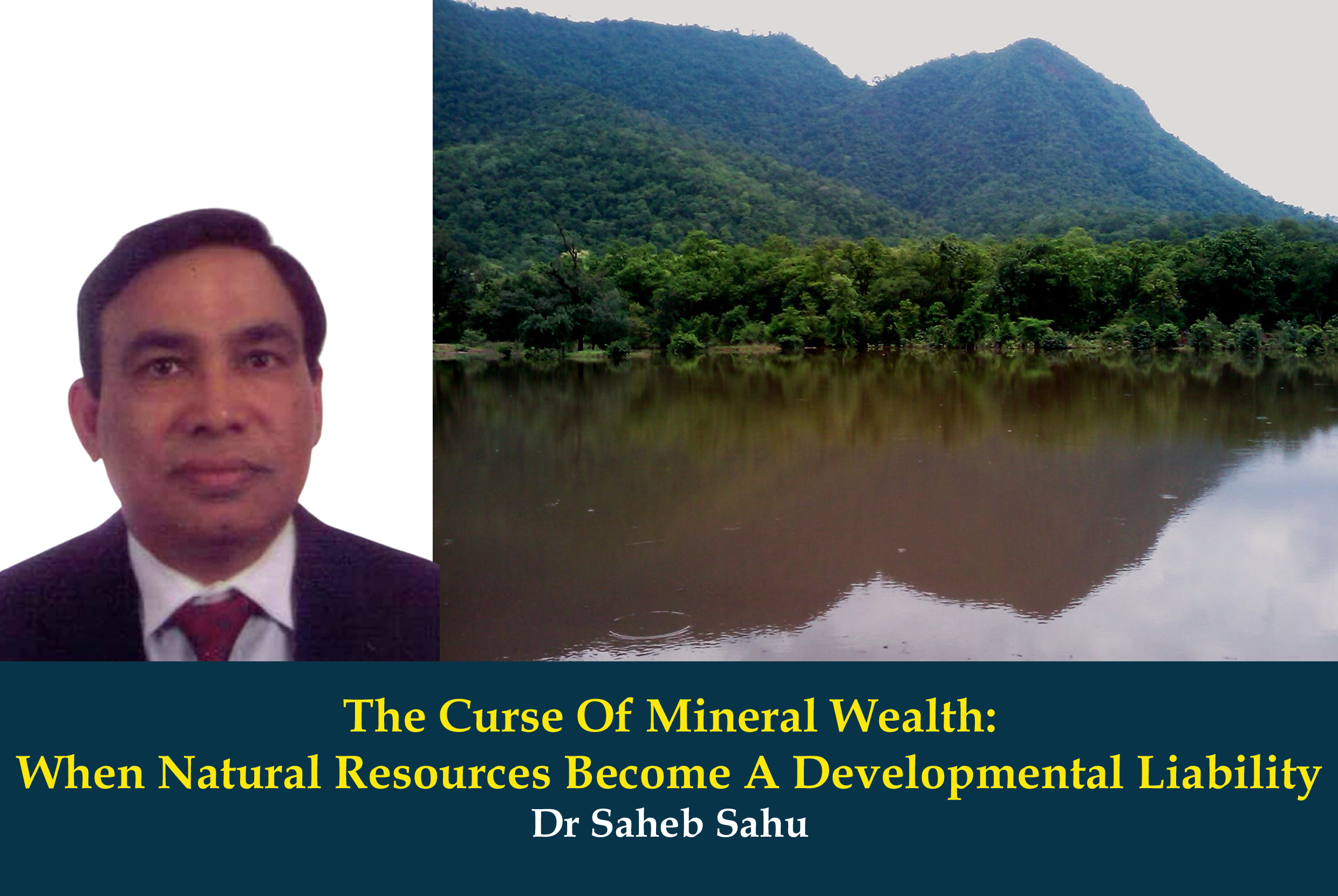
Dr Saheb Sahu
A country with abundant natural resources should in theory, have a head start on development. Coal, iron ore, bauxite, aluminum, uranium, oil and gas and other valuable resources can generate enormous revenues, provide employment, finance infrastructure and alleviate poverty. Yet history tells a surprisingly different story. Some of the world’s most mineral-rich countries have experienced poverty, corruption, political instability, weak democratic institutions, wars and serious environmental degradation. Some of the prime examples are: Democratic Republic of Congo, Nigeria, Angola, Sierra Leone, Zambia, Zimbabwe, South Sudan, Liberia and Venezuela. In the Middle East, the oil rich countries are rich but their political institutions are weak.
This paradox is often called the “resource curse” by developmental economists. The problem is not the minerals themselves. It is what happens when enormous wealth can be extracted from the ground without using that wealth for development of its people. Most of the money is siphoned by the politicians, contractors, bureaucrats and other middle men.
Corruption
Mineral wealth can create tremendous incentives for corruption. Whoever controls the government can influence mining licenses, contracts, royalties, export arrangements, and infrastructure projects. Competition among political parties becomes less about competing visions for the future of the state and more about capturing control of the mineral wealth. This can provide what economists call it “rent seeking”- the pursuit of wealth through political influence rather than productive economic activities. Instead of entrepreneurs competing to create better products and services, politically connected individuals compete for mining concessions, government contracts and access to resource revenues. The result is, connected individuals become richer and richer and poor individuals stay poor or even become poorer. This kind of rent seeking very much applies to the state of Odisha, India. You google the names of ten or twenty richest persons in the state, most of them have made their money in the mining sector.
Inequality
Mineral wealth can produce spectacular state and national income statistics, without producing corresponding improvements in ordinary people’s lives. Prime examples are the states of Odisha, Jharkhand and Chhattisgarh. They are three of the most mineral-rich states but also the three poorest states in India. Within Odisha, the districts with most minerals are among the poorer districts compare to the coastal districts, with no mineral resources.
Environmental Cost
The curse of mineral wealth is not merely economic or political. Mining pollutes air and water, destroys forest, and displaces communities. Open-pit mines (common in India and Odisha) can permanently alter the ecosystems. They produce severe environmental degradation with serious health consequences for people who work there and all the people who breathe that polluted air.
Gandhamardan Hills
Spread across 190 Square kilometers in Odisha’s Bargarh and Balangir districts, the Gandhamardan Hills are revered as sacred by the people of western Odisha. The Hills reach an elevation 915 meters (3,000ft) and form an important ecological zone in western Odisha. Its forests, streams, wildlife, and medicinal plants make it one of the state’s most valuable natural ecosystems. The Mountain is also associated with the famous Nrushinganath Temple and the Harishankar Temple. These two temples are more than seven hundred years old. These two temples give the mountain an unusual religious and cultural importance. The Mountain’s forest contains a great variety of medicinal plants which are used in Ayurvedic medicine. For many local communities the forest provides food, water, fuel, and other forest products.
The Threat of Mineral Exploitation
Gandhamardan’s mineral resources have also made it the subject of intense controversy. The previous Congress and BJD government and the present BJP government have tried to lease the mining resources under and around it to billionaire but never been quite open about it. According to some estimate about 705 million tons of bauxite lies around and under the hills. Recently the Adani group has acquired 112 acres of land around the hill. The present BJP government has stated in the state assembly that it has no plan to permit mining around the hills. But the local citizens have no faith in the government assurances. Once the mountain’s landscape is extensively destroyed by mining, its ecological, cultural and spiritual characteristics cannot be restored.
What Should Present and Future Government of Odisha Do About Mining?
The solution for the government of Odisha is not to stop mining altogether but to be extremely judicious about it. The process of the mining contract (Where, When and How) should be completely transparent. The government should collect a fair share of the mining revenue, prevent corruption and publish how those revenues are being spent. Most of the money should be spent on education, healthcare, childhood nutrition, infrastructure development and direct cash grant to the eligible poor of the communities.
Conclusion
The problem of resource curse is real but not inevitable. The paradox is that countries with enormous natural resources experience slower economic development, weaker democracy, greater corruption, more economic inequality, and conflict than countries with fewer natural resources for example – Japan, Switzerland, South Korea. These counties are rich with no mineral resources.
The Government of Odisha is getting a significant portion of its revenue from mining royalty, but it is still one of the poorest states in the country. Within Odisha, districts with mineral resources are poorer compare to coastal districts which have no mineral resources. The government of Odisha cannot lower its high Multidimensional Poverty Index just by opening up more and more land for mining. It should follow the example of the state of Kerala which has reduced its multidimensional poverty index to below one percent. It is the only state in India to do so. Kerala has almost no mineral resources and fewer industries. It has done it by promoting education, healthcare, nutrition, entrepreneurship and encouraging large scale migration to other parts of India and to the Middle East.
The people of western Odisha should ask themselves; should they sacrifice an irreplaceable natural and cultural treasure (Gandhamardan Hills) for short – term mineral revenue which will not be of benefit to the local people? The answer is a definite No! Every government lies. They should not trust the present or any future government and stay vigilant. They should learn from the successful anti-BALCO movement of 1980s.
The curse of the mineral wealth ultimately is not a geological problem. It is a political and intuitional problem. Mineral resources can be a blessing when they finance human development. They become a curse when they finance corruption, inequality, political repression, and conflict. The ultimate lesson is simple: A nation’s greatest resources are not what lies beneath its soil, but what are built above it.
Dr Sahu is an OCI, from Bargarh district, settled in USA. He has visited the Gandhamardan Hills and the temples. He has been writing about Odisha’s poverty since 2004. His book “What Can Be Done for Orissa’s Abject Poverty’ was published in 2009. He was also an expert member of WODC from 2009-2015. His articles on health, poverty, education, religions and philosophy can be found at Odishawatch.in
Sources
1- Chat Gpt,
2- Google.com