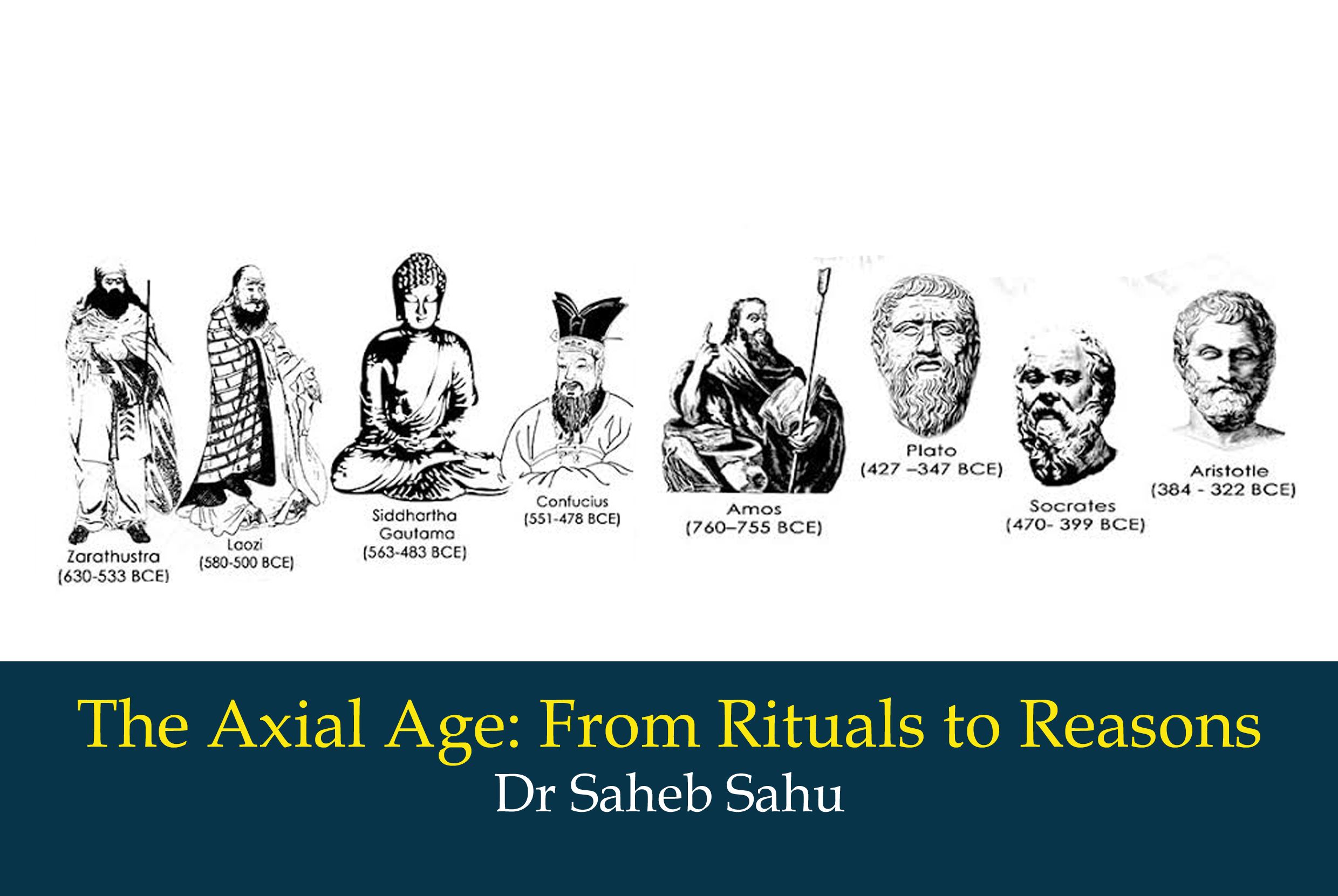
Dr Saheb Sahu
The “Axial Age” is a concept coined by German Philosopher Karl Jaspers in his 1949 work, The Origin and Goal of History. It described the period from 800 to 200 BCE, during which independent, parallel spiritual and philosophical revolutions occurred in China, India, the Middle East, and Greece.
In his book Jaspers defined this era as the “axis” or turning point of human history. The idea behind this naming was that humanity has made a critical turn, as if on an axis so that focus of attention had shifted from toil of scraping out a daily living to reflections on what made live worth living. Before this time, humanity was defined by its localized, ancient mythological cultures (such as those of Egypt, Mesopotamia and India). Following the “Axial Age” attention shifted toward the kind of self-reflective questions we continue to ask ourselves.
Core Characteristics of the Axial Age
According to Jaspers, the Axial Age was defined by several major cognitive and spiritual shifts that happened across separate civilizations without mutual contact.
. Human thoughts expanded beyond immediate physical existence and earthly desire. People developed a concept of ultimate moral or divine order.
. Instead of accepting myth as absolute truth, Individuals began to critically question the society and themselves. This critical thinking gave birth to philosophy, logic, and self-reflection.
. The focus on sacrificial rituals and local tribal gods began to fade, replaced by universal ethical principles (such as the early form of the Golden Rule) that applied to all of humanity.
The Key Eurasian Centers
Jaspers highlighted four distinct regions where these breakthroughs happened simultaneously but independently:
1- China: The era of “Hundred Schools of Thought”, most notably the teachings of Confucius and Lao-Tzu which established ethical governance and natural harmony.
2- India: The transition from Vedic ritualism to deep metaphysical inquiry. This resulted in the composition of the Upanishads and the rise of Jainism and Buddhism, which focused on asceticism, personal enlightenment, and cycles of rebirth.
3- The Middle East (Persia and Israel): The rise of Zoroastrianism in Persia, and the teachings of the Hebrew Prophets in Israel, emphasizing a singular, moral, and all powerful God (Monotheism).
4-Greece: The birth of Western philosophy, starting with the pre Socratic and culminating in the rational and dialectical methods of Socrates, Plato, and Aristotle, which sought truth through reasons.
The apex of the Axial Age was sixth century BCE, which saw such thinkers as Confucius (c 551-479 BCE ), Lao Tzu(birth date debated but traditionally dated 6th century BCE), Mahavira (c 599 – 529 BCE), Siddhartha Gautama (c 563 – 483 BCE ), the Greek philosopher Pythagoras (c 570 -495 BCE ) and the Hebrew prophet Jeremiah (c 650 – 570 BCE).
While the concept of Axial Age remains highly influential in the sociology of religion, it has not been without criticism. Modern scholarships notes that Jaspers overlooked significant vibrant civilizations, such as those in Egypt, the Americas and Sub-Saharan Africa , that did not fit neatly into his Eurasian frame work.
Some Quotations from the Axial Age Thinkers:
“C” stands for the Latin word “circa”, meaning around.
China
Lao-Tzu (6th century BCE, exact dates not known)
- Kindness in words creates confidence. Kindness in thinking creates profoundness. Kindness in giving creates love.
- A journey of thousand miles begins with a single step.
Confucius (c 551 – 479 BCE)
- What you do not want done to yourself, do not do to others. (It is the same as the Golden Rule of Christianity).
- Filial piety and brotherly love is the root of humanity.
India
Taittriya Upanishad (practical advice to students – sometimes called the convocation address)
- Speak the truth
- Practice virtue (dharma)…
- Be one to whom mother is a god.
- Be one to whom a father is a god.
- Be one to whom a teacher is a god.
- Be one to whom a guest is a god.
- Those things which among us are
- good deeds should be revered by you and no others.
Katha Upanishad – The Universal and the Individual Self
Know thyself (Atman)
As riding in a chariot.
The body as the chariot.
Know thou the intellect (Buddhi) as the chariot driver,
And the mind as the reins.
Philosophical Skepticism (The Carvaka philosophy) – Brihaspati Sutra (c 600 BCE)
There is no heaven, no final liberation, nor any soul in another world.
While life remains let a man lives happily.
Let him feed on ghee, even though he runs in debt. …
There is no world other than this;
There is no heaven, no hell; the realms of Siva and like regions are invented by stupid imposters of other schools of thought.
Mahavira – (c 599 – 527 BCE)
- Right belief, right knowledge, and right conduct – these together constitute the path of liberation.
- The vow is to be free from injury, falsehood, theft, unchastely, and worldly attachment.
Gautama Buddha (c 563 – 483 BCE)
‘Be a light unto yourself; betake yourselves to no external refuge. Hold fast to the Truth. Look not for refuge to anyone besides yourselves.
The Middle East – Persia and Israel
Zoroaster (exact date unknown – Avesta C 624 – 599 BCE)
- Think rightly
- Speak truthfully
- Act justly
- Zoroaster’s ideas influenced later religious traditions including concept of heaven and hell, final judgment, moral dualism and angel-like beings.
Hebrew prophet Jeremiah (C 650 – 570 BCE )
‘The heart is deceitful above all things, and desperately wicked; who can know it?’ (Jeremiah 29:11)
Greece
Socrates (C 470 – 399 BCE)
. The unexamined life is not worth living (from Plato’s Apology).
Plato (C 428 – 348 BCE)
- “Wonder is feeling of a philosopher, and philosophy begins in wonder”.
- “Do not train children by force or harshness; but direct them to it by what amuses their mind.”
Aristotle(C 384 – 322 BCE )
- “Man is by nature a political animal”.
- “We are what we repeatedly do. Excellence, then, is not an act, but a habit”.
Sources
1- Wikipedia .org
2- Chat Gpt.
3- Lin Yutang. The Wisdom of China and India. The Modern Library (Random House), New York. 1942