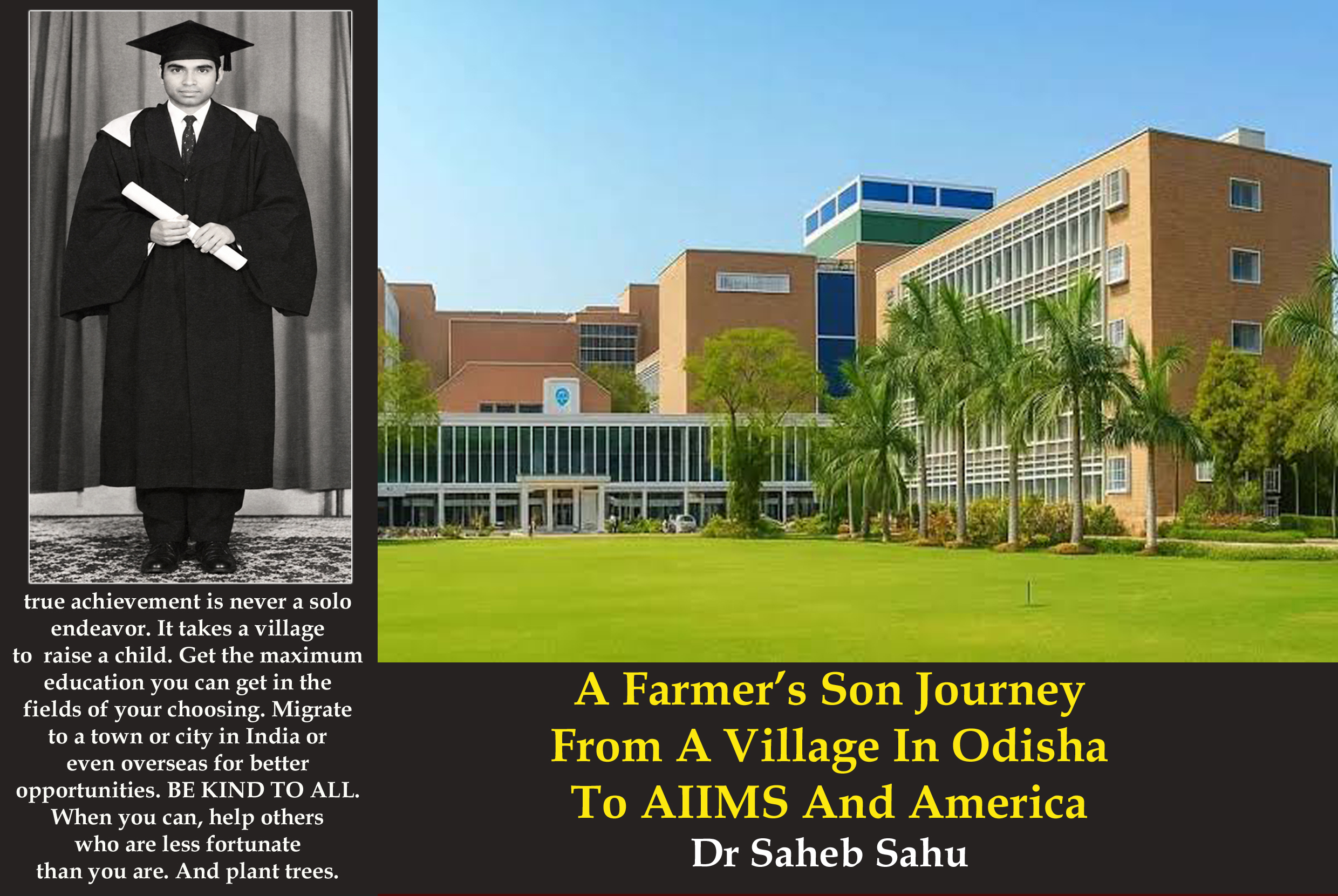
Saheb Sahu, MBBS, FAAP, MPH, MHA
The Year is 1964. This essay is about my personal journey from village Mulbar to AIIMS (New Delhi) and to America.
I was born in the village of Mulbar, in 1944. The village of Mulbar is located in the district of Bargarh, Odisha, (India) 12 km from the district HQ town of Bargarh, and 360 km from Bhubaneswar, the capital city of Odisha. In 1950s, the village of Mulbar had about 200 households and a population of about 800-1000. The village had no all-weather road, electricity, radio or safe drinking water. But luckily for us, it had an elementary school going back to 1927.
I am the youngest of three brothers. Our parents were farmers and farmed about 5 acres (2 hectares) of non-irrigated land. There were no deep tube wells in those days. Now the village has more than 250 tube wells. Our parents grew rice (one crop), sugar cane, potato, onion and some other vegetables. We always had enough food to eat but had no cash. Our mother though illiterate was a smart money manager. She sold rice, onion, potato, jaggery to some of the villagers to generate some cash. In my opinion, my mother, though illiterate was a great money manager. To our good fortune, our parents educated all three of their sons instead of making them farmers.
My eldest brother was the first high school graduate from our village. He was the top student in his class (George High School, Bargarh), but could not attend college because of lack of money. He joined the Indian Postal Service as a lower division clerk and through internal examinations and multiple promotions he retired as postal superintendent. In 1964, he was a postal inspector. My middle-elder brother finished Middle School but could not attend High School because of lack of money. He became a vaccinator, health inspector, tea agent, drug agent, retail pharmacy owner and whole seller. In 1964, he has just started a retail pharmacy in the town of Sambalpur, Odisha, the first local Oriya to do so.
I attended our village elementary school, Kamgaon Middle School, C .S. Zila School, G. M. College, Sambalpur. I was a good student throughout my student career. I got Odisha state merit scholarship from fifth grade to all the way to AIIMS. During my time at G. M. College (1962-64), most good students were going for engineering. However, I decided to become a doctor during my tenth grade in high school, after seeing my niece in a nursing home in Bargarh. She was born two or three weeks premature and survived. She was my impetus to become a doctor.
In January 1964, 68th Session of Indian National Congress was held in Bhubaneswar. About ten or twelve of us, students from G.M. College were recruited to be Congress Seva Dal volunteers to go to Bhubaneswar by local Congress Committee. After few days of training, we were taken to Bhubaneswar by a business man from Sambalpur in his jeep. We were housed in new quarters and given food without any cost to us. Mr. Biju Patnaik was the Chief Minister of Odisha at that time. Our duty was to serve tea, snacks, and soft drinks to the VIPs seated on the dais. There we saw Prime Minister Nehru and his daughter Indira Gandhi, Congress President Kamaraj Nadar and incoming Congress President Sanjiva Reddy. I had the opportunity to go to Puri and Konark, as a translator for some delegates from Gujrat. The whole experience was great and it cost me nothing. While attending the meeting, Prime Minister Nehru had a stroke and died in May 1964 at New Delhi.
In 1964, G.M. College was co-educational for science students. Sambalpur Women’s College was opened in 1962 but they had not started science courses yet. In my science class at G.M. College of about 80 students, 16 were girls. We did all our science labs together. We started applying to medical colleges around February 1964. I had applied to V.S. S. Medical College Burla, and had requested for prospectus from Vellore Medical College in Madras (present Tamil Nadu). At that time, Vellore Medical College and hospital were quite famous. Because of my good marks (grade) my admission to Burla Medical College was not in doubt. I would have gone to Burla expect that I was lucky enough to get some information from a friend of mine about AIIMS. My friend, classmate was from South India. His father had been transferred from Burla to New Delhi. His elder brother had appeared in the AIIMS exam but had not qualified. One day we were chitchatting about medical college and he asked me “Saheb, why don’t you apply to AIIMS, New Delhi?’ I had never heard of AIIMS. He got me the address. I applied for the prospectus. After receiving the application I filled them and sent it back with necessary documents. Few days or weeks later I was asked to appear for the AIIMS’s entrance exam at the Presidency College, Calcutta (now Kolkata). In those days there were no coaching centers or text books for the preparation for the exam.
Prior to going to Calcutta for the exam, I had travelled as far as Rourkela from Sambalpur by train. In those days there was no direct train from Sambalpur to Calcutta. Travelling alone was little scary. Fortunately my middle-elder brother had worked as a drug agent for a drug company headquartered in Calcutta. He used to travel to Calcutta often and new the big city well. He arranged for my stay in a travel lodge and instructed me to take the right tram from the Howrah railway station to the lodge. I caught Bombay-Howrah express train from Jharsuguda and reached Calcutta without any problem. Next day I walked to the Presidency College and took 6 hours entrance exam for AIIMS. The subjects were biology, chemistry, and physics and may have also been English. They were all essay questions, no multiple choices. Later on I found out that about 4,000-5,000 students took the entrance exam at four centers, Delhi, Calcutta, Bombay and Madras. Most of the students were from Delhi. I was the first student from Orissa to pass the AIIMS entrance exam. During that summer vacation, I was visiting my eldest brother and his family in Titilagarh in Balangir district. My brother was the postal inspector there. During that visit I received a letter indicating that I would be admitted to Burla Medical College. Two days later I received another letter from AIIMS (New Delhi) stating that I have passed the exam and would be eligible for admission starting on the first week of September 1964. That news was surprising and thrilling one. When I told my eldest brother the news, he asked me one question: “Where do you want to go?” I told him: “Of course, I will go to AIIMS, no doubt in my mind”. But there was a problem. The cost of going to AIIMS was almost twice that of attending Burla Medical College. At AIIMS, the cost of tuition (8 rupees a month), hostel fee (8 rupees a month) and mess fee (120 rupees a month, for four meals) plus pocket money and money for books. The estimated monthly cost at AIIMS would be 150-160 rupees (about 40 dollars) a month, one and half times that of attending Burla Medical College. Where to find the money? My brother’s salary at that time was about 400 rupees a month plus some allowances. He already had one child. I was likely to get some merit scholarship from government of Orissa, about fifty rupees a month. My brother and I decided to apply for the Government of Orissa’s low – interest student loan for one hundred rupees a month. We went to the district headquarter Balangir and did the necessary paper works in front of a magistrate. My loan was guaranteed by my eldest brother. My brother agreed to finance my expenses until I start receiving the loan and scholarship money which I did not receive almost for 6-8 months. During that period my brother sent me half of his salary every month. What a sacrifice my elder brother and my sister-in-law made for my education!
In 1964, there was no direct train to Delhi from Sambalpur. In the first week of September, I took the Howrah-Bombay express train from Jharsuguda (Odisha) to Nagpur. At Nagpur, I boarded the Madras-Delhi mail for Delhi. I was travelling alone in 3-tier sleeping compartment. I reached Delhi about 36 hours later, covering distance of about 1500 kilometers. From the old Delhi railway station I took a motorcycle taxi to the campus of AIIMS. I had the allotted hostel no and room no with me. To my surprise all the students were allotted fully furnished single rooms. The bathrooms were common.
AIIMS (New Delhi) 1964-1970
AIIMS was started by Government of India, Ministry of Health, as a post graduate training and research institute in 1956, with an initial grant from the government of New Zealand. The institute was admitting hundreds of post graduate students but admitted only 50 under graduate (MBBS) students. Out of 50, 5 seats were reserved for students from Common Wealth Countries, 15 were reserved for SC and ST, rest of 30 were open seats. It was a very modern campus in South Delhi; spread over 214 acres (127 hectares). It was a residential campus- everybody from the director to the peon had quarters inside the campus. A delegate from India had visited America before starting the institute. They tried to imitate the famous Mayo Clinic and Hospital of America. The teaching and research blocks and some private VIP rooms were air-conditioned. It may have been the first air-conditioned hospital in India. The hospital had 1,000 beds. There were 2,000 more beds at Safdarjung Hospital (a central government hospital) across from the AIIMS campus for the training of the students. The main teaching and research campus was six stories high and was surrounded by a nice green lawn. There were six hostels for men, one for women and one for nurses. All the hostels were within walking distance to the teaching block and the hospital. We had basketball, volleyball, football, cricket and tennis courts. We had no swimming pool or exercise room. We had two kinds of mess (canteens) – serving north and south Indian food. I joined the north Indian mess but went to the south Indian mess once in a while as a guest to eat south Indian foods.
The physical facilities at AIIMS were the best in India but the teaching faculties were even better. They were recruited from top medical colleges from all parts of India. It was truly an all India institution. There were four faculty members from Orissa, two in pathology, one in microbiology and one in social and preventive medicine. There were four post graduate students from Orissa. I was the only undergraduate student from Orissa.
Ragging (Hazing) at AIIMS
Ragging is a British tradition which was still being practiced in India of 1964. The practice was common in private boarding schools and professional colleges like medicine and engineering. I reached AIIMS few days before our class started. I was one of first freshmen of our class to stay in the hostel. I became one of the first victims for the seniors. Most of my classmates came from Delhi and did not have to stay in the hostel during the period of orientation. After few days, our classes started and I was almost left alone for newer victims. One night we, (the freshmen) were being marched towards the women’s hostel, stark naked. Our director’s bungalow was on the way. Our director happened to see what was going on. He came out of his house and asked the seniors to stripe naked and asked everybody to go back to our rooms. That was a good lesson for the seniors. The ragging lasted for about two weeks. At the end of two weeks, the seniors gave us a welcoming party and ragging was over.
Education at AIIMS
At AIIMS, my entrance examination ranking was 16 out of 50 but in my subsequent class examinations I did better. Many of my classmates had gone to better schools and colleges in Delhi. Many of them came from privileged backgrounds – English medium schools, students of Delhi University, sons and daughters of generals, professors, senior civil servants. During one of our physiology examinations I secured third position. That boosted my moral. Later on two occasions I stood first in my class – once in social and preventive medicine and once in forensic medicine. My overall position during my AIIMS days were among the top eight. The topper in our entrance examination was a woman, the daughter of a general. Half of our classmates were girls.
AIIMS had an excellent medical library with open selves and lots of medical and non-medical books and journals including foreign medical journals. I spent lots of time in the library and read many non-medical books. We had to attend talks in humanity subjects (it was compulsory for the first year students) few evenings a month by prominent people like – painter Satish Gujral, Odishi dance guru Kelucharan Mahapatra and famous dancer Sonal Mansingh. We also saw many foreign movies with sex scenes for free. The movies were supplied by foreign embassies.
At AIIMS, I established regular routine. I always read the chapters to be taught next day, the night before. I played volley ball, tennis or badminton or soccer every day, including the day before an examination. I learned to play tennis at AIIMS. I had played volley ball from my high school days. At AIIMS, I was the captain of our college volleyball team. We owned the inter-medical college volley ball championship during my captainship. We received our championship trophy from Air Marshal of India Mr. Arjun Singh, who was our chief guest. We had a group picture with him.
After our final MBBS examination in December, 1968, twenty-five of us (both girls and boys) went on a three weeks excursion to South India. Every city we visited, we stayed in the local medical college hostel for free. We visited Madras, Madurai, Bangalore, Mysore, Trivandrum, Cochin, Kanyakumari, Puna, Goa, Bombay, Ajanta, Ellora and Khajuraho. It was a great trip. We all loved it and learned a lot about how diverse India is.
ECFMG
ECFMG stands for Educational Council for Foreign Medical Graduates. The council was empowered by US government to administer an examination called ECFMG, to all the foreign medical graduates from anywhere around the world, who wanted to come to US for further training like internship and residency. The ECFMG examination was held on the same day in many centers around the world. In India, the centers were in Delhi, Bombay, Calcutta and Madras. The Indian government became concerned that too many Indian doctors were going to America for further training and did not allow the exam to be held in India, starting from 1969, the year we were to take the exam. The excuse was “brain drain”.
During December or January 1970, about 20 of us went to Colombo, Ceylon (Sri Lanka) to appear in the ECFMG examination. The examination result came in few weeks later. It may have been at the end of January or first week of February 1970. I had passed the ECFMG exam. It was one of the happiest days of my life. Passing the exam meant going to America, getting better training and making lot more money.
In 1970s, getting a medical internship in America after passing ECFMG was not that difficult. America needed more doctors because of the Vietnam War. We were allowed to apply to 10 hospitals through the National Intern and Residency Matching Program (NIRMP). I applied to Blank Children Hospital in DesMoines, Iowa, as my first choice. Fortunately the hospital accepted me. In 1970 – 71, 30 out 50 of our graduating class migrated to America for further training. All of us did well in America and no body went back to India. The fear of “brain drain” turned out to be true. The new word for educated people going overseas for better opportunity is called “brain gain” as both the countries (departing and receiving) benefit. The migrants send money and their expertise back to their home country. The computer industries in Bengaluru are a prime example.
My American internship at Blank Children Hospital was going to start from first of July 1970. Between January and June, 1970, I did six months of pediatric residency at AIIMS.
Marriage
At the time of our graduation in December 1970, none of our classmates was married. By June of that year four of us were married. Our marriage was an arranged marriage as was common at that time. My elder-middle brother knew a gentleman who had worked for my future bride’s father. He was our match-maker. My future bride has just finished her B.Ed. degree. She came from a very well-known family of Bargarh and Sambalpur. Her grandfather was the deputy director of agriculture for the states of Bihar and Orissa. He was even given the title of “Raj Sahib” by the British Raj. Her father and uncle were senior OAS officers. Her aunt was the education minister in the government of Orissa. By contrast, our family was an upstart. However, I had graduated with a MBBS degree from AIIMS and was going to America for further study. Her family did not know much about AIIMS, not many in Orissa did. I was not a bad candidate for any daughter of any father. To my good luck my future bride had rejected few candidates and was waiting for a doctor. A doctor who was coming to America was a bonus. We got married on second week of June 1970. Few days after our marriage I went back to Delhi and from there flew to America. In those days Indians were allowed only to take eight dollars per person, when they traveled out of the country. Money for my air-line ticket was advanced by my hospital. They also advanced money for my wife’s ticket, who joined me 4 months later. In America, my wife got a master degree in library science and became the head librarian in a medical college where I was an assistant professor of pediatrics.
Concluding Remarks
I am a retired senior citizen now. Even after 62 years, I wonder how a son of farmer from rural Odisha made it to AIIMS (New Delhi) the best medical college in India then and now. Even more surprising is that I was the first student from Odisha to do so. It is true that I was a good student throughout my student career and I worked hard. But did I do it alone because I was a good student? The answer is a definite No. I was lucky that our farmer parents decided to educate all three of their children. My father died in 1970 and I never had the chance to ask him that question. I attended good schools and colleges and was helped by good teachers. I was also fortunate that my eldest brother, who was eleven years older than me had an Indian Postal Service job and was able to finance my education from the 5th grade onward. I also got merit scholarships starting from 5th grade all the way to AIIMS. The loan from government of Odisha, during my four and half – years at AIIMS was also of great help. I paid off that loan within eight months after coming to America.
It was pure luck that a friend of mine told me about AIIMS, a medical Institution, I had not heard of. Passing the entrance exam was even a better. Being admitted to AIIMS changed my life’s trajectory. I was able to come to America for further training because of the great education I got at AIIMS. Except for one student, all of us who took the exam cleared it. Passing the ECFMG exam enabled me to come to America. In America our family has done well. We have been able to help both sides of our families and done something for our community in US and in Odisha, India.
Shakunatala Bidydhar Trust
In 1990, we three brothers started a non-profit trust in honor of our parents titled Shakuntala Bidyadhar Trust. Since its founding, the trust has financed constructions of multiple Middle Schools, one High School (in our birth village), two +2 colleges, one Women’s Degree College, one ITI, and built many hostels for girls. The trust has also donated more than one hundred “One-Almirah Libraries” to schools and colleges and is in the process of donating more. It is also giving hundreds of scholarships to financially needy students every year. The trust has enabled planting of more than 10 lacs (one million) trees in schools and college campuses in district Bargarh, Odisha. All the projects of the trust were executed by my eldest brother when he was alive. We (my wife and I) just sent the money. After my brother’s death in 2018, other capable local people are carrying out the works of the trust. I am grateful to all of them. The main goal of the trust is to promote education, especially girls’ education.
My wife tells me often: Your body is in America but your heart is in Odisha. I couldn’t agree more.
My dear readers keep in mind that true achievement is never a solo endeavor. It takes a village to raise a child. Get the maximum education you can get in the fields of your choosing. Migrate to a town or city in India or even overseas for better opportunities. BE KIND TO ALL. When you can, help others who are less fortunate than you are. And plant trees.
The End