Dr Saheb Sahu, FAAP, MPH
Introduction
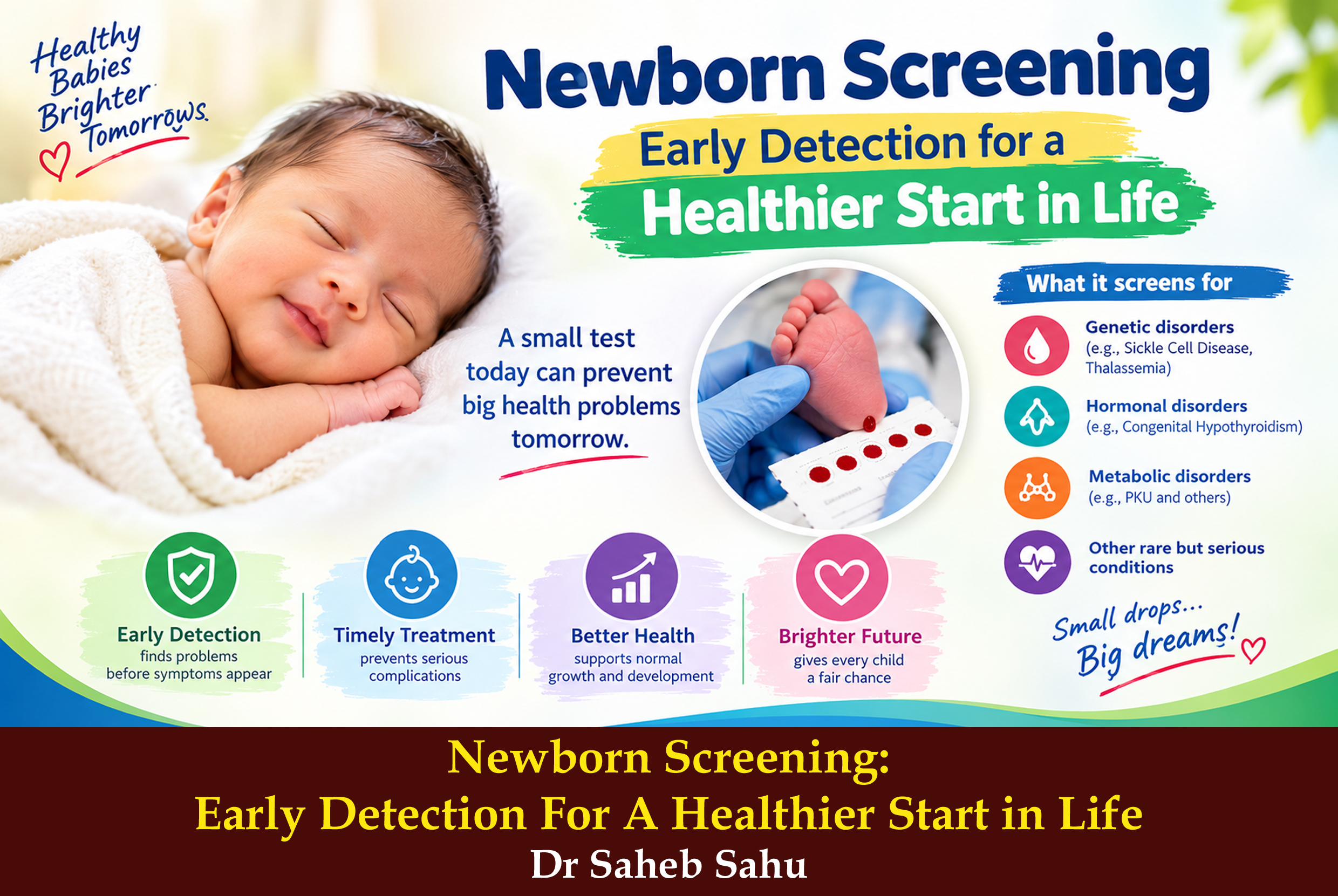
Most newborns appear healthy, but some have serious genetic, metabolic, hormonal, hearing or heart conditions without obvious symptoms. Routine newborn screening identifies some of these conditions early; allowing earlier treatment that can prevent disability or even death.
How Is Newborn Screening Done?
Newborn screening usually include three parts:
1–Blood Spot Test: A few drops of blood are taken from the baby’s heel and put on a filter paper card (called Guthrie card) and send to a qualified lab. The lab does the analysis.
2- Hearing Screening: It is a safe, painless test that checks for the hearing loss. Early detection allows timely intervention which helps in language development. If a newborn does not hear well, her/his speech will be delayed or may not develop at all.
3-Congenital Heart Defect Screening: A Pulse oximetry soft sensor strip or wrap is placed around the baby’s skin (usually on the right hand and one foot). It measures the oxygen saturation of the baby’s blood. If the saturation is below normal, it may be a sign of serious heart disease. The baby needs to be evaluated further.
What Diseases Can Be Detected By the Blood Test?
In the United States, the federal Recommended Uniform Screening Panel (RUSP) officially recommends screening for 40 core conditions and 26 secondary conditions. Many of the European countries have similar guidelines with some variation.
Some of the common conditions include:
.Phenylketonuria (PKU): early dietary treatment can prevent serious mental disability.
.Congenital hypothyroidism: early thyroid hormone treatment will lead to normal physical and mental development.
. Sickle Cell Disease: early diagnosis allows preventive vaccination for infections, and seeking early medical care for the child. Later on it helps a person with the sickle cell trait not to marry another person with the same trait and avoid passing the gene to their children.
. Inherited metabolic disorders: early diagnosis can lead to dietary changes, medication, and other treatment can prevent toxic buildup and serious health complication.
If the screening test is abnormal, the test should be repeated and if positive, genetic counselling should be provided to the parents.
Newborn Screening in India
Access to newborn screening in India varies among states. Nationwide comprehensive screening is not yet available. Kerala is the first state in India to implement a comprehensive universal newborn screening program, known as Shalabham (Butterflies). Odisha does not have any universal newborn screening.
Conclusion
Every newborn deserves the best possible start in life, and newborn screening helps that possible to some extent. Governments and public health agencies should make screening accessible to all newborns regardless of income or place of birth. In the long run screening will save money for the state. All the states in India should follow Kerala’s lead. Odisha should at least start with sickle cell screening as soon as possible because of its high prevalence rate in the state.
PS- Dr. Sahu is a graduate of AIIMS (New Delhi). He is a pediatrician settled in US. He has treated many children with sickle cell disease.
Source
1-Chat GPT