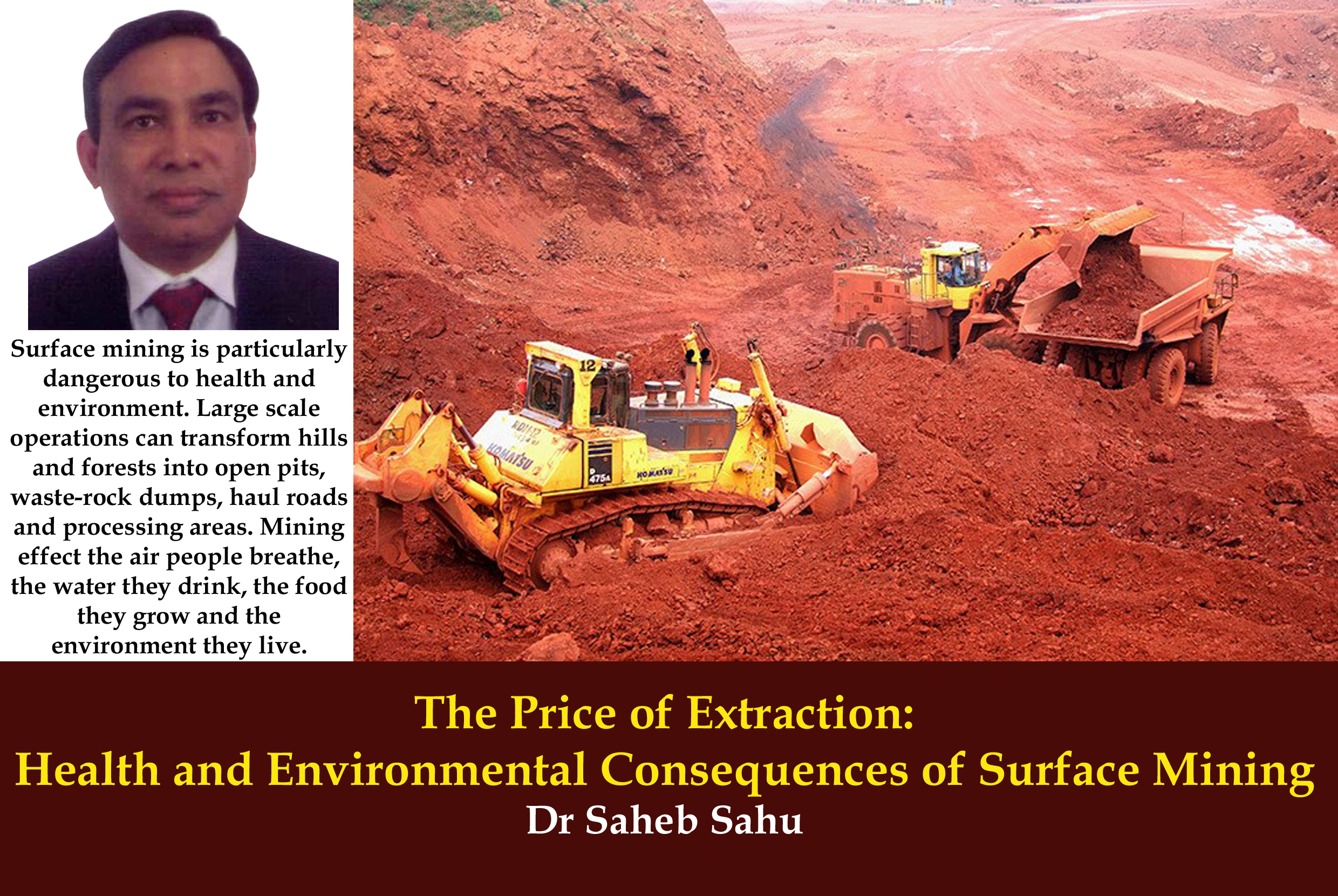
Dr Saheb Sahu, FAAP, MPH.
Surface mining — including strip mining, open-pit mining and mountain top removal— extracts valuable mineral and coals close to the earth surface. While economically profitable, the resulting health and environmental consequences are long lasting.
Surface mining is particularly dangerous to health and environment. Large scale operations can transform hills and forests into open pits, waste-rock dumps, haul roads and processing areas. Mining effect the air people breathe, the water they drink, the food they grow and the environment they live.
Air-Pollution: Most Harmful Effect
Dust is the most visible health consequences of surface mining. Drilling, blasting, excavation, crushing and transportation can generate large quantities of particulate matter. Diesel power trucks and other heavy machinery add to air pollution.
Fine particulate matter can penetrate deep into lungs and prolonged exposure contributes to respiratory (breathing) and cardiovascular (heart and blood vessel) diseases. Children, older adults and people with pre-existing lung and heart disease like asthma, COPD (chronic obstructive pulmonary disease) are particularly vulnerable.
Contamination of Drinking Water
Mining can produce acidic drainage and release iron, manganese, aluminum, and other harmful metals into the nearby streams. The particular contaminates depend on local geology. Water contamination creates two kinds of risks. The first one is the direct consumption of contaminated water. The second one is indirect exposure through agriculture: contaminated water or soil can enter crops, livestock and eventually the human food chain. For local communities that depend on streams and wells and agriculture, these pathways can be especially harmful.
Health Consequences
1- Coal Workers’ Lung (Pneumoconiosis or Black Lung Disease)
Coal workers’ lung also known as black lung disease is caused by inhalation of coal particles. Common symptoms include – shortness of breath, persistent debilitating cough, chronic chest tightness, fatigue and wheezing. The disease is chronic and there is only symptoms control but no cure.
2- Silicosis (Pulmonary fibrosis)
Silicosis is an incurable progressive lung disease caused by inhalation of crystalline silica dust. Silica dust is found in coal, iron-ore, bauxite, graphite and other mining operations. The symptoms are very similar to black lung disease mentioned above.
3- Cardiovascular Health
Fine particulate matter can enter the blood stream and trigger inflammation of the blood vessels. Chronic exposure to particulate pollution has been linked to high blood pressure, stroke and heart attack.
4-Elevated Disease Rates
Epidemiological studies consistently link proximity to surface mining with higher rates of asthma, COPD (Chronic Obstructive Pulmonary Disease), heart failure and cancers.
5- Cancer
Prolonged exposure to silica can lead to silicosis and lung cancer. According to WHO (World Health Organization) uranium and radon (a radioactive invisible gas) contribute to substantial fractions of lung cancer worldwide.
6- Effects on Children and Pregnant Women
If mining contaminates water or food with certain metals, children can be particularly vulnerable to developmental and neurological effects, as their brains are still growing and developing. Pregnant women are also vulnerable to environmental contaminants that can affect fetal growth and development.
7- Noise and Vibration
Mining activities produce substantial noise and vibration. These can interfere with sleep, contribute to hearing loss and also cause psychological stress.
8- The Social and Health Inequality in Mining Regions
Research has repeatedly shown that people working and living in mining areas are poorer and die earlier than people of non-mining communities. The mining rich regions of India like the states of Odisha, Jharkhand and Chhattisgarh have the higher poverty rate, higher infant mortality rates and lower life expectancy compare to other non-mining states. Even in the United States, the mining states of West Virginia and Kentucky are poorer and their life-expectancy is shorter. In both of these states coal mining has been going on for more than 150 years.
Conclusion
At present the government of Odisha receives significant portion of its revenue from mining. At this stage of Odisha’s development mining cannot be stopped immediately even though it is harmful to the environment and to the local communities. However the long term goal should be to diversify the economy and stop mining completely as many developed countries in Europe have already done so.
At minimum, governments of Odisha and India should take the following steps to safeguard the health and environment of the local mining communities:
1- Do a baseline health and environmental impact study of the possible mining areas before giving the mining lease.
2-Allow meaningful participation of local communities before mining lease is granted. Make the leasing process fully transparent and disclose to the public how the revenue will be spent- when, where and how.
3-Once mining starts make regular monitoring of the air, water, workers safety regulations etc. and fully disclose the findings in regular intervals. Financially punish the offenders. In Odisha, Angul-Talcher, Jharsuguda, Belpahar-Brajarajnagar corridors have the worst air quality at present. Believe me; I have been to all these places.
4-Provide special protection for children, older adults, pregnant women and other vulnerable population of the affected areas. Provide free healthcare and financial compensation when appropriate. Most of the people working in the mining industries are not fulltime employees with benefits and retirement plans. They are contract employees and get no health or retirement benefits. They should have similar benefits as full time employees.
5- The mining company must restore the mining area’s ecosystem to better than it was before the mining started.
The principle of mining extraction should be simple: mineral wealth should improve the lives of the people living above and around the deposits. Their lives should be healthier, safer, and economically better than before the mining began.
PS – Dr Sahu is a graduate of AIIMS (New Delhi). He is a pediatrician settled in USA. He has a master degree in Public Health. He was the Managing Director of Kalinga Hospital for 4 years and during that time he visited hospitals run by mining companies at Angul, Burla, Rourkela, and Bhawanipatna.
Source – ChatGpt