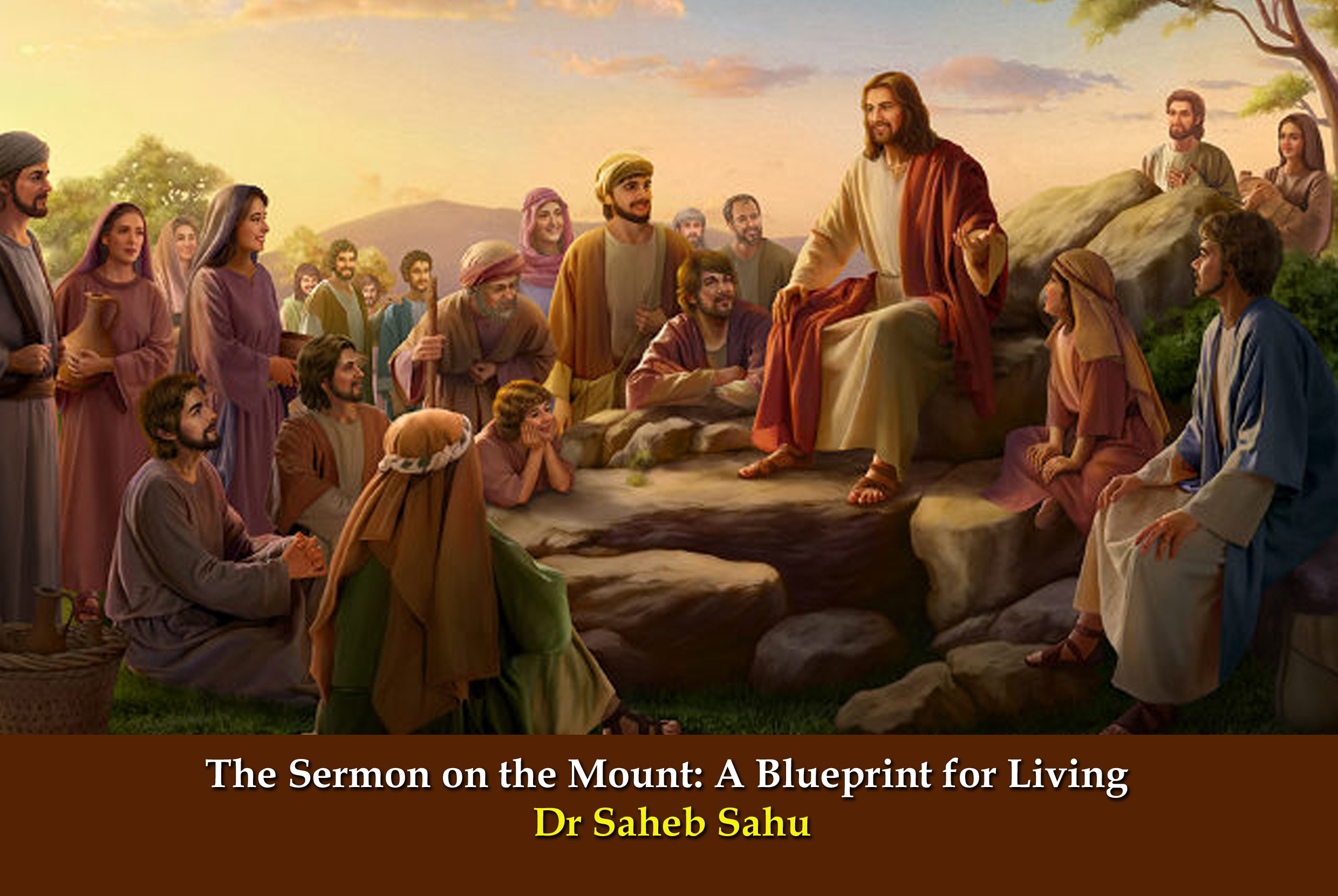
Dr Saheb Sahu
Definition of Sermon: A sermon is a religious talk, or speech on a moral or spiritual subject, typically delivered by a clergy during a church service, often based on scripture, to instruct or persuade the listeners.
The Sermon on the Mount-(Mathew 5-7)
The Gospel, according to Mathew (a book in the Bible – the New Testament) places the sermon shortly after Jesus begins preaching in Galilee (Northern Israel), gathering followers and healing the sick. Seeing the multitudes, he ascends a hillside and begins to preach them. The setting evokes a powerful image: just as Moses (of the Hebrew Bible) delivers the Ten Commandments from Mount Sinai, Jesus delivers his teachings from a mountain in Galilee. It represents not merely a sermon but a complete ethical vision – a blueprint for living. The Sermon covers chapter 5 -7 in the Gospel of Mathew.
Across the centuries the Sermon has inspired theologians, philosophers, reformers, and political leaders from St. Augustine to Tolstoy, from St. Francis to Mahatma Gandhi and Martin Luther King Jr.
Some Selected Quotes from the Sermon
The Beatitude (from the Latin word beatus meaning “blessed’)
. Blessed are those who mourn, for they will be comforted.
.Blessed are the merciful, for they will receive mercy.
. Blessed are the peace makers, for they will be called children of God.
Concerning Adultery
“You have heard that it was said,’ you shall not commit adultery’. But I say to you that everyone who looks at a woman with lust has already committed adultery with her in his heart”.
Concerning Retaliation
“You have heard that it was said, ‘An eye for an eye and a tooth for a tooth. But I say to you. Do not resist an evildoer. But if anyone strikes you on the right cheek, turn the other also… Give to everyone who begs from you, and do not refuse anyone who wants to borrow from you”.
Love for Enemies
“You have heard that it was said, ‘you shall love your neighbor. But I say to you, Love your enemies and pray for those who persecute you”
Concerning Alms giving
But when you give alms, do not let your left hand know what your right hand is doing, so that your alms may be done in secret: and your Father who sees in secret will reward you.
Forgiveness
For if you forgive others their trespasses, your heavenly Father will also forgive you; but if you do not forgive others, neither will your Father forgive give your trespasses.
Serving Two Masters
“No one can serve two masters; for a slave will either hate the one and love the other, or be devoted to the one and despise the other. You cannot serve God and wealth”.
Do Not Worry
“Therefore I tell you, do not worry about your life, what you will eat or what you will drink, or about your body, what you will wear. Is not life more than food and body more than clothing?”
“So do not worry about tomorrow, for tomorrow will bring worries of its own. Today’s trouble is enough for today”.
Judging Others
“Do not judge, so that you may not be judged”.
Ask, Search, Knock
“Ask and it will be given you; search and you will find: knock and the door will be opened for you”.
The Golden Rule
“In everything, do to others as you would have them do to you; for this is the law and the prophets”.
Beware of False Prophets
“Beware of false prophets, who come to you in sheep’s clothing but inwardly are ravenous wolves. You will know them by their fruits.”
“A good tree cannot bear bad fruit, nor can a bad tree bear good fruit.”
The Legacy of the Sermon on the Mount
The Sermon on the Mount is the moral heart of Christianity. It defines what it means to follow Jesus not just in belief but in daily living. Throughout history countless saints and reformers have drawn their inspiration from this Sermon. Its influence extends far beyond Christianity. Mahatma Gandhi studied it deeply and said, “If I had to face only the Sermon on the Mount and my interpretation of it, I should not hesitate to call myself a Christian.” Gandhi drew from its principles of nonviolence and love of enemies for his movement of civil disobedience. Martin Luther King Jr. cited the Sermon’s vision of love of peace as the spiritual basis for the American civil rights movement. The Sermon has inspired nonviolent revolutions and social justice movements around the world. Its enduring power lies in its simplicity:
“Blessed are the merciful, for they shall obtain mercy”.
“Do to others as you would have them do to you”.
“Love your enemies and pray for those who persecute you”.
Conclusion
I am not a religious person or a religious scholar. Prior to writing of my book “Religious Thoughts, Scriptures and Quotations (published in 1996), I had the opportunity to read the scriptures of all the major religions of the world (Vedas and Upanishads, Gita, Jain cannons, Dhammapada, Analects (Confucius) and Tao-te-Ching (Lao-tzu) Bible and the Koran. All faiths claim their scriptures to be divinely revealed (words of God). Their God is the only God or the superior God. Their religion is the best. Except for the Koran, most scriptures have multiple authors of different times. They have been edited and re-edited. I do believe that all religions advocate good conduct. It is well said by Lao-tzu, that “the way to Heaven has no favorites. It’s always with good men”. The problem with all religions is their followers. Followers of all religions believe that, their religion is the true and superior one. This attitude has created all the religious conflicts in the world.
Based on my reading, I agree with most religious scholars that, The Sermon on the Mount is the simplest and one of the best moral teachings among all religions. It is a blueprint for life. It is only four pages long (in Gospel According to Mathew). I strongly recommend you to read it. My personal philosophy is – BE KIND AND HELPFUL TO OTHERS!
Sources
1- The Holy Bible, Containing the Old and New Testament. New Revised Standard Version. Holman Bible Publishers: Nashville, Tennessee, 1989
2- ChatGpt 9-10-25
3- Saheb Sahu. Religious Thoughts, Scriptures and Quotations. 1996