Dr Saheb Sahu, FAAP, MPH.
What is Social Health?
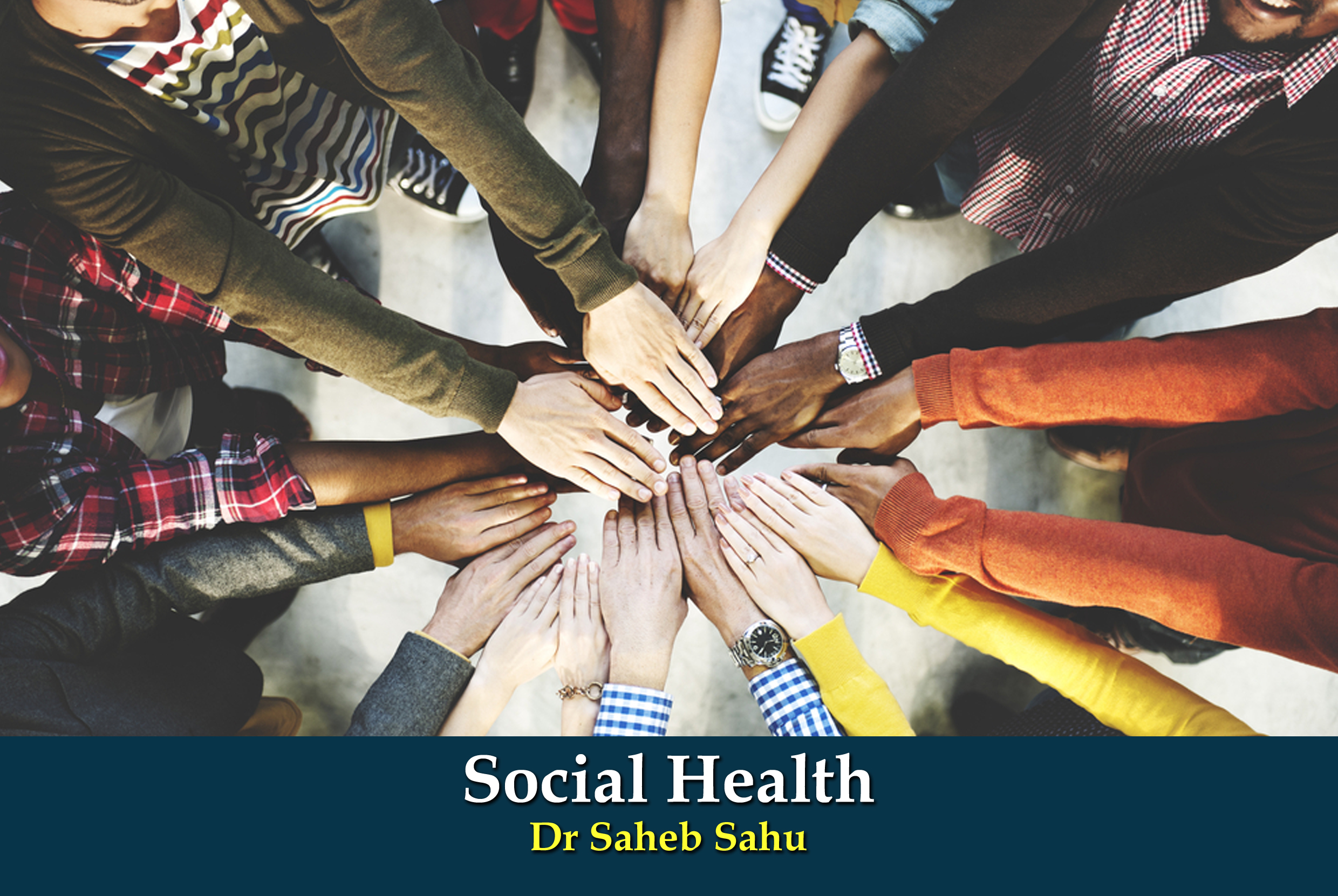
Social health is a dimension of overall health that refers to how well a person interacts with others and functions within society. It is about the quality of your relationships, your sense of belonging and your ability to adapt to social situations in a healthy way.
Examples of good social health:
. Having supportive family ties, friendships and community connections
. Having people you can rely on in times of need
. Maintaining long-term relationships
. Feeling connected to others rather than being lonely
Research shows that strong social ties:
. Reduce risk of heart disease and stroke
. Lower rates of anxiety and depression
. Slow memory decline and dementia
. Improve sleep and immunity
. Increase longevity
Some important studies that support the benefits of social health
In 1938, researchers at Harvard University launched an ambitious study to understand what makes some people thrive and others struggle. The study, which eventually became known as the Harvard Study of Adult Development, started with two distinct groups. The researchers first enrolled 268, second year undergraduate students. These were the presumed to be the leaders of tomorrow in America. One of them was future president John F. Kennedy. The Harvard group was supplemented with 456 boys of similar age, who came from some of the Boston’s (where Harvard is located) troubled and disadvantaged neighborhoods. Ultimately they expanded the study group to include some 1300 spouses and descendants. Closing in on its ninth decades, the Harvard Study of Adult Development is now the longest-run longitudinal health study in American history. Every year the researchers collect a treasure trove of data on each participant including blood tests, EKG reports, and brain scans and DNA samples. They also collect employment data, voting records, and behavioral information such as smoking and drinking.
After analyzing eighty-five years of data, the researchers have concluded that there is a formula for a healthy and happy life. It is the quality of relationships, the social fitness you might say, of the people involved. It all boils down to the idea- as Robert Waldinger; the current director of study has said-of “being engaged in activities I care about with people I care about”. If you want to know how to live a healthy and rewarding life, you start with social health.
In 1979, two researchers from Harvard and Berkley- published the result of nine-year study of almost seven thousand adults and found that loneliness increased mortality, independent of condition, socioeconomic status, or behavior like drinking or smoking. Hundreds of studies since have confirmed the close connection between social connection and healthy aging. Loneliness kills.“People who were more socially connected had less risk of dying at any age.”
These findings have been duplicated countless times throughout the intervening decades. Researcher, Julianne Holter-Lumstad, a professor at Bingham Young University, has concluded that loneliness is of greater health consequence than obesity and equivalent to smoking fifteen cigarettes a day. Other researchers have found that the effect of social health is equal to or greater than everything, from physical inactivity to high blood pressure, high cholesterol and air pollution. In 2018, U.K. created the position of minister of loneliness, a move Japan followed three years later. The U.S. surgeon general in 2023 declared a “loneliness crisis”.
Social connection and social fitness are particularly important for older people, when we are more vulnerable to the loss of social network. The only difference, researchers have been able to identify between super-agers (people older than 80) and their normally aging counterparts is that super-agers had higher rates of social connection and lower rates of loneliness.
Conclusion
Emotionally humans are social creatures. Throughout our history, the ability of human to rely on one another for food, shelter and common protection has been critical to our survival and flourishing. Our brains have adapted to expect and need proximity to our fellow human beings. Our body responds to feeling of loneliness and chronic isolation by flooding our biological system with stress signals. Our bodies respond to stress with increased inflammation. Chronic stress and inflammation has negative effect on everything from heart health, high blood pressure, diabetes, cancer, anxiety, depression and dementia.
There is a correlation between social connection and health. At its most basic level, social connection gets people out of the house and moving, a basic sign of healthy aging. People with better social health are more likely to adapt better healthy behaviors, from not smoking and drinking, to exercising more and following medical advice.
After tracking people for more than 80 years, Robert Waldinger’s (Director of Harvard Study of Adult Development) central conclusion is remarkably simple: “Good relationships keep us happier and healthier. Period. One or two reliable, emotionally supportive relationships are enough”.
Sources
1- Waldinger Robert and Sculz Marc. The Good Life: Lessons from World’s Longest Study of Happiness, Simon and Schuster, New York: 2023
2- What Makes Good Life. TED Talk, Y-Tube
3- Stern Ken. Healthy To 100: How Strong Social Ties Lead to Long Lives. Public Affairs, New York; 2025
The End