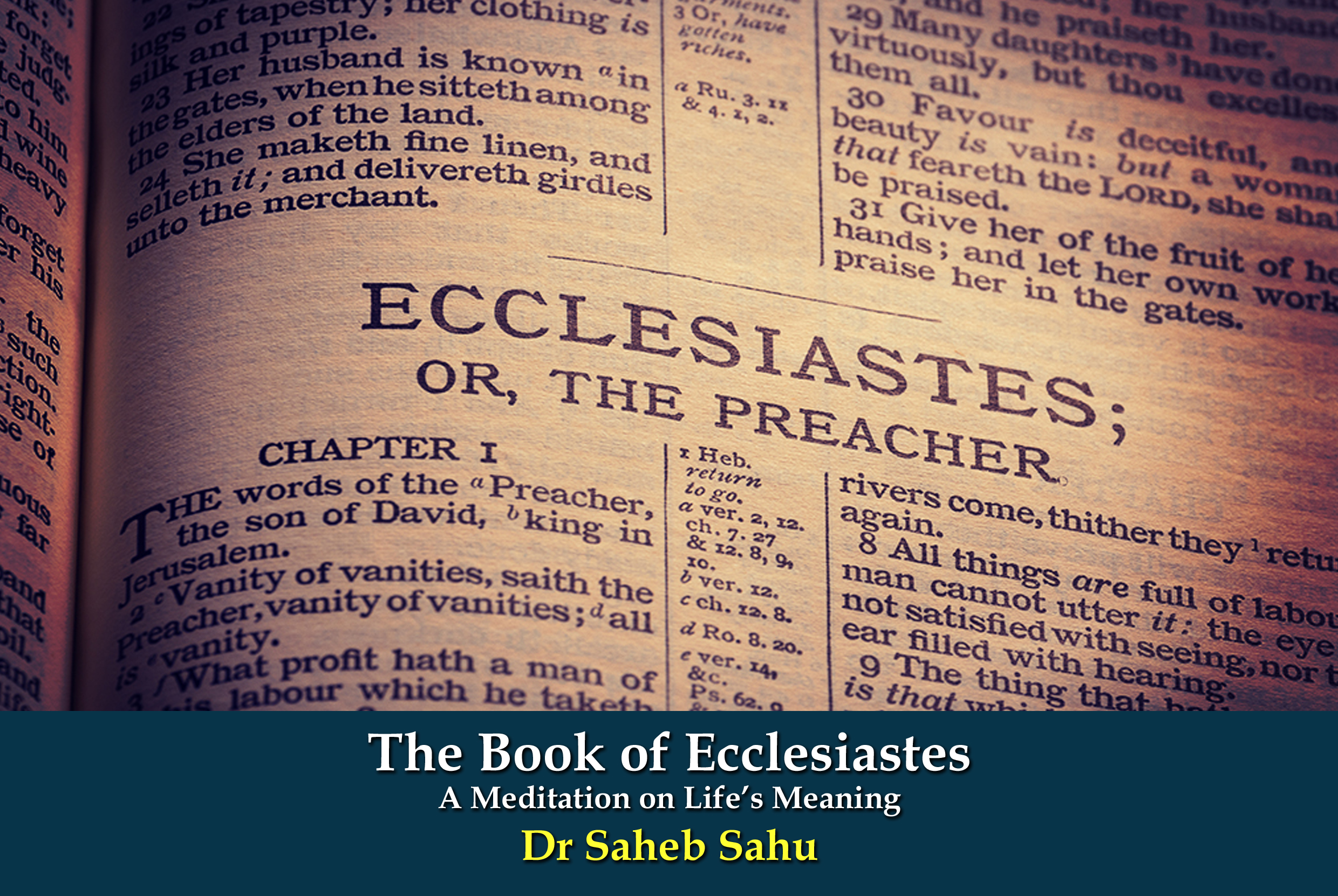
Dr Saheb Sahu
The Ecclesiastes is one of the most philosophical books in the Hebrew Bible (The Old Testament). The word “Ecclesiastes” is derived from the Greek word ekklesia. It is the Greek translation of the Hebrew title Qoheleth, meaning “assembler”, “collector”, or “preacher”. It is believed to have been composed between 480-80BCE. The exact name of the author is unknown. Traditionally it is attributed to King Solomon. It stands apart from other biblical writings due to its reflective, almost skeptical tone. Rather than offering straightforward moral instructions, Ecclesiastes wrestles with life’s deepest questions: What is the purpose of human existence? Does anything truly matters? How should one live in a world marked by uncertainty and impermanence?
At the heart of Ecclesiastes lies it’s most famous refrain: “Vanity of vanities; all is vanity”. The word “vanity”, often translated from the Hebrew word “hevel”, literally meaning something fleeting, elusive, vapor like or vanity. The King James Version of the Bible has translated it as “vanity”. The author – observes that human achievements, wisdom, wealth, and even righteousness seem ultimately temporary (not unlike the Buddha). No matter how much one accumulates or accomplishes, time erases all distinctions. The wise and the foolish, the rich and the poor, all share the same fate: death.
One of the striking features of Ecclesiastes is its realism. The author does not shy away from life’s injustices. He notes that good people sometimes suffer while the wicked prosper. Hard work does not always lead to success, and chance often governs outcomes. It forces readers to confront the unpredictability of life.
Yet, despite its somber tone, it is not a work of despair. Instead, it offers a subtle and profound form of wisdom. Since life is uncertain, the author encourages a humble acceptance of one’s limitations. Rather than striving endlessly, individuals should appreciate the simple, immediate joys of life- eating, drinking, companionship, and meaningful work.
Another important theme in Ecclesiastes is the limitation of human wisdom. The author concludes that wisdom cannot fully explain the mysteries of existence. The wisdom involves recognizing what cannot be known.
Ecclesiastes continues to resonate across cultures and beliefs. Its themes echo the theme of Carvaka philosophers of India and some of the teachings of the Buddha. Carvaka (also known as Lokayata) philosophy of India goes back to first millennium BCE. Carvaka philosophy goes even further than Ecclesiastes, by rejecting religious authority altogether-denying the validity of the Vedas, the afterlife, karma and unseen spiritual realms. According to them, the only reality is the material world. Consciousness ends with death; there is no soul that survives. Its main idea: “as long as you live, live happily”. Gautama Buddha grapples with suffering, impermanence and the limits of human understanding. While Ecclesiastes does not provide a solution, Buddha diagnoses the cause of suffering (Craving) and provides a treatment (the Eightfold Paths).
Greek philosopher Epicurus (341-270 BCE) also recognized the instability of fortune and the inevitability of death, urging individuals to free themselves from fear of divine punishment and afterlife.
How to interpret the symbols in the Bibles quotes – For example – ECC: 1-4. Ecc – means Book of Ecclesiastes, 1- means-chapter I, 1-4 means line 1 to 4.
Some quotations from the Book of Ecclesiastes:
Reflection of a Royal Philosopher
Vanity of vanities, says the Teacher,
vanity of vanities! All is vanity.
What do people gain from all the toll
at which they toll under the sun?
A generation goes, and a generation comes,
but the earth remains forever. (1; 2-4)
What has been is what will be,
and what has been done is what will be done;
there is nothing new under the sun. (1:9)
For in much wisdom is much vexation,
and those who increase knowledge increase sorrow. (1:18)
Everything Has Its Time
For everything there is a season, and a time for every matter under the heaven:
a time to be born and a time to die;
a time to plant, and a time to pluck up what is planted;
a time to kill, and a time to heal,
a time to break down and a time to build up;
a time to weep and a time to laugh;
a time to mourn and a time to dance. (3; 1-4)
…
a time to love, and a time to hate;
a time for war, and a time for peace. (3; 8)
..
All go to one place;
all are from the dust, and all turn to dust again. (3:20)
Humility and Contentment
The lover of money will not be satisfied with money; nor the lover of wealth, with gain. This also is vanity. (5:10)
A Disillusioned View of Life
A good name is better than precious ointment,
and the day of death, than the day of birth.
It is better to go to the house of mourning,
than to go to the hose of feasting;
for this is the end of everyone,
and the living will lay it to heart. (7; 1-2)
Do not be quick to anger,
for anger lodges in the bosom of fools. (7:9)
The Riddle of Life
Do not be too righteous, and do not act too wise; why should you destroy yourself?
Do not be too wicked, and do not be a fool; why should you die before your time? (7; 16-17)
Miscellaneous Observations
Whoever digs a pit will fall into it;
and whoever breaks through a wall will be bitten by a snake.(10:8)
Feasts are made for laughter;
wine gladdens life,
and money meets every need. (10:19)
The Value of Diligence
In the morning sow your seed and at evening do not let your hands be idle; for you do not know which will prosper, this or that, or whether both alike will be good. (11:6)
Youth and Old Age
Light is sweet and it is pleasant for the eyes to see the sun.
Even those who live many years should rejoice in them all; yet let them remember that the days of darkness will be many. All that comes is vanity.
Rejoice Young man while you are young, and let your heart cheer you in the days of your youth. Follow the inclination of your heart and the desire of your eyes, but know that for all these things God will bring you into judgment.
Vanish anxiety from your mind, and put away pain from your body; for youth and the dawn of life are vanity. (11-:8-9)
Conclusion
As you can see from the above description, the reflective skepticism expressed in the Ecclesiastes is not necessarily new. It has been done by the Indian, Greek and Roman Philosophers. The Book of Ecclesiastes is only seven and half pages-long. I strongly urge all of you to read it. You will love its beautiful language and learn something from it.
References
1- The Holy Bible. New Revised Standard Version. Holman Bible Publishers, Nashville, Tennessee. 1989. Pages- 536-543
2-ChatGpt