Dr Saheb Sahu
Death is certain for the born;
For the dead rebirth is certain.
Since both cannot be avoided,
You have no reason for your sorrow.
Bhagavad Gita, 2-27
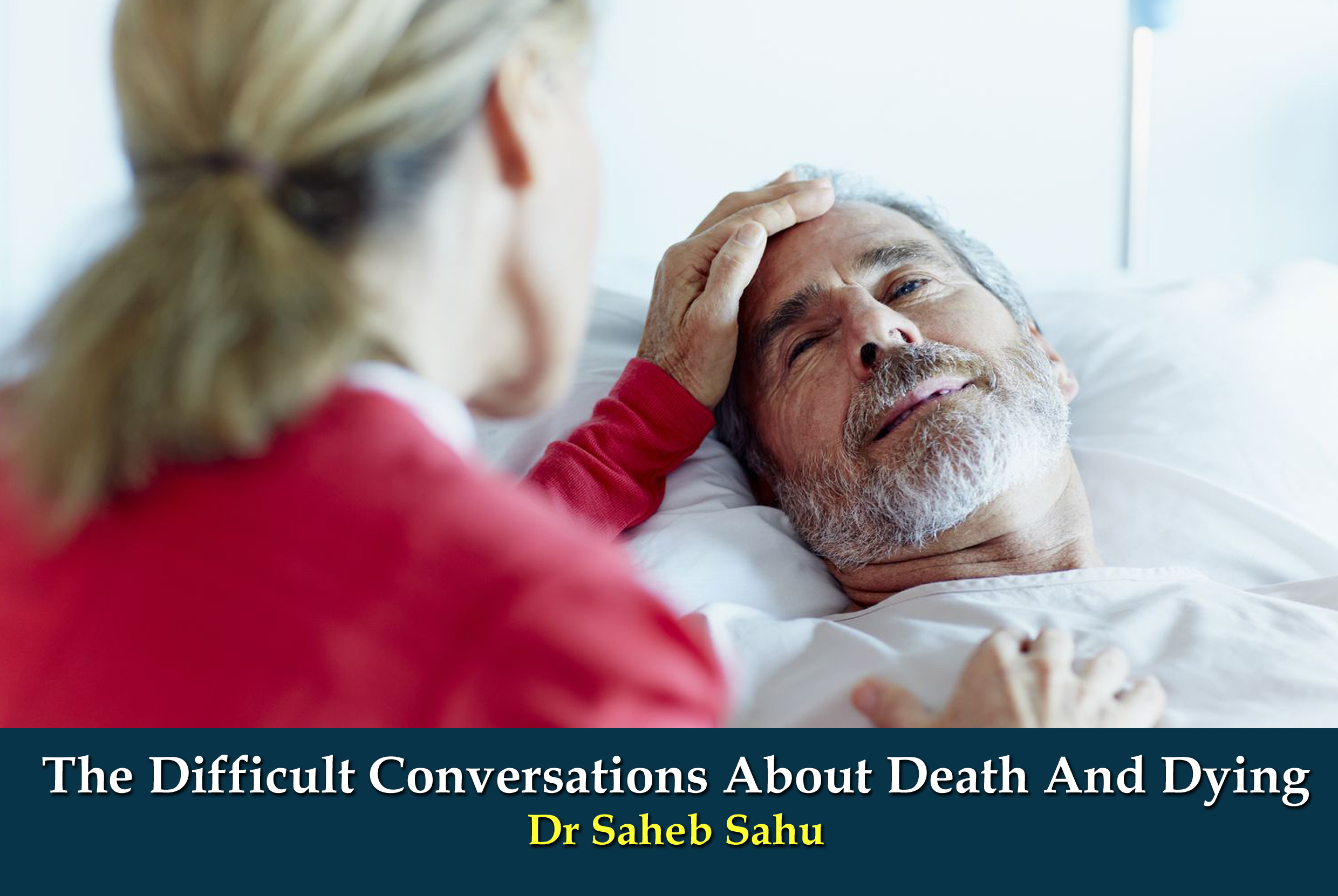
Death is the one certainty of life. Yet it remains one of the most avoided subjects in personal, social and even medical conversation. Discussions about death and dying are often postponed, softened or entirely avoided until a crisis forces them into the open. These conversations are difficult because they touch the deepest human fears-loss, pain, uncertainty, and the finality of separation. Still, engaging in honest conversations about death and dying is not only necessary, it can be profoundly humane, clarifying and even life-affirming.
One major reason these conversations are difficult is emotional discomfort. Fear of causing distress leads many to believe that silence is kindness. Families may avoid the topic to “stay positive”, while patients may suppress questions to avoid burdening others. The mutual protection, though well intended, does not help either party.
Cultural and religious beliefs complicate conversations about death. In some cultures, open discussion of death is considered taboo. In others, death is accepted as natural transition.
Medical settings present their own challenges. Physicians are trained to treat disease, not always talk about dying. As a result, conversations about limits of treatments, palliative and hospice care may be delayed or framed in technical language that obscures meaning and understanding. Patients and families may misinterpret continued treatment as a promise of recovery when in fact it may only prolong suffering.
Despite their difficulties, conversations about death and dying carry many benefits. They allow individuals to express their values, fears, and wishes. More importantly, these conversations can deepen relationships. Such conversations can bring emotional closure and peace of mind, even in the face of physical decline.
Approaching these conversations require sensitivity rather than certainty. There is no perfect script. Listening is often more important than speaking. Asking open-ended questions- What worries you most? What gives you comfort? What does a good day looks like now? – Can open space for meaningful dialogue. Silence too has its value.
What kind of Conversations?
1-Conversations about fears and worries
. What worries you most about your future?
. Are you afraid of pain, dependence, or being a burden?
2- Conversations about hopes
.What are you hoping for now?
. What would be a good day look like?
.What do you want to hold on to?
3-Conversations about values
. What makes life meaningful to you right now?
.What are you most proud of in your life?
.What gives you peace and strength?
4-Conversations about control and autonomy
. What decisions you want to make yourself?
. Who would speak for you to the doctors if you cannot? (Medical power of attorney).
5- Conversations about medical wishes
These are practical but deeply personal. Topics to discuss:
.Their preference about life-prolonging treatments- respirator (breathing machine), feeding tube, CPR (cardio pulmonary resuscitation).
.Where they would prefer to be cared for home, hospital, and hospice center.
.Their views on comfort care (palliative and hospice care).
. Their desire for organs and dead body donation.
. Their funeral and memorial service wishes.
6-Conversations about legacy
.How would you like to be remembered?
.Is there something you want to leave behind-letters, pictures, recording and anything else?
Some medical concepts you should understand
A- Advance Directive
Advance directive is a generic umbrella term that includes various documents and designations that ensure you get the type medical care that you want when you are not able to speak for yourself. Types of Advance directives include:
. A living will
. A medical durable power of attorney/ medical proxy.
. Code status documents.
.Organs and body donation
The living will is designed to alert medical professionals and your family to the medical treatments that you would or wouldn’t want to receive. It often includes whether or not you would want life – prolonging treatments such as breathing machine (respirator), CPR, feeding tube, ICU (intensive care unit) care, blood transfusions etc.
A medical durable power of attorney/ medical proxy – allows someone you have chosen to make medical decisions on your behalf when you are unable to do so.
Code status documents – refers to what you would like medical professionals to do when your heart stops.Would you like them to give you CPR or not?
Organs and dead body donation- sign the necessary paper works for organ and body donation.
B- Palliative care and hospice care
Palliative care is defined by World Health Organization (WHO) as: An approach that improves the quality of life of patients and their families, who are facing problems associated with life-threatening illnesses. It addresses the issues of physical, emotional, social, and spiritual suffering. Palliative care is provided by a team of professionals consisting of doctors, nurses, and social works, alongside curative or life-prolonging treatments. Unlike palliative care,hospice care is generally understood internationally as a type or a model of palliative care focused on the end-of-life stage. It emphasizes comfort, symptom control, and psychosocial support without trying to cure the disease or prolonging life.
C- Voluntarily Stopping Eating and Drinking (VSED)
In VSED, an adult makes a conscious decision to refuse food and drink, in order to hasten the time of one’s death. It is difficult to predict exactly when the end will come. It depends on the person’s illness, nutritional status, and age. It is important that the person does not drink any fluid including water as death comes from dehydration and not from lack of food. The most frequently reported adverse effects are – thirst, dry mouth, occasional hunger and general weakness. These symptoms can be controlled with ice-chip, lip balm and a humidifier in the room. Hunger pain usually subsides within 1-3 days on its own. Death can occur in 5-14 days. VSED is legal everywhere.
The concept of starving to death is not new. It goes back to more than 3000 years. In Hinduism, it is called Pyopavesa, meaning “the act of sitting down to death”, signifying a voluntary, gradual process of fasting until death. Jainism approves suicide at old age, especially by slow starvation, known as Sallekhana or Samadhimaran.
D – Medical Aid in Dying
Terminally ill adults, where it is legal, may request a prescription from their doctor for medication that will bring about a peaceful death. There is specific process to ensure that the patient requesting medical aid in dying is mentally capable, has a prognosis of six months or less to live and is sure about his/her decision. Currently medical aid in dying is legal in Netherlands, Belgium, Switzerland, Luxembourg, Germany, Spain, Italy, Canada, Colombia, Uruguay, Australia, New Zealand and few states in the USA. It is not legal in India.
E- Withdrawing Versus Withholding Treatments
Withdrawing treatment refers to stopping treatment, such as IV fluids, artificial nutrition or respirator, while withholding treatment means never starting it in the first place. Withdrawing treatment is infinitely more difficult for the family members than to neverhave started in the first place. No one wants to have to guess what their loved one would want under the pressure of an emergency situation. Please do your power of medical attorney a favor and give him/her guidance so that he/she can follow your wishes with less internal conflict among family members.
Withholding or withdrawing life-sustaining medical treatment is legal in India under the guidelines laid down by the Supreme Court since 2018.
Conclusion
Why don’t we die the way we want to die? Advances in medical care have eased the line between saving life and prolonging dying. Everybody wants to have a good death. A “good death” is a deeply personal concept, based on individual values, beliefs, and cultural practices. For most people, a good death means dying at home surrounded by loved ones, free from pain and suffering. But a good death is rare. In real life, “dying is painful, messy and imperfect” wrote Dr Sherwin Nuland (late Professor of Surgery at Yale University) and the bestselling author of the book “How We Die”.
We have no control or very limited control on when we will die but we do have some control over where and how we will die. For the sake of people we love, we should take steps to plan for the end stage of our life and have “the difficult conversations” now. It will bring peace of mind in the future.
PS – Dr Sahu is a 1970 graduate of AIIMS (New Delhi) and a retired premature bay specialist, settled in USA. He has written about ‘Death and Dying” for 45 years. His articles on “Health and Fitness” are published in Odishawatch.in.
Sources:
1- The conversation project- www.theconversationproject.org
2-Compassion and choices- compassionchoices.org
3-Death with dignity- deathwithdignity.org
4- Chat GPT
5-Jeannette Guerrasio, MD. Embracing Aging. Rowman and Littlefield, Lanham; 2022
6- Sherwin Nuland. How We Die: Reflection on Life’s Final Chapter. Alfred A. Knopf, New York; 1993
7- Saheb Sahu. Death, A Necessary End Will Come When It Will Come. S.B. Trust, Sambalpur, Odisha: 2014